


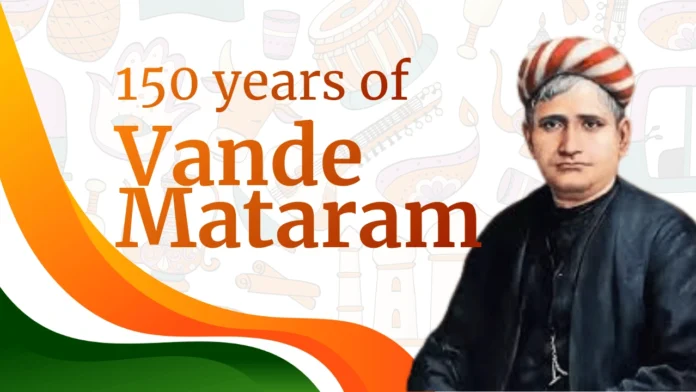
On the completion of 150 years of Vande Mataram, India is witnessing not just a celebration, but also a major political and ideological debate inside and outside Parliament. The Lok Sabha and Rajya Sabha have scheduled special discussions to mark the occasion. Prime Minister Narendra Modi is opening the session with reflections on the song’s legacy, calling it a “mantra of unity, courage and Indianness”, while Defence Minister Rajnath Singh will conclude it. The total debate is set to run for around ten hours across both houses.
But why has a 19th-century song become a 21st-century flashpoint? To understand the present tensions between Congress and the BJP, we must revisit the origins of Vande Mataram and its journey through the freedom struggle.
Where It All Began — The Birth of Vande Mataram (1870s–1880s)
Vande Mataram was composed by Bankimchandra Chattopadhyay around 1875. It gained widespread attention when it appeared in the legendary Bengali novel Anandamath, first serialized in Bangadarshan magazine in 1881.
The song symbolized the nation as a mother, Bharat Mata. In Anandamath, three symbolic forms of the motherland are represented:
- The Mother That Was – once glorious
- The Mother That Is – suffering under foreign rule
- The Mother That Will Be – destined to rise again
For freedom fighters like Sri Aurobindo, Vande Mataram was not just a lyrical composition but a spiritual call for patriotism.
From Page to Protest: The Nationalist Transformation (1900–1910)
By the early 1900s, Vande Mataram had transformed into a resonating freedom slogan. During the Swadeshi movement and protests against the 1905 partition of Bengal, it became the chorus of resistance.
People marched on the streets chanting it. The British recognized its power — and feared it.
Students were fined, processions were lathi-charged, and public singing was restricted. But repression only intensified its emotional pull among Indians. At one point, over 10,000 Hindus and Muslims marched together, chanting Vande Mataram — highlighting its cross-community influence in its early years.
Freedom icons like Rabindranath Tagore, Bipin Chandra Pal, and Aurobindo played major roles in popularising it. In Stuttgart (1907), Madam Bhikaji Cama unfurled a flag carrying Vande Mataram, marking its entry into global resistance symbolism.
Congress and Vande Mataram — From Adoption to Dilemma
- 1896
- Tagore sang Vande Mataram at a Congress session — its first major public performance.
- 1905
- Congress formally adopted it for national occasions.
- But in 1937… a turning point
- Here lies the root of today’s BJP vs Congress clash. In 1937, the Congress Working Committee (CWC) decided that only the first two stanzas would be officially sung. The rest were not banned — but excluded from formal national events.
Why Were Later Stanzas Dropped? The Inclusivity Argument
The later verses include imagery linked to the Hindu Goddess Durga, which sparked concern among some Muslim members who felt uncomfortable reciting devotional content addressed to deities. Leaders, including Mahatma Gandhi, Nehru, Sardar Patel, Subhas Chandra Bose, Rajendra Prasad, Sarojini Naidu, and Maulana Abul Kalam Azad debated the issue.
Their reasoning was:
- The first two stanzas were already the popular and widely sung part
- Later stanzas carried theological references
- National symbols should unite, not exclude
Rabindranath Tagore also advised that national usage must be inclusive, not sectarian, influencing the final decision.
Constituent Assembly Verdict — 1950
When national symbols were finalised after Independence, Jana Gana Mana was chosen as the National Anthem, but Vande Mataram was given equal honour and status as the National Song.
There was no dispute or opposition in the Assembly, reflecting deep respect for both compositions.
Then, Why The 2025 Controversy? BJP vs Congress Explained
BJP’s Position
- Claims Congress “removed” important stanzas in 1937.
- Argues that this decision weakened cultural unity
- Sees Vande Mataram as civilizational heritage beyond religion
- Wants the complete song to be recognised and celebrated
PM Modi recently stated that breaking the song into parts sowed division, calling it a historical mistake.
Congress’s Counter
- Says it elevated Vande Mataram, not diluted it
- Asserts the 1937 decision was about inclusivity
- Says BJP is rewriting history to score political points
- Claims the first two stanzas are already national symbols
- Highlights pressing issues like inflation & jobs being sidelined
Congress cites Gandhian writings to support that the move was sensitive, democratic, and consensus-based.
The Muslim Standpoint
Jamiat Ulama-i-Hind, led by Maulana Mahmood Madani, accepts the first two stanzas but opposes reciting the rest. Their view:
- Later verses involve worship-like language equating the nation with a deity
- This conflicts with Islamic monotheism
- Therefore, reciting the full composition is not acceptable, but partial singing is
Their position remains a key component of the national debate.
Why Vande Mataram Still Matters Today
150 years later, Vande Mataram remains:
✔ A symbol of sacrifice in the freedom struggle
✔ A cultural thread connecting generations
✔ A piece of literature, spirituality & patriotism
✔ A reminder of unity, diversity, and identity
Whether sung in rallies, schools, or stadiums, its first two lines still electrify hearts.
Conclusion
The story of Vande Mataram is not just about a song — it’s about India itself. From literature to liberation, from unity to political contestation, its journey reflects the evolution of Indian democracy.
As Parliament debates its legacy, the real question isn’t whether stanzas are missing — but whether India can reclaim the song in its spirit of unity, not division.
Vande Mataram began as a song of freedom, but today it is also a mirror to India’s cultural debate:
What symbols define our nation — and who gets to decide?

