


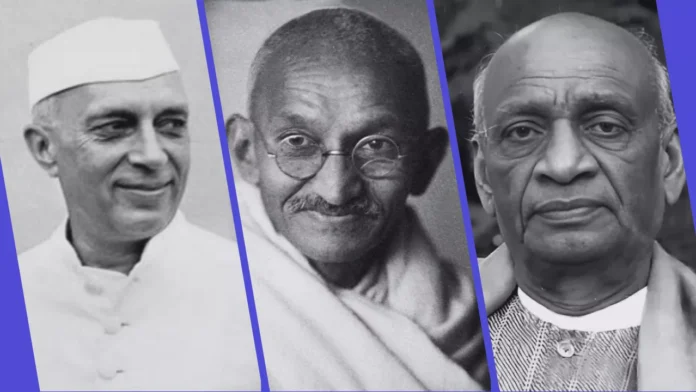
Few political debates in India ignite passion like the question: Why did Jawaharlal Nehru, and not Sardar Vallabhbhai Patel, become India’s first prime minister?
For decades, historians have documented the events of 1946 with meticulous detail—but rarely has the central dilemma been asked bluntly:
Did Nehru actively resist Patel’s rise? And did Gandhi’s favouritism shape a decision that permanently altered India’s destiny?
This question gained renewed relevance after Union Home Minister Amit Shah described the 1946 Congress selection as “vote chori,” sparking fresh political and public interest in a moment that determined the future leadership of a soon-to-be independent nation.
The Scene in 1946: Patel Was the Organisation’s Choice, Nehru Was Gandhi’s
By mid-1946, India was on the cusp of freedom. The Congress was electing a president who would immediately become the head of the interim government—effectively India’s prime minister before Independence.
Here were the facts on the ground:
- 12 of 15 provincial Congress committees nominated Patel.
- Nehru received zero provincial nominations.
- Gandhi indicated—quietly but firmly—that he wanted Nehru.
This imbalance between popular mandate and Gandhi’s preference created the political tension that still shadows the Nehru–Patel relationship.
The Crucial Moment: Nehru’s Silence That Spoke Loudly
According to multiple historical sources, Patel was prepared to contest. Provincial units had backed him decisively. But Gandhi’s circle put forward Nehru.
When Gandhi, as a matter of fairness, offered Nehru the chance to step aside (given his complete lack of provincial support), Nehru refused to withdraw.
He did not argue. He did not negotiate. He simply stayed silent—an unmistakable message.
Historians interpret that silence as Nehru’s clear unwillingness to let Patel take the top job.
It was this silence that forced Gandhi’s hand. He then instructed Patel to withdraw—and Patel complied without protest.
Thus, Nehru was elected unopposed.
Was Nehru Afraid of Patel’s Power?
This is where the deeper political question emerges. Patel was universally seen as:
- a stronger administrator
- a firmer negotiator
- more decisive under pressure
- the architect of the Quit India Movement’s organisational backbone
Many in the Congress believed Patel could overshadow Nehru in matters of governance.
Would a Patel-led India have made different decisions—on Kashmir, Tibet, China, centralisation of states, or handling of the princely territories?
Many argue yes.
Nehru was aware of Patel’s formidable stature. Accepting a position below Patel in the interim government—effectively agreeing that the nation preferred Patel’s leadership—would have fundamentally altered Nehru’s political identity.
For Nehru, stepping aside was never an option.
Did Gandhi’s Favouritism Create a Historical Blunder?
Gandhi chose Nehru not because Patel lacked competence but because:
- Nehru was Western-educated and seen as more acceptable to the British
- he had a global intellectual reputation
- Gandhi believed Nehru symbolised modernity and internationalism
- he thought Patel’s authority would remain intact regardless
But was this a misjudgment?
Many historians suggest that Gandhi underestimated the long-term impact of that decision:
- Patel’s administrative clarity was sidelined at a crucial nation-building moment.
- India’s early foreign policy, shaped almost entirely by Nehru, went unchallenged—with consequences still debated today.
Even Gandhi’s later writings reveal a trace of internal conflict. He insisted Nehru and Patel were like “two oxen yoked together,” but the decision effectively placed one ahead of the other.
Whether the nation benefitted from this choice remains a subject of debate.
How Patel Took the Blow: Calm Outside, Hurt Inside
Patel did not protest. His loyalty to Gandhi was absolute. Yet sources close to him later recalled:
- The decision deeply wounded him
- He knew this was his only chance to lead India
- He accepted the outcome for the sake of unity
Remarkably, Patel set aside personal disappointment and went on to perform one of the greatest administrative feats in world history—the integration of over 500 princely states.
A Question That Still Divides India
The 1946 leadership decision remains one of the most consequential political choices in Indian history. The debate endures because it raises uncomfortable but important questions:
- Should Gandhi have overridden the organisational mandate?
- Did Nehru’s refusal to step back reflect ambition or necessity?
- Would India have taken a different path under Patel?
- Did Congress—and India—pay a long-term price for this choice?
There is no definitive answer, but one conclusion is unavoidable:
The silence of Jawaharlal Nehru and the deference of Vallabhbhai Patel shaped the leadership of a new nation—and the consequences still echo through Indian politics today.

