


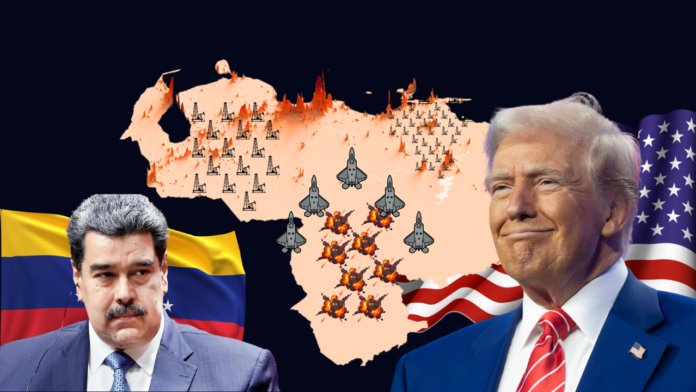
The United States has confirmed that it carried out a military operation in Venezuela that resulted in the capture of President Nicolás Maduro and his wife, Cilia Flores. The action, which involved airstrikes on parts of Caracas, has triggered sharp international backlash and reopened a long-running debate over sovereignty, international law, and the limits of U.S. power.
What makes this episode unusual is not just the scale of the operation, but the fact that it targeted a sitting head of state and was justified by Washington as a criminal arrest rather than an act of war.
How the Operation Unfolded
According to official statements from the White House and President Donald Trump, U.S. forces launched strikes in the Venezuelan capital before detaining Maduro and Flores. Trump later said the two were taken aboard a U.S. naval vessel and would be transferred to New York.
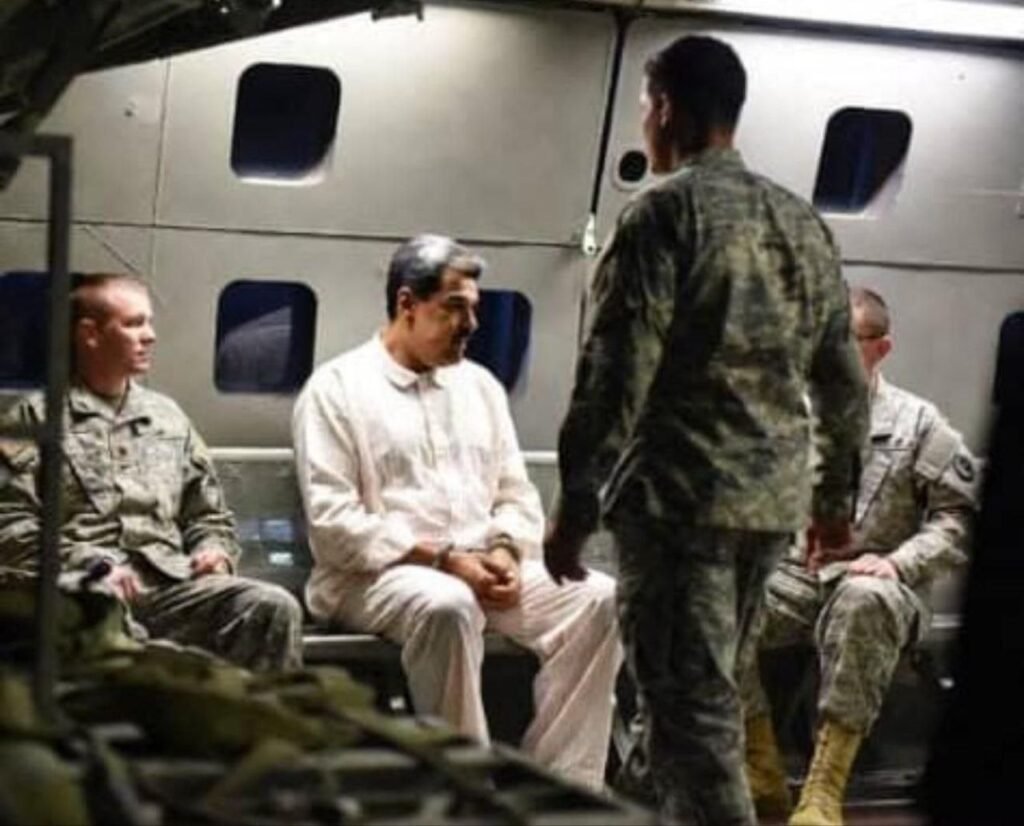
Images and videos released by U.S. authorities appeared to show Maduro in custody aboard a U.S. military ship, lending visual confirmation to claims that had initially seemed extraordinary even by recent geopolitical standards.
The Legal Case Cited by Washington
The U.S. government says the operation was carried out to enforce long-standing criminal indictments. Attorney General Pam Bondi confirmed that Maduro and Flores will face prosecution in New York. Secretary of State Marco Rubio said the charges relate to international drug trafficking and narco-terrorism.
These accusations are not new. U.S. authorities first unsealed indictments against Maduro and senior Venezuelan officials in 2020, alleging involvement in cocaine trafficking networks. Washington’s position is that these charges strip Maduro of the protections normally granted to a head of state.
The administration has described the action as law enforcement supported by military force, rather than a declaration of war or an attempt at regime change.
A Wave of Global Condemnation
That explanation has found little acceptance outside the United States.
Governments across Europe, Latin America, and Asia have condemned the operation, arguing that domestic criminal charges do not justify unilateral military action against a sovereign country.
China’s foreign ministry said it was “deeply shocked” by the use of force and accused the U.S. of engaging in hegemonic behaviour that threatens peace and stability in Latin America. Russia called for the immediate release of Maduro and Flores, describing their detention as a violation of international norms.
In Europe, the response has been notably unified despite political differences over Venezuela. The European Commission said international law must be respected. Commission President Ursula von der Leyen warned that disputes cannot be settled through military intervention.
France’s foreign minister Jean-Noël Barrot said the operation violated the core principle of non-use of force. Spain’s Prime Minister Pedro Sánchez took a similar line, saying Spain does not recognise the Maduro government but also cannot support an intervention that breaks international law and risks regional instability. Spain’s deputy prime minister Yolanda Díaz went further, calling the attack a clear violation of the UN Charter.
Several countries have called for an urgent meeting of the United Nations Security Council to address the legality of the operation.
The Oil Factor That Cannot Be Ignored
Venezuela holds the largest proven oil reserves in the world, mainly in the Orinoco Belt. This reality has shaped much of the reaction to the U.S. action.
After confirming Maduro’s capture, Trump said the United States would oversee Venezuela during a political transition and that American companies would help restart oil production. Those remarks have intensified criticism, with many governments arguing that they blur the line between legal enforcement and economic control.
Even countries critical of Maduro have questioned whether such statements undermine Washington’s claim that the operation was purely judicial in nature.
The Core Dispute
At the heart of the controversy is a simple but profound disagreement.
The U.S. argues that no leader accused of serious international crimes should be immune from arrest. Much of the rest of the world counters that sovereignty and international law do not allow one country to use military force to enforce its domestic indictments on another.
This is why opposition to the operation has come not only from U.S. rivals, but also from allies who otherwise reject Maduro’s rule.
Where This Leaves the World
What is clear so far is limited but significant. The U.S. has confirmed it used military force in Venezuela and detained its president. It has justified the action through long-standing criminal cases. Much of the international community has rejected that justification and condemned the operation as unlawful.
What happens next—whether through diplomatic pressure, UN action, or legal challenges—will shape how this episode is remembered. For now, it stands as one of the most consequential and contested uses of American power in recent decades, unfolding at the intersection of law, sovereignty, and the strategic weight of oil.

