


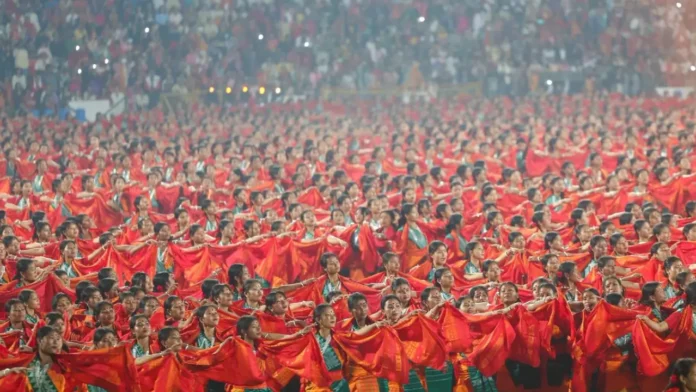
Bagurumba Dwhou is the most recognisable folk dance of the Bodo people of Assam. It draws inspiration from nature, especially birds and butterflies. The dance is closely linked to the Bwisagu New Year festival and is performed mainly by women, with men providing music. In recent years, the dance has gained renewed visibility through large public performances and cultural showcases.
Origin and meaning
Bagurumba Dwhou evolved within the everyday life and rituals of the Bodo community. In the Bodo language, “Dwhou” means dance, while “Bagurumba” refers to the specific form known for its soft and flowing movements. The dance reflects a close bond with nature. Each gesture mirrors natural elements such as fluttering wings, flowing air, and blooming life. Because of this symbolism, the dance is deeply associated with seasonal change and renewal.
Cultural and festival context
Bagurumba Dwhou is traditionally performed during Bwisagu, the Bodo New Year, celebrated in April. This period marks the end of the old agricultural cycle and the beginning of a new one. The dance expresses joy, hope, and gratitude. Over time, its role expanded. Today, it is also performed at weddings, community gatherings, cultural festivals, and state-level events, without losing its core identity.
Modi sees the act: national spotlight on Bagurumba
A defining moment in the modern journey of Bagurumba Dwhou came when Narendra Modi witnessed a large-scale Bagurumba performance during a public cultural event in Assam. His visible appreciation brought national attention to the dance. This moment mattered. It signalled recognition of indigenous traditions at the highest level of public life. Following this, interest in Bagurumba Dwhou increased among cultural institutions, youth groups, and event organisers. The dance moved from regional pride to a symbol of India’s cultural diversity on national platforms.
Music and traditional instruments
The music of Bagurumba Dwhou remains simple yet powerful. A small group of traditional instruments creates the rhythm and melody.
• The kham sets the main beat and controls tempo.
• The sifung, a bamboo flute, adds a light and airy melody.
• The serja provides a sustained musical line that supports the dance flow.
• Percussive tools like tharkha and jota sharpen the rhythm.
Together, these instruments produce a natural sound that matches the gentle movement of the dancers.
Costume and visual identity
Costume plays a key role in Bagurumba Dwhou. Dancers wear the dokhona, a handwoven traditional garment of the Bodo women. It features distinctive borders and patterns that reflect community identity. The aronai scarf completes the attire. Floral ornaments and simple jewellery are often used to strengthen the connection with nature. The costume allows free movement and enhances the elegance of each step.
Dance technique and structure
Bagurumba Dwhou follows a clear and repeatable structure, which makes it easy to learn and perform in groups.
• Dancers usually perform in lines or circular formations.
• Footwork remains light, rhythmic, and grounded.
• Arm movements stay soft and flowing, resembling wings in motion.
• Steps repeat in short rhythmic cycles, allowing coordination among many dancers.
• Facial expressions remain calm and joyful rather than dramatic.
This balance keeps the dance graceful and visually soothing.
Social role and gender dynamics
Traditionally, women lead Bagurumba Dwhou as dancers, while men support the performance through music. The dance encourages collective harmony rather than individual display. In earlier times, it also worked as a social space where young people interacted within community norms. Even today, the dance reflects unity, discipline, and shared cultural values.
Modern revival and large-scale performances
In recent years, Bagurumba Dwhou has entered larger public spaces. Mass performances with hundreds or even thousands of dancers have brought national attention to the form. These events use synchronized movements and expanded formations while retaining traditional steps. Such visibility has strengthened cultural pride, especially among younger generations.
Preservation challenges and future direction
Despite growing popularity, challenges remain. Rapid standardisation can reduce regional variations. Commercial performances may sometimes weaken ritual meaning. At the same time, opportunities are strong. Community-led training, school-based cultural education, support for traditional weavers, and documentation of elder practitioners help protect authenticity. Balance remains the key.
Practical notes for learners and performers
• Begin with basic rhythmic patterns before adding arm movements.
• Practice in groups to develop coordination and flow.
• Use traditional attire whenever possible to maintain cultural integrity.
• For large stages, divide dancers into smaller units to keep timing precise.
These steps help preserve both form and spirit.
Final thought
Bagurumba Dwhou is more than a folk dance. It is a living expression of Bodo identity, shaped by nature, rhythm, and community life. When performed with understanding and respect, it continues to feel warm, grounded, and deeply human.

