


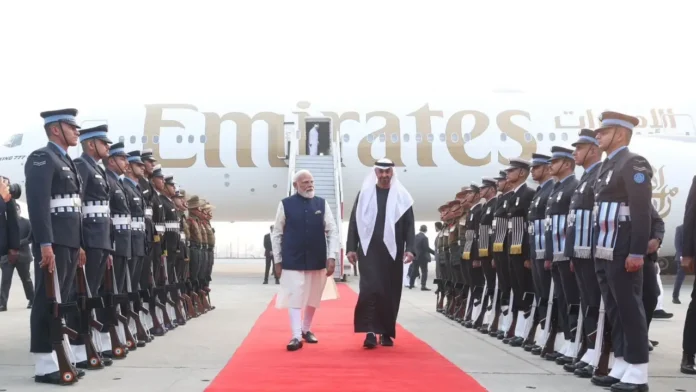
Prime Minister Narendra Modi and UAE President Sheikh Mohamed bin Zayed met in New Delhi and moved quickly from ceremony to deals. They agreed to pursue a strategic defence framework, signed a 10-year LNG supply plan, and set a goal to double bilateral trade to $200 billion by 2032. They also mapped cooperation in nuclear energy, space, digital infrastructure, finance, and big-ticket investments. The meeting lasted only a few hours, but it packed long-term priorities into a focused agenda.
Why the visit matters now
First, the UAE hosts nearly 4.5 million Indians and stands as a key energy partner.
Second, both sides already enjoy strong commercial ties since the CEPA in 2022, and they want to accelerate momentum.
Third, New Delhi wants diversified partnerships that combine investments, tech, and supply-chain resilience.
Finally, the timing reflects broader Middle East shifts; India aims to strengthen ties without getting drawn into regional conflicts.
Defence: from cooperation to a framework
The leaders agreed to work toward a Strategic Defence Partnership Framework Agreement. The plan will expand defence industrial collaboration, joint innovation, training, special operations cooperation, cyber-defence, and interoperability. The intent remains clear: deepen practical military ties while avoiding entanglement in regional wars. New Delhi emphasised strategic autonomy and said the pact will not draw India into West Asian conflicts.
Energy security: LNG, oil, and long-term supply
The two sides signed a pact for 0.5 million tonnes per annum of LNG for ten years, starting in 2028, linking Hindustan Petroleum and ADNOC Gas. Beyond this deal, the UAE remains a top supplier of oil and gas to India. The agreement aims to strengthen energy predictability and support India’s transition plans.
Trade and investment: a $200 billion target
Modi and MBZ set an ambitious target to double bilateral trade from $100 billion (2024–25) to $200 billion by 2032. They want more UAE investments in Indian infrastructure and technology, and invited sovereign funds to participate in India’s second NIIF Infrastructure Fund. The leaders also signed a letter of intent for the development of Dholera Special Investment Region with airport, port, MRO, and smart-city elements.
Nuclear, technology, and space cooperation
Both countries will explore partnerships in large nuclear reactors and small modular reactors (SMRs), taking advantage of India’s new SHANTI law for nuclear collaboration. They also pledged to work on AI, supercomputing, data centres, and launch a space-industry cooperation LOI between IN-SPACe and the UAE Space Agency to build launch facilities and accelerators for startups.
Payments, digital embassies, and trade facilitation
Officials will interlink national payment platforms to reduce transaction costs and speed cross-border flows. They also agreed to study “digital embassies” — secure sovereign data repositories in each other’s territory — to boost diplomatic and commercial data resilience.
Food, logistics, and connectivity
The leaders signed an MoU to harmonise food-safety rules and ease exports of rice and processed foods to the UAE. They reaffirmed support for the India–Middle East–Europe Corridor (IMEC) to improve regional connectivity and supply chains.
Governance, transparency, and strategic signals
Both sides underlined counter-terror cooperation, anti-money-laundering work, and FATF collaboration. New Delhi framed the defence and security deal as a natural step in an already deep partnership, not a response to specific events. The warm public optics — a personal welcome and shared ride to the residence — signalled political trust at the top.
Regional context and risk factors
The UAE’s tensions with Saudi Arabia over Yemen add complexity. India must balance deeper ties with assurances that cooperation won’t drag it into local conflicts. Moreover, defence and nuclear cooperation will need clear safeguards, export controls, and transparency to satisfy domestic politics and international partners.
What India gains — and what it must watch
India gains energy security, faster trade integration, sovereign investment, and tech partnerships. It also gains a stronger strategic partner in the Gulf as India deepens its Indo-Pacific outreach. However, New Delhi must guard strategic autonomy, insist on clear legal and operational limits in defence pacts, and ensure any nuclear and technology deals protect national interests and comply with safety norms.
Bottom line
The Modi-MBZ meeting converted goodwill into concrete goals across energy, defence, trade and tech. The agenda now moves to implementation — drafting the defence framework, finalising investment deals, and building operational links in payments, space and nuclear. Execution will determine whether the visit becomes a historic pivot or a promising statement that needs follow-through.

