


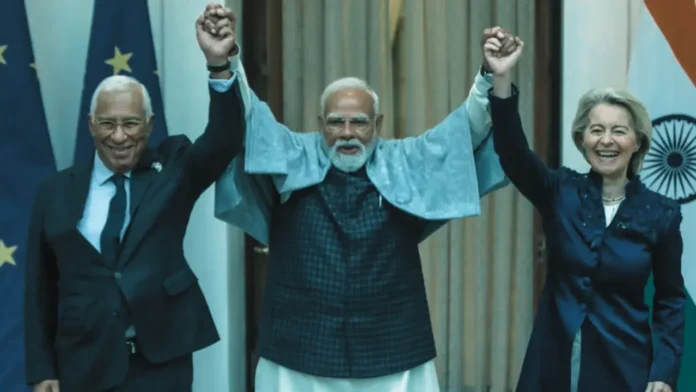
India and the European Union finalised a comprehensive free trade agreement after nearly two decades of talks. The deal cuts major tariffs, opens services, and eases short-term mobility for professionals. It protects specific sensitive sectors while granting broad preferential access for labour-intensive Indian exports. Economically, the pact strengthens supply chains and reduces strategic dependence. Politically, it sends a message that large economies prefer cooperation over protectionism.
What the agreement actually does
First, it phases down EU tariffs on chemicals, machinery, electrical equipment, aircraft and spacecraft.
Second, it reduces duties on motor vehicles to 10% inside a 250,000-vehicle quota.
Third, India cuts tariffs on EU items such as wine, beer, and olive oil.
Fourth, nearly all Indian exports gain preferential access, notably textiles, leather, marine products, handicrafts and gems and jewellery.
Fifth, both sides agree on a mobility framework to ease short-term professional travel. Finally, the deal sets the stage for deeper cooperation on investment, standards, security and climate action.
Sectoral winners and micro effects
Textiles and apparel gain immediate advantage through lower EU duties and smoother market access, which should boost factories and exports. Gems and jewellery and leather firms win through tariff reductions and better market entry. Marine products and processed foods gain new buyers but face strict EU sanitary standards. Auto component makers see growth opportunities through integrated supply chains. IT and professional services benefit from mobility measures for short projects. Small exporters and MSMEs gain access, provided they meet compliance and traceability rules.
Compliance, standards, and capacity challenges
EU market access demands strict environmental, safety, and digital standards. Indian manufacturers face gaps in carbon reporting, traceability and product certification. Therefore, companies must upgrade production processes, invest in quality control and secure third-party certifications. Transition assistance, capacity building and public-private efforts will determine how fast firms adjust. In short, the opportunity exists, but firms must close compliance gaps quickly.
Economic geometry and trade balance implications
The deal reduces bilateral transaction costs and deepens supply-chain integration. India’s labour-intensive exporters should see near-term gains, while high-value EU manufacturers secure better access to Indian demand. The agreement may widen two-way investment flows and encourage joint R&D and manufacturing. However, tariff cuts will put pressure on sensitive Indian producers; the government already carved out protections for dairy, cereals, certain fruits, poultry and soy meal to limit domestic disruption.
Political and geopolitical context
The FTA arrives amid global trade tensions and shifting alliances. It gives both India and the EU strategic diversification away from unilateral pressure and tariff diplomacy. Politically, the pact signals that plural trading blocs can build resilient partners without exclusive dependence on any single power. It also creates leverage for future security and climate cooperation.
Implementation pathway and likely timeline
Negotiations concluded; formal signing requires approval by EU member states and the European Parliament. Once ratified, tariff phase-downs occur in staged timelines specified in the pact. Governments must publish schedules for quota administration, rules of origin and procedural details. Meanwhile, firms should plan immediate compliance audits and supply-chain adjustments.
Risks, friction points and likely mitigations
Risk: Non-compliance with EU standards can block exports. Mitigation: Invest in testing labs, certifications and supplier audits. Risk: Domestic producers face competition in protected sectors. Mitigation: Gradual phasing, targeted subsidies and skill upgrades. Risk: Quota management for vehicles could create lobbying and allocation disputes. Mitigation: Transparent, rules-based allocation and periodic review. Risk: Parliamentary hurdles in the EU. Mitigation: Political outreach and minor concessions to sensitive member states.
What this means for ordinary people
Consumers will see cheaper European cars, wines and some medicines over time. Exporters and factory workers in textiles, leather and marine sectors may gain jobs and higher orders. Farmers and fishermen could access new markets for specific produce, but some producers will need support to meet sanitary and sustainability rules. Startups and IT firms gain easier short-term mobility for contracts; however, talent mobility remains limited to short stays, not long-term migration.
Use the FTA to upgrade factory standards, pursue higher value-added exports, and attract joint EU–India manufacturing projects. Leverage mobility to build service exports and project delivery. Push for phased financing and technical assistance for SMEs to meet EU norms. Strengthen climate and defence cooperation to convert the economic pact into a broader strategic partnership.
Bottom line
The India–EU FTA creates a large, practical opening for trade and investment. It promises real gains for labour-intensive Indian sectors and a stronger foundation for technology, defence and climate cooperation. Still, success depends on swift compliance upgrades, clear quota rules and targeted domestic measures to protect vulnerable sectors. In short, the deal offers opportunity, but delivery will require fast, concrete action from governments and businesses.

