


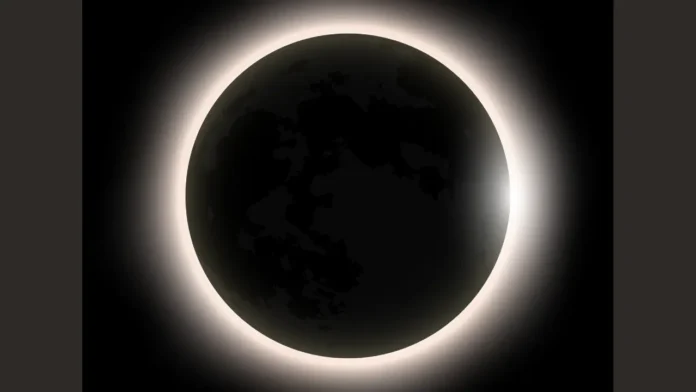
An annular eclipse occurs when the Moon crosses between Earth and the Sun, but appears slightly smaller than the Sun. Therefore, the Moon does not fully cover the Sun. Instead, the Sun forms a bright ring around the Moon. People call that ring the “ring of fire.” The geometry depends on the Moon’s distance from Earth that day.
When it happens (exact times, IST)
Date: 17 February 2026.
Approximate timeline (Indian Standard Time): begins ~03:26 PM, maximum central phase ~05:40 PM, ends ~07:55 PM.
Total visible duration of the event runs about 4½ hours from first to last contact. Note: local times vary by longitude. Use these IST times only if you are in India or converting from IST.
Where the annular phase will appear
The path of annularity crosses southern latitudes and does not pass over mainland India. Observers in and near the path—mainly parts of the Southern Ocean and sections of Antarctica—see the full “ring of fire.” Outside that path, many regions see a partial eclipse where the Sun appears partly covered.
Will people in India see the eclipse?
Most of India will not see the annular ring. However, some regions far south and surrounding oceanic zones might register a partial eclipse at low altitude just before sunset. In short, the dramatic ring is not visible from typical Indian cities.
Scientific explanation — why annular, not total
The Moon’s orbit around Earth is elliptical. When the Moon sits near apogee (its farthest point), it looks smaller in the sky. If an eclipse happens near apogee, the Moon cannot fully cover the Sun. The result produces the annulus. The Sun–Moon–Earth alignment still forms an eclipse, but the geometry dictates the exposed solar rim.
Viewing safety — non-negotiable rules
Never look at the Sun with the naked eye during any partial or annular eclipse. Do not use regular sunglasses; they do not protect your eyes sufficiently. Use ISO-certified solar filters, eclipse glasses, or welders’ glass of shade 14 or darker. If you use binoculars, a camera, or a telescope, place the filter over the front objective — never at the eyepiece. If you see any glare or discomfort, stop immediately and seek shade. Protect children and educate companions in advance.
How to photograph the eclipse (practical tips)
Use a solar filter on your lens from first contact to last. Mount the camera on a tripod. Use low ISO and a fast shutter to avoid overexposure of the bright ring. For the partial phases, bracket exposures: take a series at different shutter speeds. If you want the ring, plan for short exposures and precise framing. Most smartphones need a proper solar filter or a safe projection method; avoid direct hand-held shots without protection.
Live viewing and broadcasts
Because the annular path crosses remote oceanic and Antarctic regions, professional observatories and space agencies will stream the event online. Check trusted astronomy organisations or national space agencies for high-quality live streams. These streams also offer commentary, scientific context, and safe visuals.
Cultural practices and traditional precautions
Many cultures attach rituals to solar eclipses. Common practices include fasting, reciting prayers, or avoiding certain activities for a short window. Scientific views on eclipses vary across communities. If you plan to observe traditional customs, combine them with safety measures. Do not let ritual override eye protection rules.
Potential short-term environmental effects
Eclipses briefly reduce local sunlight. That drop can lower the temperature slightly and change wind patterns near the path. Wildlife may alter behaviour briefly. Effects last only for the duration of the eclipse and pose no lasting environmental risk.
Checklist for viewers (simple)
• Verify local contact times and convert from IST. • Arrange ISO-certified solar viewers or front-mounted solar filters. • Keep children supervised and informed. • Use a tripod and filter for photography. • Prefer official live streams if you cannot view safely in person.
Key takeaways
The 17 February 2026 event is an annular eclipse. The full “ring of fire” falls along a path outside most inhabited regions, including mainland India. Partial views may occur for some southern latitudes. Safety matters more than spectacle. Plan, protect your eyes, and enjoy scientifically sound coverage if you cannot travel.
Eclipses remind us how precise celestial mechanics can be. They also offer a rare moment to pause and look up together. Plan responsibly, protect your eyes, and share the experience with someone who will remember it.

, safety rules, photography tips, and cultural notes.)