


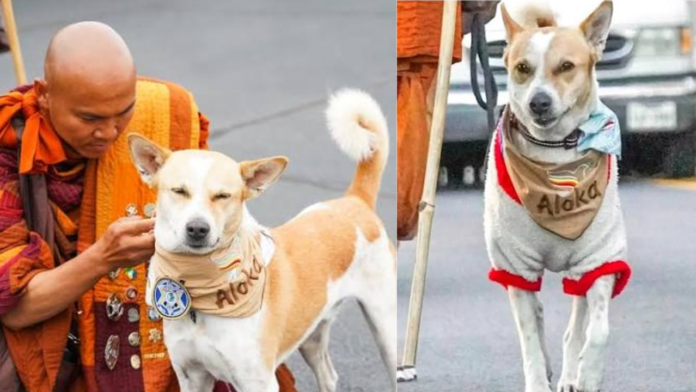
Aloka, the Indian Pariah dog who walked 2,300 miles across America with Buddhist monks and became a global emblem of compassion, arrived in Delhi on June 8, 2026 — meeting Maneka Gandhi and reigniting India’s urgent debate on the fate of its own street dogs.
On a warm Monday evening in June, the quiet lawns of Jor Bagh in New Delhi filled with an unusual gathering — Buddhist monks draped in saffron robes, international peace advocates, animal welfare supporters, and one small, white-and-brown dog with a heart-shaped marking on his forehead. The dog’s name is Aloka. He was born a stray on the streets of Odisha. He is now, by almost any measure, the most famous dog in the world.
Aloka arrived in India on June 8, 2026, accompanying Venerable Bhikkhu Pannakara and an international delegation of Theravada Buddhist monks and peace walkers. At Jor Bagh, they met BJP leader and long-time animal rights activist Maneka Gandhi — and the meeting sent a message that resonated far beyond the pleasant lawns of a Delhi neighbourhood: that India must look at its community animals differently.
A Dog Called Divine Light
The name Aloka comes from Sanskrit, and it means “divine light” or “illumination.” It is a name that would come to feel almost prophetically apt for a dog who has illuminated, quite literally, the concept of peace for millions of people across three continents.
Aloka is an Indian Pariah dog — a breed that predates recorded history, considered one of the oldest domesticated dog breeds on Earth. Also called the “Indie dog” in common parlance, the Indian Pariah is recognised for its sharp intelligence, remarkable loyalty, and robust health. Yet for generations, the very dogs that first walked alongside human civilisation in the subcontinent have been treated as a nuisance and a menace on India’s streets.
Aloka’s story began in 2022, when a group of Buddhist monks led by Venerable Bhikkhu Pannakara, a Vietnamese Theravada Buddhist monk and vice president of the Huong Dao Vipassana Bhavana Center in Fort Worth, Texas, undertook a 112-day peace pilgrimage across India. On the sixth day of that walk, somewhere on the outskirts of Kolkata, a scruffy young street dog appeared at the edge of the road and fell into step beside the monks.
He did not leave.
From Odisha to the World
The Bond That Changed Everything
What happened next became the founding myth of one of the most heartwarming stories in recent memory. When Aloka fell critically ill as a young puppy — weakened by the road, injury, and the hardship of street life — Pannakara did not leave him behind. The monk carried him. He nursed the dog back to health. And when Aloka recovered, he stayed. The relationship that formed was not one of ownership or command; it grew, as the delegation would later describe it in Delhi, from “trust, presence, and shared purpose.”
Pannakara would later joke, with characteristic warmth: “I brought him here and he’s a U.S. citizen now. Every one of us loves him so much.” The monks, known collectively as the Sangha, took turns holding Aloka’s leash on the road. When he was tired, they carried him or let him rest in the support vehicle that accompanied the group. When he was well, he trotted out ahead — at times appearing to lead the procession.
Aloka has found peace. He began as a stray in India, alone, wandering, searching. But when he saw the venerable monks on a similar journey years ago, something stirred in his heart. He chose to follow them. And they welcomed him.— Walk for Peace social media, widely shared during the US walk
The description of Aloka as having “chosen” the monks — rather than being chosen by them — became central to the story’s emotional power. It suggested something about the dog’s own nature: an intuitive alignment with the values the monks embodied.
The Walk That Stopped America
On October 26, 2025, the Huong Dao Vipassana Bhavana Center launched what would become one of the most widely followed peace demonstrations of the decade. Nineteen Theravada Buddhist monks, accompanied by lay supporters, set out from Fort Worth, Texas on foot. Their destination: Washington, DC — 2,300 miles away. Their message: peace, loving kindness, mindfulness, and non-violence for all living beings. They also called on the United States government to recognise Vesak, the birthday of Gautama Buddha, as a federal holiday.
The monks walked mostly in silence, in single file, clad in orange robes and carrying wooden staffs. Some walked barefoot, placing their feet directly on the American soil to stay present and grounded. The group crossed nine states — Texas, Louisiana, Mississippi, Alabama, Georgia, South Carolina, North Carolina, Virginia, Maryland — before arriving in the nation’s capital.
- 2022 — India Bhikkhu Pannakara leads a 112-day peace walk across India. Aloka, a stray pup near Kolkata, joins the monks on Day 6 and never leaves. After falling ill, he is nursed back to health by Pannakara.
- October 26, 2025 — Fort Worth, Texas The Walk for Peace USA begins at the Huong Dao Vipassana Bhavana Center. Nineteen monks and Aloka set off. The walk is 2,300 miles and is planned to last 120 days.
- January 12, 2026 — South Carolina Aloka is diagnosed with a knee and chronic right hind limb condition — an old injury from his street life in India. He undergoes surgery and temporarily separates from the group.
- January 15, 2026 — Charlotte, North Carolina, Aloka is reunited with the monks after successful surgery. Supporters line the road to cheer his return. Thousands bring dog treats alongside water and food for the monks.
- February 10, 2026 — Washington, DC. The Walk for Peace USA concludes after 108 days. The monks arrive in Washington, DC. Aloka walks the final steps of the journey at his handler’s side. The walk is covered by AP, the Washington Post, and media across the world.
- April 21–28, 2026 — Sri Lanka Ven. Pannakara arrives in Sri Lanka with Aloka at the invitation of President Anura Kumara Dissanayake. The Walk for Peace Sri Lanka commences in Dambulla, covers 117 miles (188 km), and concludes at Independence Square in Colombo.
- June 8, 2026 — New Delhi, IndiaAloka arrives in Delhi with an international delegation of monks and peace advocates. The group meets Maneka Gandhi at Jor Bagh in a gathering dedicated to compassion, non-violence, and animal welfare in India.
A Dog Who Became the Message
What made Aloka more than a mascot was the way his presence transformed public interaction with the Walk for Peace. When locals gathered to greet the monks across America, they didn’t only bring water and food for the monks — they brought dog treats for Aloka. When the group reached North Carolina, strangers rushed out to the roadside not just to see the monks but to see the dog.
His social media accounts — @alokathepeacedog on Instagram — gained more than 1.4 lakh followers in less than a month of launching. The Facebook page crossed 3.5 lakh followers.
His distinctive heart-shaped marking on his forehead became a symbol in itself, widely shared in posts and artworks. The media coverage was extraordinary: the Associated Press photographed Aloka at the Washington National Cathedral. Getty Images documented him leading the monks through Charlotte. Every major American publication covered the walk, and Aloka was at the centre of each story.
Delegation members, speaking in Delhi, observed that in all their travels, they had never encountered another dog quite like him. “What bound them to him,” they said, “was something rare and deeply special — a bond built not through ownership or command, but through trust, presence, and shared purpose.” He would sense danger on the road, warn the group, and yet carry himself through the journey with a composure and warmth that moved everyone he encountered.
The Sri Lanka Chapter
The walk did not end in Washington. In April 2026, Bhikkhu Pannakara and Aloka flew to Sri Lanka at the personal invitation of President Anura Kumara Dissanayake. Despite Sri Lanka’s intense heat, the lingering effects of Aloka’s leg surgery, and the logistical challenge of transporting a dog across continents, Aloka participated in the Sri Lanka leg, walking from Dambulla and concluding at Independence Square in Colombo. The seven-day journey of approximately 117 miles drew animal rights campaigners in Sri Lanka who gathered to demand the country’s long-overdue Animal Welfare Bill.
The Indian Pariah Dog — Aloka’s Breed
Also Known As Indie dog, Desi dog, South Asian Pye Dog
Origin: Indian subcontinent, one of the world’s oldest breeds
Temperament: Highly intelligent, fiercely loyal, alert, calm
Health Naturally selected; robust health, few hereditary conditions
Historical Status: Lived alongside humans for over 15,000 years
Current Status: Widely stigmatised in India; classified as “community dogs”
The Homecoming and Its Irony
Aloka’s arrival in Delhi on June 8 occurred at a moment of intense national debate. India’s Supreme Court has been hearing cases related to street dogs and their presence in public spaces — schools, bus stands, and public institutions — following complaints about dog bite incidents. The discourse around community animals in India has often been adversarial, with community dogs cast as a public safety problem rather than as living beings deserving dignity.
Against this backdrop, the meeting at Jor Bagh carried a profound charge. The delegation spoke of Aloka not merely as a companion to the monks, but as a living argument — a community dog, born on Indian streets, who had gone out and shown the world what an Indian street dog is capable of. The group said they hoped Aloka’s return would shift empathy toward community animals in India and make the case that peaceful coexistence must include all living beings, not only humans.
If people could see in every community dog even a fraction of what the world sees in Aloka, our attitudes would be very different. Aloka embodies the very best qualities of India’s street dogs: loyalty, courage, resilience, peace, and unconditional love.— Maneka Gandhi, BJP Leader & Animal Rights Activist, at Jor Bagh, New Delhi, June 8, 2026
Maneka Gandhi’s words at the gathering underscored the central irony of Aloka’s story. An Indian dog — born to the streets, stigmatised by birth — had to leave the country, join a peace pilgrimage, walk across a foreign continent, and become an internet sensation before India would look at him as an ambassador. “It was both inspiring and deeply ironic,” Gandhi observed, “that an Indian street dog had come to represent peace and compassion across the world while many of his fellow community dogs continue to be misunderstood, feared, and unfairly treated as a menace in their own homeland.”
What Aloka’s Journey Tells India
The story of Aloka is, at its core, a story about choice — and about what animals are capable of when met with compassion rather than fear. Aloka chose the monks. He chose to follow, to trust, to stay. He was not trained or domesticated in the conventional sense; he was a stray who made a decision. And the monks chose him back — not just as a companion, but as a symbol of the very values they were walking to promote.
The Indian Pariah dog has been part of human civilisation on this subcontinent for longer than most breeds of dogs have existed anywhere in the world. They were the companions of the Indus Valley people. They have lived alongside farmers, shepherds, and urban communities for millennia. What Aloka has done — and what the Walk for Peace has amplified for the world — is remind people of what this ancient bond looked like before it was replaced by neglect and hostility.
The Global Walk for Peace — Where It Stands
Organised by 24 Theravada Buddhist monks affiliated with the Huong Dao Vipassana Bhavana Center in Fort Worth, Texas, the Walk for Peace has now spanned three countries — the United States, Sri Lanka, and India. The walk draws inspiration from Gautama Buddha’s own 45-year journey, and aims to promote peace, loving kindness, mindfulness, and compassion.
Aloka’s official social media presence — @alokathepeacedog — documents each stage of the journey. The meeting at Jor Bagh, attended by monks, peace advocates, and Indian animal rights voices, signals that India itself may now become a key chapter in the walk’s ongoing global story.
The delegation’s statement from Delhi was clear: the meeting ended with “a shared commitment to compassion, non-violence, and the humane treatment of animals.” Whether that commitment translates into legislative change, public attitude shifts, or judicial recognition of community animals’ rights remains to be seen. But Aloka — small, scruffy, white and brown, with his heart-shaped forehead marking and his tail in perpetual wag — has made the argument more viscerally than any policy brief ever could.
He came home. And in doing so, he held a mirror to his homeland.

