


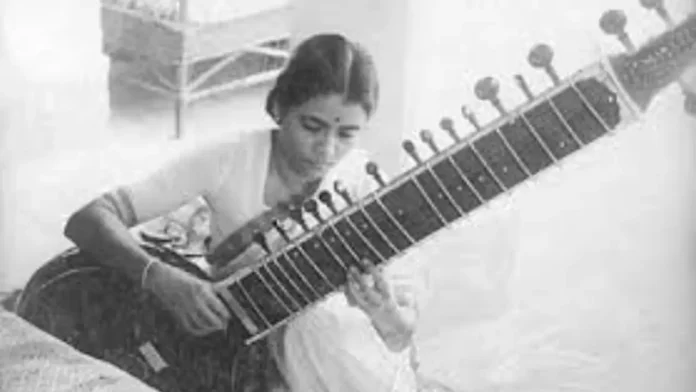
Annapurna Devi remains one of the greatest yet least visible figures in Hindustani classical music. She mastered the surbahar and preserved the deepest traditions of the Maihar gharana. Yet she avoided public performances and chose a life of privacy.
Musicians considered her a supreme guru. Many believed her musical knowledge exceeded that of most performers of her generation. Her influence spread quietly through her disciples.
However, behind this musical brilliance lay a deeply complex personal life, especially her troubled marriage with Ravi Shankar.
Early Life and Musical Roots
Annapurna Devi grew up in a household devoted entirely to music. Her father, Allauddin Khan, founded the Maihar gharana and trained many legendary artists.
From childhood, she underwent strict musical training. Her father demanded discipline and perfection.
He trained her as seriously as any male disciple. This decision was unusual at that time and helped her develop extraordinary skill.
Her brother Ali Akbar Khan also became one of the greatest musicians of the century.
The Maihar tradition emphasized deep knowledge rather than popularity. Annapurna Devi absorbed this philosophy early in life.
Training Under Allauddin Khan
Allauddin Khan believed that music required total dedication. He expected his students to practice for long hours every day.
Annapurna Devi showed exceptional discipline and sensitivity. Her father trusted her with rare ragas and advanced techniques.
He prepared her not only as a performer but also as a guardian of tradition.
This training gave her a deep and structured understanding of classical music.
Mastery of the Surbahar
The surbahar is a large string instrument related to the sitar but designed for slow and profound musical exploration.
Annapurna Devi became one of the greatest surbahar players in history.
Her style emphasized:
- Slow alap development
- Perfect note control
- Deep tonal quality
- Emotional intensity
Her music created a meditative atmosphere.
Musicians who heard her private recitals described them as transformative experiences.
Because she avoided recordings, only a small part of her artistry survives.
Marriage to Ravi Shankar
Annapurna Devi married Ravi Shankar in the 1940s. Both trained under Allauddin Khan and belonged to the same musical tradition.
In the early years, they shared a deep musical partnership. They practiced together and influenced each other’s artistic development.
Many musicians believed Annapurna Devi possessed deeper knowledge of ragas and structure. Some accounts suggest she even guided Ravi Shankar during his formative years.
However, their personal relationship gradually deteriorated.
The Darker Side of the Marriage
The marriage between Annapurna Devi and Ravi Shankar became increasingly troubled.
Ravi Shankar’s growing international career demanded constant travel and public appearances. Annapurna Devi preferred a quiet and disciplined musical life. This difference created emotional distance.
Reports from close associates suggest that Ravi Shankar’s personal relationships outside the marriage deeply affected Annapurna Devi. The emotional strain caused serious tension between them.
Eventually the marriage collapsed and they separated.
The separation marked a turning point in Annapurna Devi’s life.
Afterward, she withdrew almost completely from public performances. Many musicians believe this personal trauma played a major role in her decision to avoid the concert stage.
While Ravi Shankar became an international celebrity, Annapurna Devi chose solitude and teaching.
This contrast shaped how history remembers both musicians.
Why She Stopped Performing
After the separation, Annapurna Devi gradually stopped appearing in public concerts.
Several reasons explain this decision.
First, the emotional impact of her failed marriage affected her deeply.
Second, she believed music should remain a spiritual discipline rather than public entertainment.
Third, she demanded absolute perfection and refused to perform unless conditions were ideal.
As a result, she became a legendary musician whom very few people heard in person.
Annapurna Devi as a Guru
Although she stopped performing publicly, Annapurna Devi became one of the most respected teachers in Indian classical music.
Her students included renowned musicians such as Hariprasad Chaurasia and Nityanand Haldipur.
Her teaching method emphasized discipline and patience.
Students often spent years mastering basic exercises.
She focused on:
- Tone quality
- Breath control
- Raga structure
- Musical discipline
Many disciples believed her lessons transformed their understanding of music.
Through teaching, she shaped Indian classical music in a profound way.
Musical Philosophy
Annapurna Devi believed that music should purify the mind.
She valued discipline more than talent and depth more than popularity.
Her philosophy emphasized:
- Slow and careful learning
- Respect for tradition
- Emotional sincerity
- Spiritual growth
She discouraged display-oriented performances.
Her approach preserved the pure form of the Maihar tradition.
Life in Seclusion
Annapurna Devi lived quietly for decades, mainly in Mumbai.
She avoided publicity and rarely gave interviews.
Even famous musicians visited her with deep respect.
This reclusive life increased her reputation as a hidden master.
Many musicians described her as a “musician’s musician.”
Legacy and Influence
Annapurna Devi left a unique legacy.
Her influence survives through her disciples and the Maihar tradition.
Her contributions include:
- Preservation of traditional ragas
- Mastery of the surbahar
- Exceptional teaching methods
- Deep musical philosophy
Despite limited recordings, musicians continue to study her teachings.
Why Annapurna Devi Still Matters
Modern classical music often values fame and global recognition.
Annapurna Devi represents a different ideal.
She chose mastery over popularity.
Her life combined extraordinary talent with deep personal struggle.
Her story reminds us that true artistic greatness often develops quietly and sometimes carries hidden pain.
She remains one of the most respected and mysterious figures in Indian classical music history.

