


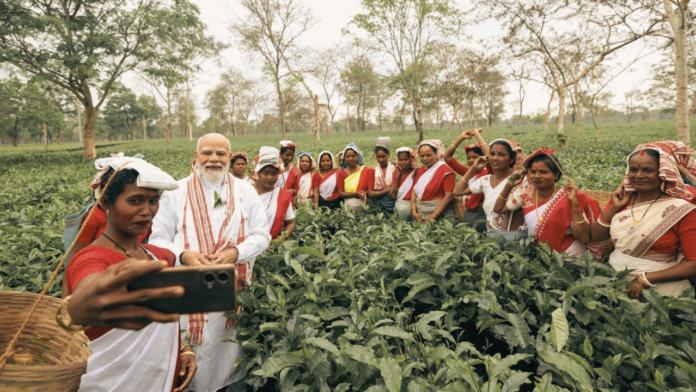
The Assam Assembly Elections 2026 have entered a decisive phase. Political messaging has sharpened, and ideological lines are becoming clearer. At the centre of this evolving narrative stands Narendra Modi, who has positioned key issues such as the Uniform Civil Code (UCC), illegal infiltration, and tribal identity as defining pillars of the campaign.
During a rally in Gogamukh, Dhemaji district, the Prime Minister directly targeted the Congress, alleging that its policies could alter Assam’s demographic and cultural balance. This framing reflects a broader electoral strategy that blends governance promises with identity-driven concerns.
Uniform Civil Code: Political Promise or Strategic Signal?
The promise to implement a Uniform Civil Code in Assam is not merely a legal proposition. It carries deep political implications.
What UCC Means in Assam’s Context
The Uniform Civil Code aims to replace personal laws based on religion with a common set of civil laws governing marriage, divorce, inheritance, and adoption. While it is a national debate, its introduction in Assam signals a localized adaptation of a broader ideological agenda.
Why It Matters Now
First, the BJP is attempting to position itself as a party of legal uniformity and national integration. Second, Assam’s diverse ethnic and religious composition makes the issue more sensitive. The promise of UCC, therefore, serves both as a governance reform and a political signal to its core voter base.
However, critics argue that such a move could trigger resistance among minority communities and indigenous groups who fear erosion of customary practices.
Infiltration Debate: The Core Electoral Narrative
One of the strongest themes in the Prime Minister’s speech was the issue of infiltration. He accused the Congress of intending to introduce laws that would “protect infiltrators.”
Historical Background
Assam has long grappled with concerns over illegal immigration, particularly from Bangladesh. This issue has shaped major political movements, including the Assam Agitation of the late 1970s and early 1980s.
Current Political Framing
The BJP has reframed the infiltration issue as a threat to:
- Demographic balance
- Cultural identity
- Economic resources
By contrast, the Congress has often emphasized humanitarian and constitutional approaches, leading to a clear ideological divide.
Electoral Impact
This narrative resonates strongly in border districts and among indigenous communities. It also helps consolidate support among voters who view demographic change as a critical concern.
Safeguarding Tribal Identity: A Strategic Emphasis
Another major promise highlighted by the Prime Minister was the protection of tribal communities.
Why Tribal Protection Matters
Assam is home to several indigenous tribes with distinct languages, traditions, and land rights. These communities have historically demanded safeguards against displacement and cultural dilution.
Policy Implications
The BJP’s commitment includes:
- Strengthening land protection laws
- Preserving cultural heritage
- Preventing encroachment
This focus aligns with the party’s broader Northeast strategy, which seeks to balance development with identity preservation.
Congress vs BJP: Competing Visions for Assam
The political contest in Assam is no longer just about governance. It is increasingly about competing visions of identity, legality, and inclusivity.
BJP’s Position
- Strong stance on illegal immigration
- Push for Uniform Civil Code
- Emphasis on indigenous rights and cultural protection
Congress’ Counter-Narrative
- Focus on inclusive policies
- Criticism of the BJP’s “polarizing” rhetoric
- Advocacy for constitutional safeguards
The ideological gap between the two parties has widened, making this election a referendum on broader national issues as well.
Spillover Politics: West Bengal Enters the Discourse
Interestingly, the Assam narrative has influenced political debates in neighboring states. In West Bengal, BJP MLA Dr. Sankar Ghosh countered claims made by Chief Minister Mamata Banerjee regarding dietary restrictions under a BJP government.
Why This Matters
This exchange highlights how:
- Regional elections are increasingly interconnected
- Political messaging crosses state boundaries
- Cultural identity remains a sensitive electoral issue
It also shows the BJP’s effort to counter narratives that may impact its voter base beyond Assam.
Identity Politics: The Underlying Theme
At its core, the Assam election is being shaped by identity politics. The debate revolves around three key questions:
- Who belongs?
- What defines Assamese identity?
- How should the state balance diversity with unity?
The BJP’s campaign leans toward protection and regulation, while the Congress emphasizes inclusivity and pluralism.
What Lies Ahead
As campaigning intensifies, several factors will determine the outcome:
- Voter response to UCC and infiltration narratives
- Tribal community alignment
- Opposition unity and counter-strategy
- Ground-level implementation credibility
The Assam Assembly Elections 2026 are not just a state contest. They reflect larger national debates on law, identity, and governance.
Conclusion
The current phase of the Assam elections reveals a clear shift toward high-stakes ideological politics. With Narendra Modi foregrounding issues like the Uniform Civil Code and infiltration, the BJP has set a sharp narrative.
At the same time, the opposition faces the challenge of countering this narrative without alienating key voter groups. As a result, the चुनाव has evolved into more than a political contest—it is now a defining moment for Assam’s identity and future direction.

