


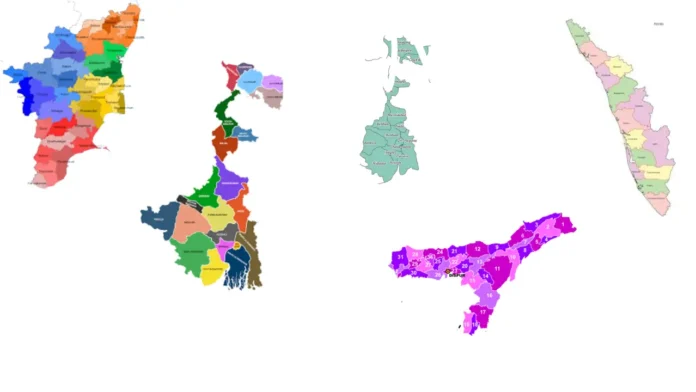
India is heading toward another crucial democratic exercise as the Election Commission of India has officially announced the schedule for the 2026 assembly elections in four major states and one union territory.
The states going to the polls are West Bengal, Tamil Nadu, Assam, and Kerala, along with the Union Territory of Puducherry. Voting will be conducted in phases from April 9 to April 29, and the results will be declared on May 4, 2026.
These elections are being held because the current legislative assemblies in these regions are set to complete their terms between May and June 2026.
Why These Elections Are Being Held
Each legislative assembly in India has a five-year term. Once that period ends, fresh elections must be conducted to form a new government.
The current assembly terms are scheduled to expire on the following dates:
- West Bengal – May 7, 2026
- Tamil Nadu – May 10, 2026
- Assam – May 20, 2026
- Kerala – May 23, 2026
- Puducherry – June 15, 2026
Because of these deadlines, the Election Commission has scheduled voting well in advance so that the new governments can be formed without constitutional delays.
Voting Schedule for Each State
The elections will not take place everywhere on the same day. Instead, the Election Commission has adopted a multi-phase strategy depending on the size, security needs, and administrative logistics of each state.
West Bengal
West Bengal will vote in two phases:
- First phase: April 23, 2026
- Second phase: April 29, 2026
The state has 294 assembly seats, making it one of the largest electoral contests in the country.
Tamil Nadu
Tamil Nadu will vote in a single phase on April 23, 2026.
The state assembly consists of 234 seats, and elections here often attract national attention because of the state’s strong regional political identity.
Assam
Assam will hold its assembly election in one phase on April 9, 2026.
The northeastern state has 126 assembly constituencies.
Kerala
Kerala will also conduct its voting in a single phase on April 9, 2026.
The state has 140 assembly seats, and elections here traditionally witness intense political competition.
Puducherry
The Union Territory of Puducherry will vote in one phase on April 9, 2026.
Its legislative assembly consists of 30 seats.
West Bengal Election 2026: High-Stakes Political Contest
West Bengal is expected to witness one of the most intense political battles of the election season.
The ruling Trinamool Congress (TMC), led by Chief Minister Mamata Banerjee, enters the contest with a strong base after winning a large majority in the previous election.
The party has relied heavily on welfare schemes such as financial assistance programs for women and rural employment initiatives.
However, the Bharatiya Janata Party (BJP) is attempting to expand its presence in the state. The opposition is focusing on issues such as corruption allegations, governance concerns, and identity politics in certain regions.
Meanwhile, the Left and Congress alliance is trying to regain its lost ground after years of declining influence in the state.
Tamil Nadu Election 2026: Dravidian Politics in Focus
Tamil Nadu politics continues to revolve around the rivalry between two major regional parties.
The ruling Dravida Munnetra Kazhagam (DMK), led by Chief Minister M.K. Stalin, will defend its governance record, highlighting industrial growth, welfare schemes, and social justice initiatives.
On the other side, the All India Anna Dravida Munnetra Kazhagam (AIADMK) and its allies are expected to challenge the government by raising concerns about corruption, law and order, and power supply issues.
The BJP, although traditionally weaker in the state, is trying to strengthen its alliance network and expand its voter base.
Assam Election 2026: Development vs Opposition Alliance
In Assam, the ruling coalition led by Chief Minister Himanta Biswa Sarma faces the Congress-led opposition alliance.
The election campaign is expected to revolve around several critical issues:
- Flood management and infrastructure
- Indigenous identity and migration concerns
- Employment opportunities for youth
- Development projects across the state
The ruling party is highlighting development initiatives and citizenship reforms, while the opposition is focusing on economic concerns and governance issues.
Kerala Election 2026: Traditional Two-Front Battle
Kerala’s political landscape remains dominated by two powerful alliances.
The ruling Left Democratic Front (LDF), led by Chief Minister Pinarayi Vijayan, is seeking another term in office.
The opposition United Democratic Front (UDF), led by the Congress, hopes to capitalize on issues such as unemployment, rising living costs, and anti-incumbency sentiment.
Although the BJP has limited electoral success in the state so far, the party continues to attempt to expand its political footprint among new voter segments.
Puducherry Election 2026: A Small Territory with Big Political Stakes
Despite its smaller size, Puducherry often attracts national attention during elections.
The ruling coalition led by N. Rangasamy and supported by the BJP is aiming to retain power.
Meanwhile, the opposition alliance including Congress and regional parties is focusing on local governance issues such as infrastructure, electricity supply, and economic development.
With only 30 assembly seats, even a small shift in voter preference can significantly change the political outcome.
Result Date and What Comes Next
All votes cast during the election phases will be counted on May 4, 2026.
Once counting is completed, the Election Commission will announce the results for all five assemblies on the same day.
The winning parties or alliances will then form governments before the current assembly terms officially expire.
Why the 2026 Elections Are Politically Important
These elections are being closely watched because they could reshape the political balance in several important regions of India.
West Bengal and Tamil Nadu are major political battlegrounds with strong regional identities. Kerala and Assam also hold strategic significance for national parties trying to expand their influence.
Therefore, the results of these elections will not only determine state governments but could also influence the broader political narrative ahead of future national contests.

