


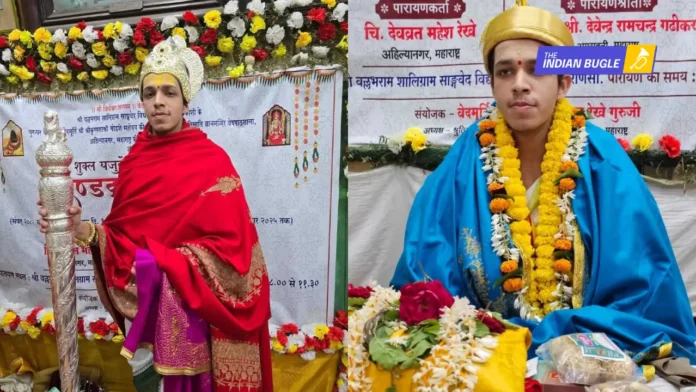
Who Is Devavrat Mahesh Rekhe?
Devavrat Mahesh Rekhe, a 19-year-old practitioner of Vedic studies, has recently drawn national attention after completing the Dandakrama Parayanam of the Shukla Yajurveda — a rare and technically demanding recitation tradition that very few scholars in modern India have attempted.
Guided by his father and guru, Mahesh Chandrakant Rekhe, Devavrat dedicated 50 days to an intensive and highly regulated chanting practice. His feat is considered a revival moment for a tradition that has remained largely dormant for nearly two centuries.
What Exactly Is the Dandakrama Parayanam?
Among the various traditions of Vedic recitation, Dandakrama Parayanam is considered one of the most challenging for several reasons.
1. Complex Chanting Structure
It follows a “danda” (pillar-like) recitation pattern that requires:
- Reverse-forward mantra sequencing
- Multi-layered phonetic transformations
- Precise tonal rendering
2. Demanding Memory Requirements
The practitioner must retain:
- Approx. 2,000 mantras of the Shukla Yajurveda
- Their permutations and combinations
- Rhythm and timing without deviation
3. Continuous Daily Recitation
Traditionally performed for several hours each day, this discipline demands:
- Breath control
- Mental stability
- Physical stamina
Most Vedic scholars today do not train in Dandakrama due to its difficulty and the scarcity of teachers proficient in the method.
This is what makes Devavrat’s achievement historically significant.
Why Is This Achievement Being Called a “Revival”?
Based on inputs from Vedic scholars and institutions, the classical execution of the Dandakrama Parayanam had not been completed in its full original form for nearly 200 years.
There are several reasons for this gap:
- Decline in oral transmission for advanced krama methods
- Shrinking number of Shukla Yajurveda experts
- Migration away from gurukula learning
- Lack of structured modern platforms for such practices
By successfully completing the Parayanam under a traditionally trained guru, Devavrat becomes one of the youngest documented practitioners to revive the method in its pure form.
The Father–Guru Behind the Achievement
Devavrat’s father, Mahesh Chandrakant Rekhe, is a respected Shukla Yajurveda scholar known for his expertise in advanced recitation patterns.
He trained Devavrat from early childhood in:
- Vedic swara shastra (phonetics)
- Krama, Jata, and advanced patha
- Long-duration recitation discipline
- Spiritual grounding and ritual procedures
This father–son lineage represents the traditional guru-shishya parampara, one of the few environments where ancient oral traditions continue to survive with purity.
The 50-Day Discipline: How Devavrat Prepared
For 50 consecutive days, Devavrat followed a strict regimen that included:
- Waking up before sunrise
- Performing nitya karmas and purification rituals
- Hours of uninterrupted chanting
- Reviewing pronunciation and correcting micro-level errors
- Maintaining dietary sattva
- Avoiding social distractions and digital interruptions
The Parayanam’s structure typically requires multi-hour recitation blocks, making physical fatigue a real challenge. The success of such a discipline depends not only on memory but also on sustained mental focus.
National Recognition and Appreciation
Devavrat Mahesh Rekhe’s completion of the Dandakrama Parayanam quickly moved beyond the boundaries of Vedic circles and gained national visibility. The most prominent acknowledgment came from Prime Minister Narendra Modi, who publicly congratulated the 19-year-old for accomplishing a recitation tradition that had remained dormant for nearly two centuries.
In his message, the Prime Minister described Devavrat’s achievement as something “future generations will remember” and praised the dedication, discipline, and precision required to complete such a rigorous form of chanting. He emphasised that Devavrat had brought pride not only to scholars of the Shukla Yajurveda but to everyone who cherishes India’s cultural and spiritual heritage.
Modi also highlighted the emotional significance of the feat being performed in Kashi, a city historically regarded as the heart of Vedic learning. He extended his blessings to Devavrat’s father and guru, the supporting institutions, and the many elders who guided the young practitioner through the demanding process.
Following the Prime Minister’s message, several respected Vedic scholars, purohits, Sanskrit academies, and traditional gurukulas acknowledged the accomplishment as a milestone in the preservation of advanced oral traditions. They noted that the technical purity with which the Parayanam was executed is rarely seen today, making the revival even more noteworthy.
Cultural organisations and religious institutions also honoured Devavrat with recognitions and felicitation ceremonies, acknowledging both the scale of the achievement and the years of preparation behind it. His dedication, along with the meticulous guidance of his father-guru, was widely cited as a model of how ancient knowledge can be revived through authentic training and unwavering discipline.
Collectively, these responses have transformed Devavrat’s accomplishment from a personal victory into a nationally celebrated moment — one that reinforces the importance of protecting India’s intangible heritage for the generations to come.
Why This Story Matters Today
In an era where oral traditions are rapidly declining, Devavrat’s accomplishment demonstrates that:
- Advanced Vedic knowledge can still be preserved with rigorous training.
- Guru–shishya lineage is essential for maintaining technical purity.
- Young practitioners can lead the revival of complex traditions.
- Cultural heritage survives only when actively practiced, not just archived.
His success is now being viewed as a case study in how ancient knowledge can continue to thrive even in a modern, digital-first world.
What Comes Next for Devavrat?
While Devavrat has not publicly announced his next steps, scholars believe he may contribute in several ways:
- Teaching and guiding other young aspirants
- Documenting rare recitation techniques
- Collaborating with Sanskrit universities
- Participating in heritage preservation initiatives
- Training in higher krama or ghana-level recitations
His expertise makes him a valuable resource for cultural institutions seeking to revive advanced Vedic practices.
Conclusion
Devavrat Mahesh Rekhe’s completion of the Dandakrama Parayanam is not merely a personal milestone. It is a historic and well-documented revival of a rare Shukla Yajurveda tradition, achieved with discipline, lineage-based training, and scholarly precision.
In a time when many ancient systems face extinction, his accomplishment serves as a reminder that India’s timeless knowledge systems can still be revived — provided there is dedication, guidance, and authenticity.

