


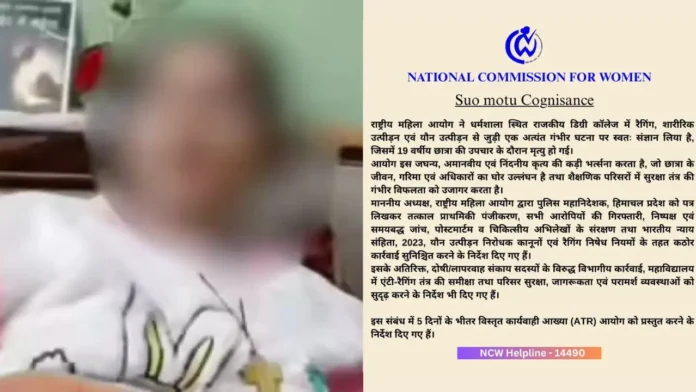
On December 26, 2025, a 19-year-old second-year student of Government Degree College, Dharamsala, died after months of medical treatment. Her family alleges prolonged ragging and harassment. They also accuse a college professor of sexual harassment. The case sparked national attention and official probes. This article lays out the facts, timeline, legal issues and recommended actions in clear, compact sections.
Key facts at a glance
Victim: 19-year-old second-year student (identified in reports as Pallavi).
Date of death: December 26, 2025.
Accused: One college professor and three senior students.
Action: FIR registered after family complaint.
Probes: UGC fact-finding committee and NCW involvement.
Issue: Alleged ragging, physical assault, sexual harassment, and institutional lapses.
Timeline of events
In mid-2025, the student reported harassment and trauma to family and friends. Subsequently, she sought medical care and underwent treatment over several months. In late December 2025, her condition worsened, and she died on December 26, 2025. After her death the family filed a complaint alleging ragging and sexual harassment. Police then registered an FIR naming a professor and three senior students. Soon after, national bodies moved to investigate.
Nature of the allegations
The family says senior students physically and emotionally abused the victim. They claim the conduct amounted to severe ragging. They also allege sexual harassment by a professor. Video clips circulated online in which the student spoke about trauma and mistreatment. These clips intensified public concern and prompted regulatory action.
Police action and FIR
Following the family complaint police registered criminal charges under provisions that address assault, harassment, and ragging. The FIR lists a professor and three senior students as accused. Investigators are gathering medical records, witness statements and any video or digital evidence. Meanwhile, the accused have denied some allegations and maintain their version of events.
Institutional and regulatory response
The University Grants Commission set up a fact-finding committee to probe the college’s role and procedures. The National Commission for Women took suo motu cognisance and urged a fair and time-bound probe. The college suspended or placed on leave involved staff while internal checks proceed. Authorities are reviewing anti-ragging mechanisms, complaint redressal and campus safety protocols.
Legal framework and implications
Ragging constitutes a criminal offense and a violation of university regulations in India. Institutions must maintain anti-ragging squads and help lines. The UGC mandates strict punishment for institutions that fail to prevent ragging. If investigators find institutional negligence, the college could face regulatory sanctions and disciplinary action against staff.
Evidence and investigative priorities
First, investigators must verify medical records and timelines of treatment. Second, they should authenticate and review video or audio evidence. Third, they must interview classmates, staff and family members under oath. Fourth, they should examine whether the college followed anti-ragging rules and took prior complaints seriously. Those steps will determine criminal liability and institutional responsibility.
Public reaction and broader concerns
The case triggered protests, social media outrage and calls for stricter campus safety. Students demanded transparent probes and faster justice. Advocates pressed for mental-health support for survivors and stronger preventive measures. Public sentiment highlights long-standing worries about ragging culture in higher education.
Shortcomings revealed
The incident exposed gaps in complaint escalation, delayed institutional response, and limited survivor support. Also, stigma and fear can deter reporting. The presence of recorded statements by the victim shows families sometimes turn to public platforms when formal channels fail.
Recommended reforms and immediate actions
First, fast-track the criminal investigation with clear timelines. Second, ensure independent medical and forensic review of records. Third, strengthen anti-ragging cells and hotlines with external oversight. Fourth, train faculty and administrators on handling complaints sensitively. Fifth, provide counseling and protection to potential witnesses. Sixth, publish a public report of findings and corrective measures.
What to watch next
Key developments to follow include police charge-sheets, the UGC committee report, any disciplinary action against college staff, and judicial proceedings if the case moves to court. These outcomes will set precedents for institutional accountability.
Conclusion
The Dharamsala case highlights how ragging can devastate a young life and how institutional failures compound harm. Clear investigations, measured legal action and systemic reforms can prevent recurrence. Above all, colleges must prioritise student safety, transparent complaint handling, and compassionate care for survivors.

