


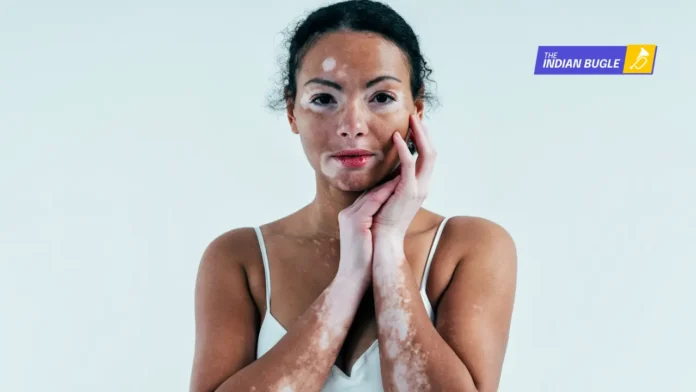
Short answer: It’s a myth.
There is no scientific proof that eating dairy products with salt causes vitiligo. But since this belief is widespread in India and worries many families, let’s break it down clearly and calmly.
First, what is Vitiligo?
Vitiligo is a skin condition in which:
- Some areas of the skin lose their color
- White or light-colored patches appear
- It happens because the pigment-producing cells (melanocytes) in the skin are destroyed or stop working
Important points:
- It is not an infection
- It is not contagious (you cannot “catch” it from someone)
- It is often related to autoimmunity (the body’s immune system mistakenly attacks its own pigment cells)
- It may also have a genetic link – it can run in some families
So, vitiligo is a complex medical condition, not a simple “reaction” to one food combination.
Where did the myth about “dairy + salt causes vitiligo” come from?
In India, there are some very old and very strong beliefs, like:
- “Fish and milk together cause white patches.”
- “Curd with salt or milk with salty foods causes leukoderma/vitiligo.”
- “Certain food combinations are ‘forbidden’ or ‘nakhush’ for the skin.”
These are based on:
- Traditional ideas about incompatible foods
- Observations without scientific testing
- Cases where vitiligo began around the same time as certain eating habits, and people assumed a direct cause-and-effect relationship
Over time, this turned into “Don’t eat milk or dairy with salt, you’ll get white patches.”
However, modern dermatology does not support this belief.
What does modern science say?
Are dairy and salt known causes of vitiligo?
No. In medical textbooks and scientific research, the main factors linked to vitiligo are:
- Autoimmune issues – the immune system attacks pigment cells
- Genetic factors – family history
- Oxidative stress – imbalance of harmful and protective molecules in skin cells
- Sometimes, skin injury, stress, or certain chemicals may trigger or worsen it in prone individuals
But food combinations like “dairy + salt” are NOT listed as causes of vitiligo.
There is:
- No study has proven that eating paneer sabzi, curd with salt, cheese, buttermilk with salt, etc., causes vitiligo.
- No medical guideline that says patients will get vitiligo because they consumed milk with salt.
So, from a modern, scientific dermatology point of view:
Dairy + salt does not cause vitiligo.
Can food trigger or worsen vitiligo in any way?
For most people with vitiligo:
- There is no strict, universally proven “vitiligo diet”.
- Doctors usually do not ban dairy or salt unless there is another health issue.
Some patients feel that certain foods (very spicy, junk food, preservatives, etc.) make their skin or stomach feel worse, but this is individual and not the same for everyone.
Doctors are much more focused on:
- Medical treatment (creams, light therapy, tablets, etc.)
- Monitoring autoimmune issues
- Protecting the skin from sun damage
Why do people still strongly believe food causes white spots?
Because of a few things:
- Timing confusion
Vitiligo may start at any age. If white patches appear shortly after a special meal, people emotionally connect the two events – and blame the food. - Visible condition, invisible cause
When a disease is visible on the skin but the real cause is inside (immune system, genetics), people try to create simple explanations like “it happened because you ate X with Y.” - Social stigma
Vitiligo, unfortunately, carries social stigma in many communities. Families want a “reason,” and often that reason becomes:- “You didn’t follow food rules.”
- “You ate the wrong combinations.”
This blames the patient, which is unfair and emotionally damaging.
Does Ayurveda say dairy + salt causes vitiligo?
Ayurveda talks about “viruddha ahar” – incompatible food combinations.
Certain combinations, like milk with sour or salty food, are considered unfavourable for long-term health and balance.
Some Ayurvedic practitioners believe:
- Such combinations may disturb doshas
- Could lead to “ama” (toxins) buildup
- It might contribute to skin diseases over time in susceptible people
But even here:
- It is not as simple as “eat this once, and you will get vitiligo.”
- It is more about overall lifestyle, digestion, and long-term balance.
If someone chooses to follow Ayurvedic diet rules strictly, they may prefer to avoid milk with salty foods as a precaution.
But that is very different from saying:
“Dairy + salt directly causes vitiligo in everyone.”
That statement is too strong and not supported by modern science.
What actually causes vitiligo?
While research is ongoing, the understood major factors are:
- Autoimmune mechanism – the body attacks its own pigment cells
- Genetics – having a family history of vitiligo or other autoimmune diseases (like thyroid issues, type 1 diabetes, etc.) increases risk
- Oxidative stress in the skin
- Sometimes triggers like:
- Skin injuries (cuts, burns, friction, repeated pressure)
- Severe emotional stress
- Certain chemicals or severe sunburn
Food combination myths distract from these real causes and may delay proper medical treatment.
Is it safe for someone with vitiligo to eat dairy + salt?
For most people with vitiligo:
- Milk, curd, paneer, cheese, and buttermilk are all usually safe.
- They can be part of a balanced, nutritious diet.
- Unless a doctor specifically says otherwise (for another health issue), there is no need to completely avoid dairy + salt.
However, some practical tips:
- Avoid any food that personally seems to trigger discomfort for you (acidity, allergy, etc.).
- Focus on:
- Fresh fruits and vegetables
- Adequate protein
- Good hydration
- Sun protection and proper skin care
- Follow your dermatologist’s advice on medications and treatments.
Why is this myth harmful
The belief that “dairy + salt causes vitiligo” is not just wrong – it is harmful because:
- It creates fear around normal food, especially for children.
- It blames the patient or parents, causing guilt:
“Yeh daag tumne khud khane ki galti ki wajah se laaye.” - It may cause people to waste time on strict, unscientific food rules instead of:
- Visiting a dermatologist early
- Starting proper treatment
- Taking psychological and emotional support
We should move from blaming food to understanding the disease.
How to explain to family in simple words
You can tell them:
“Safed daag (vitiligo) ek autoimmune bimari hai, jisme shareer ke pigment cells khud hi khatam ho jaate hain. Yeh kisi khaas khane ki wajah se seedhe nahi hota. Doodh ya dahi namak ke saath khane se vitiligo hone ka koi pakka medical saboot nahi hai.”
(“White patches (vitiligo) are an autoimmune condition where the body’s own pigment cells get destroyed. It doesn’t directly happen because of a particular food. There is no solid medical proof that eating milk or curd with salt causes vitiligo.”)
Final Answer: Myth or Truth?
“Eating dairy products with salt leads to vitiligo” – this is a MYTH.
- Modern medical science does not support this claim.
- Vitiligo is mainly related to autoimmunity and genetics, not to simple food combinations.
- Ayurveda may advise avoiding certain combinations for overall balance, but that does not mean they directly and universally cause vitiligo.
If you want, I can now:
- Convert this into a ready-to-publish SEO article with headings and FAQs like:
- “Can milk and fish cause white patches?”
- “Which foods should vitiligo patients avoid?”
- “Is vitiligo caused by eating the wrong foods?”
- Or write a short awareness post for social media to fight this misconception.

. Is this true or just a myth? Understand what really causes vitiligo, what science says about food, and how such misconceptions started.)