


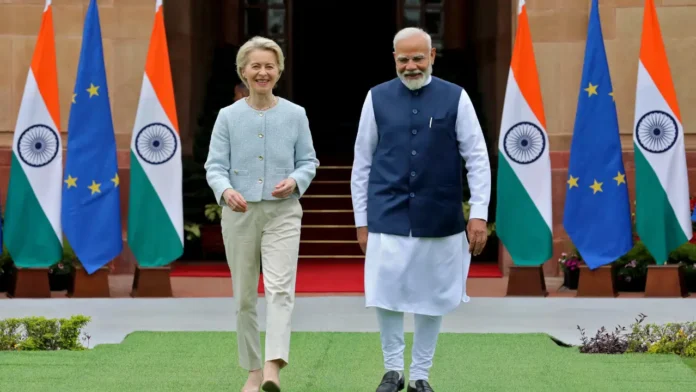
India and the European Union are on the verge of finalising a Free Trade Agreement that could reshape global trade patterns. Together, they represent a market of nearly two billion people and around one-fourth of global GDP. This is not just another trade pact. It is a statement of long-term economic intent at a time when global trade rules are shifting fast.
How was the agreement reached to this stage?
Trade talks between India and the EU began in 2007. They stalled in 2013 due to differences over ambition and market access. Both sides returned to the table in 2022 with a broader and more flexible approach. Since then, negotiations have moved steadily, focusing on balance rather than speed. Today, leaders openly acknowledge that the agreement is close to completion.
The political momentum behind the talks
The push gained fresh energy after Ursula von der Leyen described the agreement as the “mother of all deals” during her address at the World Economic Forum in Davos. Her planned visit to India with Antonio Costa signals a strong political commitment. The upcoming summit with Narendra Modi is expected to mark a decisive moment.
What the Free Trade Agreement actually covers
This FTA goes far beyond lowering tariffs. It aims to simplify customs rules, improve market access for services, protect investments, and align standards. It also addresses intellectual property, government procurement, and supply-chain transparency. In simple terms, it tries to make it easier and safer for businesses on both sides to trade, invest, and grow.
The EU is already India’s largest trading partner in goods. Annual bilateral trade stands at well over $130 billion. With predictable rules and lower barriers, this number can rise sharply. More importantly, businesses gain certainty. That certainty often matters more than tariff cuts alone.
Why defence and security are part of the story
This partnership is not limited to economics. India and the EU are preparing a Security and Defence Partnership to deepen cooperation. This framework encourages joint defence projects, smoother information sharing, and operational compatibility. It also opens doors for Indian companies to participate in European defence initiatives. The planned Security of Information Agreement will further remove barriers to sensitive industrial collaboration.
Global trade has entered an uncertain phase. Tariff pressures, supply chain shocks, and geopolitical rivalries have compelled countries to reassess their dependencies. Europe wants reliable partners in fast-growing regions. India wants diversified markets and long-term investment. Their interests now align more closely than ever.
Who stands to gain the most
Manufacturing, pharmaceuticals, green energy, automobiles, and digital services are likely to benefit early. Indian service providers could gain better access to European markets. European investors may find new opportunities in India’s expanding industrial and clean-tech sectors. At the same time, sensitive sectors like agriculture will continue to see cautious negotiations.
Short-term changes businesses should expect
Once the deal is announced, companies will start preparing for new compliance rules and origin requirements. Exporters will revisit pricing. Investors will reassess risk. Supply chains may shift gradually as confidence grows. The real gains will come not overnight, but through consistent implementation.
Strategic impact beyond economics
This agreement strengthens India–EU ties at a strategic level. It signals that both sides value openness, rules-based trade, and long-term cooperation. It also sends a message to the world that large economies can still build comprehensive partnerships without turning inward.
What still needs watching
Key details remain crucial. The depth of services liberalisation, safeguards for sensitive sectors, and dispute resolution mechanisms will define the real impact. How quickly both sides implement commitments will matter just as much as what is written on paper.
At its core, this deal is about confidence. Confidence to trade, invest, and collaborate in an uncertain world. If executed well, the India–EU FTA can create jobs, open markets, and deepen trust. It may not solve every challenge, but it can set the tone for the next phase of global economic cooperation.

