


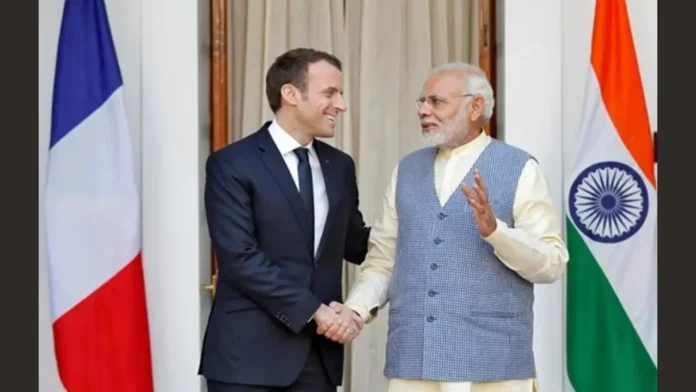
India and France have formally elevated their bilateral ties to a “Special Global Strategic Partnership”, signalling a sharp expansion in ambition and scope. The announcement followed high-level talks between Prime Minister Narendra Modi and French President Emmanuel Macron in Mumbai.
This is not a symbolic rebranding. Instead, it reflects a shared intent to shape global outcomes in defence, technology, climate action, and governance at a time of geopolitical uncertainty.
From 1998 to Horizon 2047
India and France launched their strategic partnership in 1998, making France India’s first such partner after nuclear tests. The latest upgrade builds on that foundation while aligning with the Horizon 2047 Roadmap, which charts cooperation until India marks 100 years of independence.
To institutionalise the relationship, both sides agreed to an annual Foreign Ministers’ Comprehensive Dialogue. This mechanism will track progress across security, economy, technology, and people-to-people exchanges.
Defence Cooperation Moves to the Centre
Defence emerged as the most concrete pillar of the upgraded partnership. India and France will now focus on co-design, co-development, and co-production of advanced military platforms.
A key highlight was the approval of 26 Rafale Marine fighter jets for the Indian Navy, strengthening France’s role as a long-term defence supplier. Collaboration will also expand into fighter aircraft engines, aligned with India’s Make in India push. French aerospace major Safran is expected to deepen manufacturing and technology transfer in India.
Manufacturing Footprint Expands
Several defence-industrial projects underline this shift. These include engine maintenance facilities for LEAP and M-88 engines, domestic production of HAMMER missiles with Bharat Electronics Limited, and a helicopter assembly line backed by Tata Advanced Systems and Airbus.
France has also shown interest in India’s Pinaka rocket system, opening doors for future defence exports.
Submarines, Space, and Cybersecurity
Submarine cooperation will continue after the successful delivery of the sixth Kalvari-class submarine under the Scorpene programme. Both sides see under-sea capabilities as vital for Indo-Pacific security.
In space, India and France will strengthen cooperation on sovereign access to space, space situational awareness, and defence space. Collaboration between ISRO and France’s CNES will deepen, with India also set to participate in France’s International Space Summit in 2026.
Cybersecurity now features as a strategic priority. Regular cyber dialogues and coordination at the United Nations will guide joint positions on responsible state behaviour in cyberspace.
Artificial Intelligence Takes Centre Stage
Artificial intelligence formed a defining theme of the engagement. Both leaders reiterated their commitment to secure, trustworthy, and people-centric AI.
The partnership aims to reduce the global AI divide by democratising access to computing resources while addressing risks such as misuse, bias, and security threats. France’s role in global AI governance aligns closely with India’s push for inclusive digital growth.
Nuclear Energy and the Clean Transition
Nuclear energy emerged as a critical pillar of long-term cooperation. France welcomed India’s ambition to reach 100 GW of nuclear capacity by 2047, especially after reforms allowing private participation.
The two sides agreed to expand collaboration across large reactors, Small Modular Reactors, and Advanced Modular Reactors. Discussions on the Jaitapur Nuclear Power Plant also moved forward, alongside closer ties between nuclear regulators and research institutions.
Climate, Oceans, and Sustainability
Both countries reaffirmed strong commitment to the Paris Agreement, the International Solar Alliance, and climate-resilient infrastructure. They also backed stronger ocean governance and expansion of marine protected areas, following the High Seas Biodiversity Treaty coming into force.
For India and France, climate action is no longer separate from security or economic strategy. It now forms a core pillar of global leadership.
Big Diplomatic Signals on the Global Stage
France formally invited India to the G7 Summit in 2026, underlining New Delhi’s growing influence in global economic debates. Paris also reiterated firm support for India’s permanent membership of the UN Security Council.
Both sides agreed to coordinate closely on UNSC reform, veto restraint in humanitarian crises, and a rules-based Indo-Pacific order. Cooperation with the EU and projects like the India-Middle East-Europe Economic Corridor also featured prominently.
People-to-People Ties Get a Boost
Beyond geopolitics, the partnership prioritises mobility and cultural exchange. France plans a visa-free airport transit pilot for Indian nationals. Both countries aim to host 30,000 Indian students in France by 2030.
Cultural engagement will expand through the India-France Year of Innovation 2026, alongside museum partnerships, artist residencies, and health research collaborations focused on AI.
A Partnership Designed for an Uncertain World
The elevation to a Special Global Strategic Partnership signals strategic maturity. India and France now view each other as long-term collaborators, not tactical allies.
In a world marked by fractured supply chains, power rivalries, and technological disruption, this partnership seeks autonomy, resilience, and influence. It is not about reacting to global change. It is about shaping it.

