


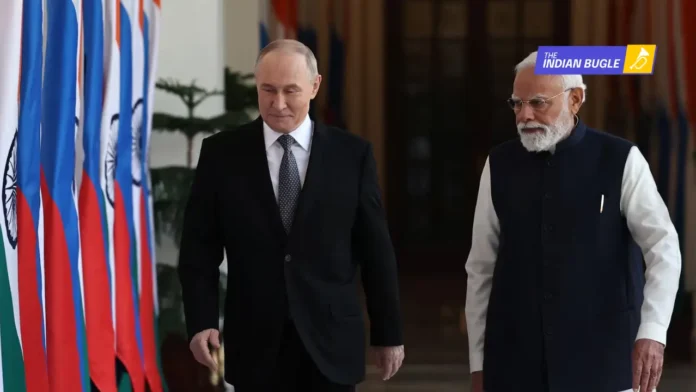
The recent meeting between Indian Prime Minister Narendra Modi and Russian President Vladimir Putin in New Delhi once again proved that India–Russia relations are guided by continuity, strategy, and national interests rather than global noise. While geopolitics around them shift, the economic partnership between the two nations is not only surviving — it is expanding.
Trade, energy and connectivity dominated discussions. But beyond agreements and numbers, one moment stood out symbolically — the cultural gifts PM Modi presented to Putin, reflecting tradition, friendship and soft diplomacy. Together, they narrate the story of a partnership anchored in both economic logic and civilizational warmth.
India–Russia Trade: Strong, Growing & Strategically Important
India–Russia trade has witnessed an unprecedented surge over the last two years, especially after the Ukraine conflict disrupted global supply chains. India, focused on affordable energy security, increased purchases of Russian crude oil, making Moscow one of its top energy suppliers.
Key Highlights of Trade Relationship
- Trade value has grown rapidly, touching multi-billion-dollar levels annually
- India imports far more from Russia than it exports
- Oil forms the largest chunk of imports, followed by coal and fertilisers
- India aims to diversify exports to pharmaceuticals, agriculture, machinery & technology sectors
In simple terms, Russia fuels India, and India wants to fuel trade balance with technology, medicines, and food products.
What India Buys From Russia
India’s imports are largely strategic and essential for domestic stability:
| Imported Sector | Why It Matters |
|---|---|
| Crude Oil | Helps maintain fuel prices & check inflation |
| Fertilisers | Critical for Indian agriculture & food supply |
| Coal | Required for steel, energy & manufacturing industries |
| Sunflower Oil | Big consumption in Indian households |
| Defence Equipment & Spares | Supports existing Russian-origin military systems |
India did not buy Russian oil for political alignment — it did so because, economically, it made sense, keeping domestic inflation under control when the world struggled with rising fuel costs.
What India Sells to Russia
While exports are still modest compared to imports, the list is expanding gradually:
- Pharmaceutical products — one of India’s strongest export strengths
- Tea, coffee & agricultural produce
- Machinery, chemicals & industrial equipment
- Textiles & consumer goods
India’s long-term goal is to balance trade by increasing exports and facilitating Indian industry presence inside Russia, including manufacturing hubs for pharma, fertilisers, and engineering goods.
The Payment Challenge & New Trade Mechanisms
Western sanctions have complicated traditional payment routes. To keep trade running smoothly, both nations are working on:
- Currency-based settlement frameworks
- Rupee-Rouble and local-currency trade options
- Digital payment and banking interoperability
This isn’t an attempt to disrupt the global system — it’s a practical strategy to safeguard essential trade from sanctions-based disruptions.
Future of Trade: Beyond Oil & Towards Joint Growth
India and Russia are now planning for a more investment-driven partnership that goes beyond buying and selling.
Key sectors of future cooperation:
- Energy 2.0: long-term crude supply, LNG cooperation, nuclear energy projects
- Connectivity infrastructure:
- International North-South Transport Corridor
- Chennai–Vladivostok sea route
- Arctic Northern Sea Route accessibility
- Technology & joint development:
- Aviation materials, defence manufacturing modules
- BrahMos-style joint projects as a template for future R&D
The vision is clear — make trade broader, deeper and shock-resistant.
Diplomacy Through Culture: The Gift Modi Gave President Putin
Beyond policy talks, gifts are where diplomacy becomes human.
During Putin’s India visit, PM Modi presented a thoughtfully curated gift hamper representing India’s heritage, craftsmanship, and essence.
What is the Gift Hamper?
- Russian-language edition of the Srimad Bhagavad Gita
- A profound gesture of respect, bonding spirituality with diplomacy
- Assam black tea (GI-tagged)
- One of India’s finest agricultural exports
- Kashmiri saffron
- Rare, premium & symbolic of India’s diverse geography
- Handcrafted Murshidabad silver tea set
- Showcasing Bengal’s centuries-old artisan skill
- Hand-sculpted silver horse from Maharashtra
- Symbolising strength, progress and forward movement in relations
- Marble chess set from Agra
- Connecting India’s craftsmanship with Russia’s love for chess
Each item was chosen with meaning — not a formality, but storytelling of India through art, agriculture and spirituality.
It reflects India’s ability to balance hard power trade deals with soft power cultural diplomacy.
Final Thoughts
Trade with Russia is not just transactional — it’s strategic, long-term and resilience-oriented. India seeks energy security, diversified imports and stable pricing. Russia needs large buyers beyond Europe. Both can benefit — but only through balanced trade, better settlement systems and deeper industrial collaboration.
And amidst all the seriousness of diplomacy, human warmth still matters.
The cultural gifts Modi gave Putin were a reminder that relationships run deeper than agreements, and soft power often strengthens what policies alone cannot.
India is not choosing sides — India is choosing its interests.
And in a shifting world, keeping doors open with every power centre is not just diplomacy — it’s strategy.

