


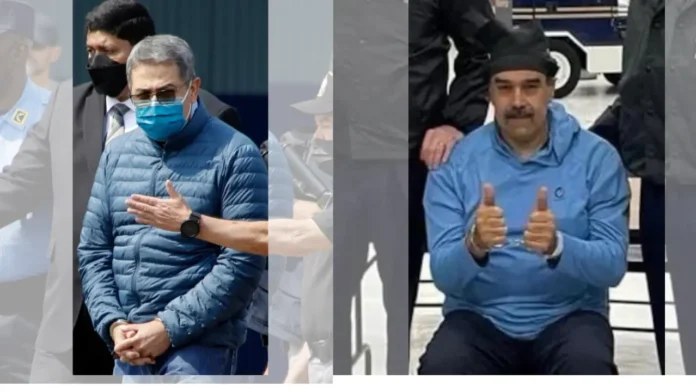
The arrest of Nicolás Maduro sent shockwaves across Latin America and beyond. Images of a sitting leader brought before a US court felt unprecedented. Yet this was not the first time a powerful president faced American justice. Just months earlier, Juan Orlando Hernández had already stood trial in New York for similar crimes. What followed, however, could not have been more different. One walked free after a pardon. The other now faces a long legal battle behind bars.
These two cases go beyond individual guilt or innocence. They test a bigger idea: can powerful leaders truly be held accountable? For years, many presidents believed power guaranteed protection. Hernandez and Maduro prove that protection is no longer absolute. At the same time, their contrasting outcomes show that politics still shapes justice in decisive ways.
Investigations into both leaders began quietly more than a decade ago. US drug enforcement agencies tracked cocaine routes moving through Central America and the Caribbean into the United States. Over time, investigators alleged that these routes survived because political leaders offered protection. In both cases, prosecutors claimed that state institutions were not victims of corruption but tools of it. That shared origin explains why the names of Hernandez and Maduro now appear together in headlines.
Juan Orlando Hernández: From power to prison to pardon
Hernández ruled Honduras with a strong hand and close ties to Washington. After leaving office, his protection collapsed quickly. US authorities arrested him and extradited him to New York. Prosecutors accused him of running an extensive drug-trafficking network that pushed hundreds of tonnes of cocaine into the United States. They said traffickers operated freely because the state shielded them. Hernández denied every allegation and insisted he was targeted for political reasons. A jury convicted him, and the court handed down a 45-year sentence. Many believed the story had ended. Then came a sudden twist. US President Donald Trump issued a pardon, calling Hernández a victim of unfair persecution. Overnight, a convicted former president became a free man again.
Nicolás Maduro: A dramatic fall from power
Maduro’s story took a far more explosive turn. Unlike Hernández, he did not lose power quietly. US authorities carried out a high-risk operation in Caracas that ended with Maduro and his wife in custody. He was flown to New York and brought before a federal court in Manhattan. Prosecutors accused him of narco-terrorism and conspiracy to import cocaine. The indictment painted a picture of a system built on corruption, where political loyalty ensured safe passage for drug shipments across borders. Maduro rejected the charges and claimed foreign aggression. Still, the image of a sitting leader facing trial in another country changed the tone of global politics overnight.
The contrast between the two cases triggered sharp political reactions in Washington. Former House Speaker Nancy Pelosi took to X to criticise what she called a clear double standard. She argued that if the US administration justified action against Maduro on drug-trafficking grounds, then pardoning Hernández—who had already been convicted by an American jury for similar crimes—looked hypocritical. Her tweet quickly went viral. It amplified public debate and forced attention back to Hernández’s case just as Maduro’s prosecution began.
The biggest difference lies in timing. Hernández faced justice after leaving office. That allowed extradition and a conventional court process. Maduro was seized while still claiming power. That raised questions of sovereignty and international law.
The second difference lies in executive power. A presidential pardon erased Hernández’s sentence. No such relief stands between Maduro and trial.
The third difference lies in global reaction. Hernández’s pardon sparked political debate inside the US. Maduro’s arrest triggered diplomatic shock, emergency meetings, and fears of a dangerous precedent
Law does not operate in isolation. Governments weigh strategic interests, alliances and public opinion. Hernández was once seen as a friendly partner. Maduro was long labelled an adversary. Those labels shaped how each case unfolded.
Supporters of the US actions argue that both cases show courage in confronting narco-politics. Critics see double standards. They ask why one convicted leader was forgiven while another was hunted down.
The human cost is often ignored
Behind court filings and political speeches are real people. In Honduras, allegations of state-backed trafficking meant violence, fear, and weakened institutions. In Venezuela, years of crisis forced millions to leave home. Drug flows do not remain abstract crimes. They fuel addiction, crime, and broken families far beyond borders. For many citizens, these trials represent a rare hope that powerful figures might finally answer for the damage done.
What comes next
Maduro’s legal fight is just beginning. His lawyers will challenge jurisdiction and immunity. Prosecutors will push to prove their case. Diplomatic tensions will continue to rise. Meanwhile, Hernández’s pardon will remain a reference point in every debate about fairness and political influence in justice.
The stories of Juan Orlando Hernández and Nicolás Maduro mark a turning point. They prove that even presidents can fall. Yet they also reveal an uncomfortable truth. Accountability exists, but it is uneven. Evidence matters, but power still shapes outcomes. In this new era, the world is watching to see whether justice can truly rise above politics — or whether politics will always have the final word.

