


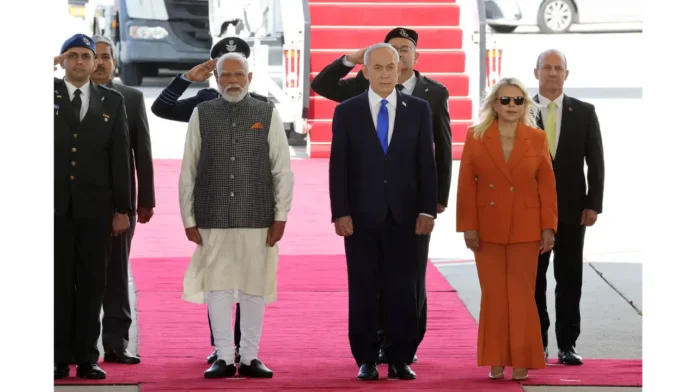
Prime Minister Narendra Modi’s visit to Israel marks an important moment in India’s foreign policy. The two-day visit focuses on strengthening strategic cooperation, defence ties, and economic partnerships between the two countries.
India and Israel now share a close partnership based on technology, security cooperation, and trade. Over the past decade, this relationship has grown rapidly and gained strategic importance.
The visit comes at a time of rising tensions in the Middle East. Therefore, global observers are watching closely.
What is on the Agenda
The visit includes meetings with Israel’s top leadership and the signing of new agreements.
Prime Minister Modi is scheduled to meet Israeli Prime Minister Benjamin Netanyahu for detailed discussions on strategic cooperation. The talks focus mainly on defence, technology, and economic cooperation.
Modi is also expected to address the Israeli parliament and meet the President of Israel. He will visit the Holocaust Memorial Museum and participate in official ceremonies.
Leaders from both countries plan to strengthen economic and security agreements.
Key Areas of Discussion
Defence Cooperation
Defence cooperation remains one of the strongest pillars of India-Israel relations.
India is one of the largest buyers of Israeli defence equipment. The two countries work together in areas such as:
- Missile systems
- Surveillance technology
- Drones
- Border security systems
- Intelligence sharing
New agreements may update existing security cooperation frameworks.
Technology and Innovation
Technology cooperation has become increasingly important.
Israel is known for innovation and advanced technology. India provides a large market and skilled workforce. Both countries plan to expand cooperation in:
- Artificial intelligence
- Cybersecurity
- Quantum technology
- Agricultural technology
- Water management
These sectors are expected to shape future cooperation.
Economic Cooperation
Economic ties continue to grow steadily.
India and Israel signed a new investment treaty recently to protect investors from both countries. The two countries are also working towards a free trade agreement.
Israel wants Indian infrastructure companies to invest in construction and development projects.
Trade between India and Israel has increased significantly over the years.
India exports:
- Precious stones
- Chemicals
- Machinery
- Electrical equipment
- Fuel products
India imports:
- Petroleum products
- Machinery
- Technology equipment
India is now one of Israel’s largest trading partners in Asia.
History of India-Israel Relations
Early Opposition
India initially opposed the creation of Israel in 1948. During the freedom movement, Indian leaders strongly supported the Palestinian cause.
India voted against Israel’s membership in the United Nations in 1949.
Although India recognised Israel in 1950, diplomatic relations remained limited for many decades.
Diplomatic Relations Begin
India and Israel established full diplomatic relations in 1992.
Trade and cooperation slowly expanded after that.
However, India maintained a balanced policy between Israel and Palestine.
Major Shift After 2014
Relations strengthened significantly after 2014.
Prime Minister Modi became the first Indian prime minister to visit Israel in 2017. Since then, cooperation has expanded rapidly.
Today, India and Israel maintain strong strategic ties.
Strategic Importance of India-Israel Partnership
India and Israel see each other as complementary partners.
Israel offers advanced technology and defence expertise. India offers a large market and economic opportunities.
This cooperation supports both economic growth and national security.
Security cooperation plays a key role in the partnership. Both countries face security challenges and share intelligence and defence technologies.
Geopolitical Significance
Middle East Tensions
The visit comes during a period of instability in the Middle East.
Tensions involving Israel and Iran remain high. Global powers are closely involved in the region.
Any escalation could affect global energy markets and security.
India must balance relations with multiple countries in the region, including Israel and Iran.
India has long maintained friendly relations with Iran, especially through strategic infrastructure projects.
Therefore, India must carefully manage its diplomatic position.
International Reactions
Some analysts believe the visit signals strong support for Israel.
Others view it as a continuation of India’s strategic diplomacy.
The visit takes place amid global debates over Israeli policies and regional conflicts. This timing increases its international significance.
Growth of Trade Relations
Economic cooperation has expanded dramatically since diplomatic ties began.
Trade has grown from a small level in the early 1990s to several billion dollars annually.
India is now one of Israel’s largest trading partners in Asia.
Growing sectors include:
- Technology
- Defence
- Agriculture
- Infrastructure
- Energy
Future trade agreements could expand cooperation further.
Defence Partnership
India has become one of the largest importers of Israeli defence systems.
Israeli technology plays a role in:
- Border surveillance
- Air defence
- Naval security
- Electronic warfare
Joint development projects continue to expand.
This defence partnership strengthens India’s national security capabilities.
Challenges and Diplomatic Balancing
India maintains relations with Israel as well as Arab countries and Iran.
This balancing act remains essential for India’s foreign policy.
India continues to support diplomatic solutions in the Middle East while strengthening ties with Israel.
Managing these relationships requires careful diplomacy.
Why the Visit is Important
Modi’s visit signals the growing strategic partnership between India and Israel.
It highlights cooperation in defence, trade, and technology.
The visit also reflects India’s expanding role in global politics.
India seeks partnerships that support economic growth and national security.
Therefore, the visit represents both strategic and economic priorities.
Conclusion
India-Israel relations have transformed over the past decades. What began as limited diplomatic contact has become a strong strategic partnership.
Prime Minister Modi’s visit represents another step in this growing relationship.
The agreements and discussions during the visit may shape future cooperation in defence, technology, and trade.
As global tensions rise, partnerships like this will play an increasingly important role in international relations.

