


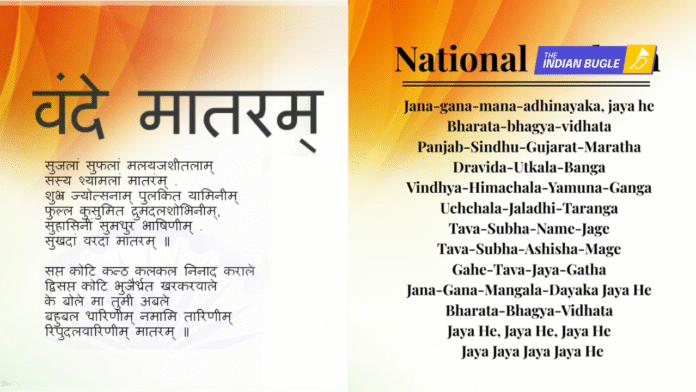
What is the Difference Between the National Anthem and the National Song of India?
India takes pride in its rich cultural heritage, and two of the most significant symbols of national identity are the National Anthem and the National Song. While both evoke patriotism and unity, they are not the same and hold different legal and historical statuses.
Below is a simple, clear explanation.
1. National Anthem of India – Jana Gana Mana
Composer:
Rabindranath Tagore
First Performed:
1911, Calcutta Session of the Indian National Congress
Adopted As National Anthem:
24 January 1950 (by the Constituent Assembly)
Duration:
52 seconds (official)
Legal Status:
The National Anthem has constitutional recognition and is governed by law and official protocols.
Standing during its playing is considered mandatory as per Supreme Court guidelines, except for people with disabilities.
Importance:
- Represents India’s unity in diversity
- Played during national ceremonies, school assemblies, official functions, and international events
- Has specific rules for how it must be sung or played
2. National Song of India – Vande Mataram
Composer:
Bankim Chandra Chattopadhyay
Appeared In:
His novel Anandamath (1882)
Adopted As National Song:
Though honored as the National Song, it was not given constitutional status like the anthem.
However, the Constituent Assembly acknowledged it on 24 January 1950 for its historic importance in the freedom struggle.
Legal Status:
- Not mandatory for citizens to sing
- No fixed time duration or rules
- No legal penalties for not standing or singing
Importance:
- A rallying cry during the Indian independence movement
- Evokes strong patriotic feelings
- Considered a cultural treasure
3. Key Differences Between the National Anthem and the National Song
| Feature | National Anthem (Jana Gana Mana) | National Song (Vande Mataram) |
| Composer | Rabindranath Tagore | Bankim Chandra Chattopadhyay |
| Year Written | 1911 | 1870s–1882 |
| Constitutional Status | Official & legally recognized | Not constitutional but culturally significant |
| Mandatory to Stand? | Yes, except for people with disabilities | No |
| Official Guidelines | Strict rules for performance | No formal rules |
| Adopted As | National Anthem of India (1950) | National Song of India (acknowledged 1950) |
| Usage | National events, schools, government functions | Cultural, patriotic events |
4. Why India Has Both a National Anthem and a National Song
India’s freedom struggle drew strength from various forms of art, especially poetry and music.
- Vande Mataram inspired countless revolutionaries.
- Jana Gana Mana was chosen as the anthem because of its universal appeal across cultures, languages, and regions.
Both pieces symbolize India’s nationalism, but the anthem has legal authority, and the song has emotional and historical power.
5. Which One Is More Important?
Both are important in different ways:
- National Anthem: Mandatory, formal, and officially recognized
- National Song: Emotional, historical, and inspirational
Together, they represent India’s patriotic spirit.
The National Anthem and the National Song of India are two pillars of the nation’s cultural identity. While the National Anthem holds legal and constitutional authority, the National Song carries immense emotional significance from the freedom movement. Together, they reflect India’s unity, diversity, and timeless patriotism.

