


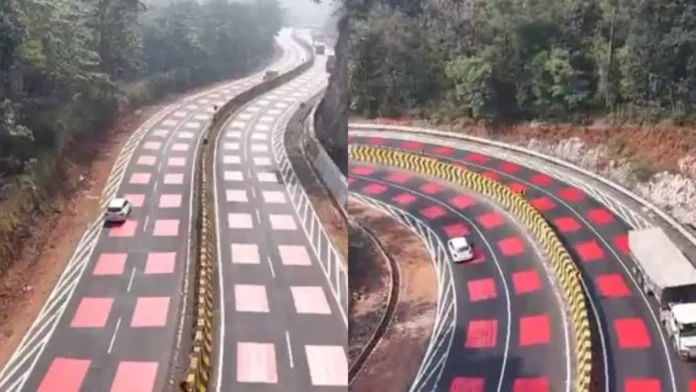
As India continues to expand its national highway network, the focus is no longer limited to speed and connectivity alone. The National Highways Authority of India (NHAI), under the Ministry of Road Transport and Highways (MoRTH), is now redefining infrastructure development by combining road safety, wildlife protection, and environmental conservation.
A recent initiative implemented on a forest and ghat section of a National Highway in Madhya Pradesh showcases how modern engineering can coexist with nature without compromise.
A Highway Through a Sensitive Tiger Reserve
The project has been executed on a 2-kilometre ghat stretch that forms part of an 11.96-kilometre highway section passing through the Veerangana Durgavati Tiger Reserve, earlier known as the Nauradehi Sanctuary.
This region is ecologically sensitive and known for frequent wildlife movement. Recognising the risk of accidents involving animals and vehicles, NHAI introduced innovative safety solutions that protect both motorists and wildlife.
India’s First ‘Table-Top Red Marking’ on a National Highway
For the first time in India, NHAI has introduced ‘table-top red markings’ on a National Highway, drawing inspiration from global best practices, including roads such as Dubai’s Sheikh Zayed Road.
A 5 mm thick hot-applied thermoplastic red layer has been laid across the carriageway in identified danger zones. The bright red surface serves as a clear visual warning, alerting drivers that they are entering a speed-restricted, wildlife-sensitive corridor.
The slightly raised surface also produces mild vibration and sound when vehicles pass over it. This natural feedback encourages drivers to slow down smoothly, without sudden braking or discomfort.
Low Ecological Impact, High Safety Value
One of the most notable aspects of this intervention is its minimal impact on the surrounding ecosystem. The red marking solution:
- Does not disturb wildlife movement or habitat
- Requires no change in road structure or drainage
- Produces less noise compared to conventional rumble strips
- Is easy to maintain and can be reversed if needed in the future
In addition, white shoulder lines have been added on both sides of the highway to guide vehicles and prevent them from drifting into forested or grassy areas, further improving road safety.
Strong Focus on Wildlife Protection
Beyond speed control, NHAI has adopted a comprehensive wildlife safety strategy along this stretch:
- 25 dedicated animal underpasses have been constructed along the 11.96 km corridor at identified animal movement locations.
- These underpasses align with natural terrain and drainage paths, encouraging regular use by animals.
- Continuous chain-link fencing has been installed on both sides of the highway (except in deep cutting areas) to prevent animals from entering the road and to guide them toward safe crossings.
- Cameras installed on minor bridges, which also act as animal crossings, help monitor wildlife movement.
- Solar lighting at bridges and junctions improves visibility at critical points without adding environmental pressure.
Although the 2-kilometre ghat section is classified as a danger zone due to its geometry, the fencing and underpass system ensures that animals cannot cross the roadway directly, significantly reducing the risk of collisions.
Setting a Benchmark for Sustainable Highways
This project highlights how infrastructure development does not have to come at the cost of nature. By combining scientific research, international best practices, and local ecological understanding, NHAI has delivered a solution that:
- Reduces road accidents and saves human lives
- Protects wildlife from vehicle collisions
- Preserves forest ecology and natural movement corridors
- Ensures safer and smoother travel for motorists
As India builds highways through forests, hills, and wildlife zones, this initiative sets a new benchmark for environmentally responsible and people-centric development. Here, red roads no longer signal danger — they reflect thoughtful design backed by green intent.

