


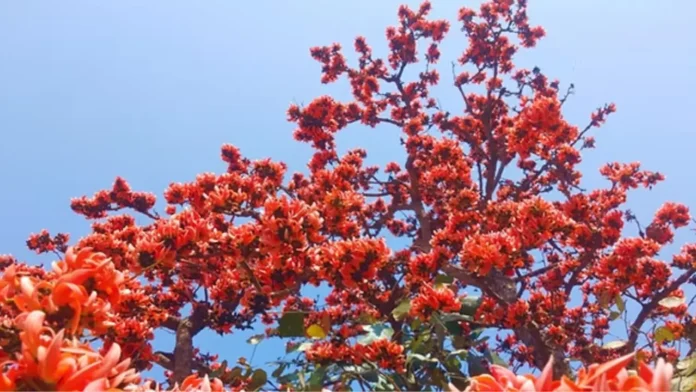
Every year, when winter ends and spring arrives, the forests of Jharkhand change dramatically. Hills, roadsides, and forest landscapes suddenly glow with bright red and orange colours. This transformation happens because of the blooming of the Palash tree, often called the “Flame of the Forest.”
During March and April, thousands of Palash trees blossom across the region. Their fiery flowers create a striking natural scene that attracts travelers, photographers, and nature lovers. For the people of Jharkhand, however, the bloom is not just beautiful. It represents cultural identity, seasonal change, and the deep bond between humans and forests.
The Palash Tree and Its Unique Bloom
The Palash tree is a deciduous species that belongs to tropical and subtropical forests. During most of the year the tree looks ordinary. As spring approaches, the leaves fall and thick clusters of bright red-orange flowers cover the branches.
Because the leaves drop before the flowering begins, the blossoms appear clearly on bare branches. This unusual pattern makes the tree look as if flames are rising from it. For this reason people call it the Flame of the Forest.
The flowers have thick petals that curve outward and resemble the beak of a parrot. When many Palash trees bloom together, the entire forest canopy appears red.
Why Jharkhand Experiences This Red Landscape
Jharkhand contains large stretches of dry deciduous forest. These forests provide the perfect environment for Palash trees. The species grows easily in dry soil, rocky land, and open forest areas.
Because Palash trees spread widely across the state, they bloom in large numbers during the spring season. When this flowering happens almost at the same time, entire hills and forest areas turn red. This natural event gives Jharkhand its unique spring landscape.
Where the Palash Flower Is Found
Although the Palash tree is strongly associated with Jharkhand, it grows across many parts of the Indian subcontinent. The tree is widely found in central, eastern, and northern India.
Large populations of Palash trees grow in states such as Jharkhand, Chhattisgarh, Odisha, Bihar, West Bengal, Madhya Pradesh, and Uttar Pradesh. It also appears in forest regions of Maharashtra, Telangana, and parts of Rajasthan.
Beyond India, the tree grows in countries such as Nepal, Bangladesh, Sri Lanka, Myanmar, and Thailand. Because it adapts well to tropical climates and dry forests, it spreads easily in many South Asian landscapes.
Even though it grows in several regions, the Palash bloom appears particularly striking in Jharkhand because of the state’s dense forest cover.
Cultural Meaning for Jharkhandi Communities
For tribal communities in Jharkhand, the Palash flower carries deep cultural meaning. The flower symbolizes strength, renewal, and the arrival of spring. Its bloom marks a time when nature begins a new cycle of growth.
Local folklore, songs, and stories often mention the Palash tree. Many communities see it as a symbol of their connection with the forest. The sight of blooming Palash trees reminds people of their shared heritage and the importance of protecting nature.
Relationship with Spring Festivals
The blooming of Palash trees coincides with important spring festivals in Jharkhand. One of the most important among them is Sarhul, a festival celebrated widely by tribal communities. Sarhul honors nature, forests, and village deities.
Although sal flowers are traditionally used during Sarhul rituals, the surrounding Palash blossoms create the colorful spring environment of the festival season.
Palash flowers also have a historical connection with Holi. In earlier times people dried the petals and used them to prepare natural colours for the festival.
Traditional Uses in Rural Life
The Palash tree has supported rural communities for generations. People use different parts of the tree in everyday life.
The bright flowers produce a natural dye that people once used for colouring fabrics and festival powders. The leaves are large and flexible, so villagers stitch them together to make eco-friendly plates and bowls used in traditional meals.
Traditional medicine also values the Palash tree. Healers have used extracts from its bark, gum, and seeds in herbal treatments for various health conditions.
Ecological Importance of the Palash Tree
The Palash tree also plays an important role in forest ecosystems. Its bright flowers attract bees, birds, and insects that help pollinate plants. This process supports biodiversity and maintains ecological balance.
The tree grows well in dry landscapes where many other plants struggle. Its roots help hold the soil together and reduce erosion in hilly or rocky areas. Because of this resilience, Palash trees help maintain the health of forest environments.
A Symbol of Jharkhand’s Natural Identity
Over time, the Palash flower has become a strong symbol of Jharkhand’s natural beauty. Artists, photographers, and writers often describe the red forests of spring as one of the region’s most remarkable sights.
For many Jharkhandi people, the flower represents pride in their land and culture. The bright blossoms remind them of the forests that shape their traditions and everyday life.
Conclusion
When Palash trees bloom during March and April, Jharkhand transforms into a landscape filled with vibrant red and orange colours. This seasonal change reflects the power and beauty of nature.
The Palash flower connects ecology, culture, and tradition uniquely. It marks the arrival of spring, supports forest life, and symbolizes the identity of Jharkhand’s people. Even though the tree grows across many regions of India and South Asia, its blooming forests remain one of the most unforgettable natural sights of Jharkhand.

