


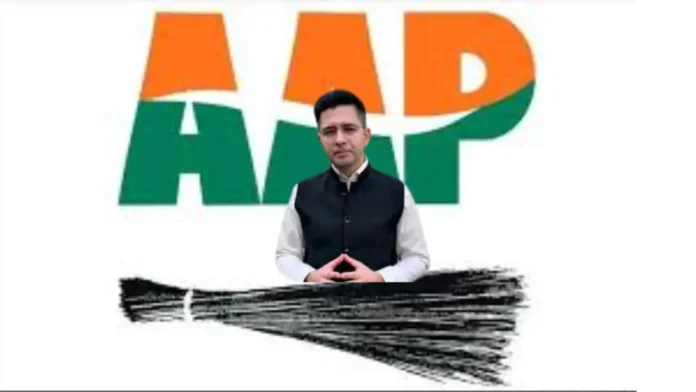
The decision to remove Raghav Chadha as Deputy Leader in the Rajya Sabha has sparked intense political debate. The opposition calls it a clear sign of internal conflict. However, the Aam Aadmi Party insists it is a routine organisational change.
This development comes at a crucial time. With elections approaching in Punjab, every political move carries strategic weight. So, the key question is simple: Is this a power struggle or a calculated shift?
Why Was Raghav Chadha Replaced?
AAP replaced Chadha with Ashok Mittal as the Rajya Sabha deputy leader. According to party leaders, this is part of internal restructuring.
Sanjay Singh confirmed that the decision was formally communicated to the Rajya Sabha Secretariat. Meanwhile, Mittal described the transition as a normal leadership rotation.
AAP argues that such changes are common. Leaders are rotated to bring fresh perspectives. The party also wants stronger representation of Punjab-specific issues in Parliament.
Opposition Sees a Rift
The opposition has strongly disagreed with AAP’s explanation. Leaders from the BJP and Congress claim the move reflects deeper tensions within the party.
Virendra Sachdeva linked the decision directly to Arvind Kejriwal. He suggested that Chadha may have distanced himself from the leadership style.
Sachdeva also drew parallels with Swati Maliwal, claiming she too had differences with the party leadership earlier.
Similarly, Ramvir Singh Bidhuri questioned the party’s internal democracy. He even termed the move “dictatorial.”
From the Congress side, Mallu Ravi and Amarinder Singh Raja Warring raised concerns. They argued that such actions could weaken democratic practices within parties.
The Kejriwal–Chadha Equation
At the center of the debate lies the perceived equation between Chadha and Kejriwal.
Speculation intensified after Chadha’s absence during key political moments. For instance, when Kejriwal faced legal trouble in the excise policy case in 2024, Chadha was in London for eye surgery.
Opposition leaders used this to question his commitment. However, Chadha had clarified the reason publicly at that time.
Even now, no official confirmation suggests any direct fallout. Still, political perception often matters more than facts in such situations.
Chadha’s Response: Silence with Signals
Chadha did not immediately issue a formal statement after his removal. Instead, he shared a video highlighting his work in Parliament.
Later, he broke his silence with a pointed question: “Have I done something wrong?”
He emphasized that he consistently raised public issues. These included:
- Middle-class tax burden
- Airport charges
- Gig workers’ challenges
- Telecom and data concerns
His statement carried a subtle message. He questioned why raising public issues would be seen negatively.
He also added, “Don’t mistake my silence for my defeat.” This line suggests he is not stepping back from politics.
AAP’s Strategic Angle: Focus on Punjab
AAP’s explanation cannot be ignored. The party currently has a strong presence in Punjab.
Out of its 10 Rajya Sabha MPs:
- 7 are from Punjab
- 3 are from Delhi
By appointing Ashok Mittal, who has roots in Punjab, AAP may be sharpening its regional focus. This becomes important as the Punjab Assembly elections approach.
Mittal has also been active in international delegations. His exposure may help the party strengthen its policy positioning.
Thus, the move could be less about conflict and more about electoral strategy.
Internal Democracy vs Political Optics
This episode highlights a larger issue in Indian politics—how internal decisions are perceived publicly.
AAP claims internal democracy and leadership rotation. However, the opposition frames the same move as suppression of dissent.
The truth likely lies somewhere in between. Political parties often balance internal management with public messaging.
In Chadha’s case, his visibility and popularity make the decision more sensitive. Any shift involving him naturally attracts attention.
What Happens Next?
Several possibilities emerge from this development:
- Chadha continues as a key AAP leader without formal conflict
- Internal differences, if any, become more visible over time
- The move strengthens AAP’s Punjab strategy ahead of elections
- Opposition continues to use the issue as a political weapon
At present, there is no concrete evidence of a split. But the narrative of a “rift” has already entered political discourse.
Raghav Chadha’s removal as Rajya Sabha deputy leader is more than a routine reshuffle. It sits at the intersection of political perception, internal strategy, and electoral calculations.
AAP calls it organisational restructuring. The opposition calls it a sign of rebellion.
For now, the situation remains fluid. Chadha’s future role and AAP’s electoral performance, especially in Punjab, will determine how this episode is ultimately remembered.
One thing is certain—this is not just a personnel change. It is a political moment that could shape narratives in the months ahead.

