


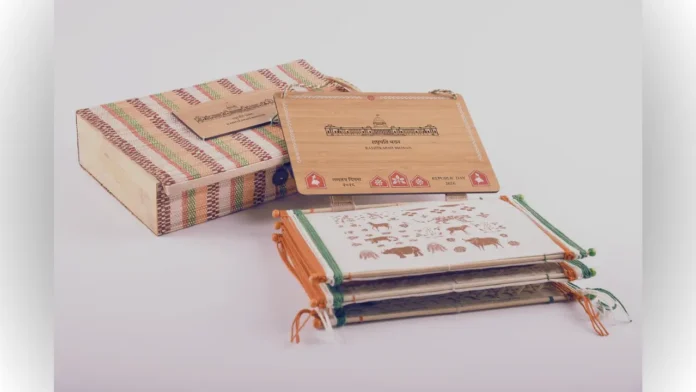
The President’s Republic Day ‘At Home’ invitation this year spotlights the skilled artisans of India’s North-eastern Ashtalakshmi states. Designed as a keepsake rather than a disposable card, the kit uses Eri silk, bamboo weave, handmade paper and region-specific crafts to present a living portrait of the region’s material culture. The project bridges state protocol and grassroots craft, giving public visibility to often-overlooked makers.
What the invite contains and why it matters
The invitation box combines practical objects and symbolic design. Guests receive a specially woven Eri silk stole, a smoked-bamboo ornament, a handmade paper tag, and an octagonal bamboo-woven wall scroll that displays selected craft forms from each state. The kit reflects both artistry and ecology. It foregrounds materials that sustain rural economies and carries specific local motifs so each state appears in its own voice. By doing so, the invitation turns a ceremonial gesture into cultural recognition.
The Ashtalakshmi states and their cultural markers
The Ashtalakshmi idea maps eight North-eastern states to forms of abundance. Each state contributes distinct craft and ecological symbols: Arunachal’s mon shugu paper; Assam’s Gogona and textile motifs; Manipur’s Longpi black pottery and Shirui Lily; Meghalaya’s smoked bamboo craft; Mizoram’s Puan Chei and orchids; Nagaland’s nettle weaving and wild rhea motifs; Sikkim’s woven nettle and embroidery; Tripura’s cane and bamboo jewellery and Nagkesar references. Together, these motifs tell a layered story of biodiversity, technique and regional identity.
Materials and techniques highlighted
Eri silk stands centre-stage as the welcome stole. Known as “peace silk”, it supports ethical sericulture and local livelihoods. Bamboo features across the kit — in the woven mat, the octagonal scroll, and the smoked ornament — emphasising a widely available, renewable resource and deep craft knowledge in the region. Handmade paper, split bamboo wefts, loin-loom references and local dye traditions complete the palette. Each technique reflects generations of embodied skill and low-tech sustainability.
Design intent and curation
Designers aimed to create a tactile story. They used colour, texture and form to evoke daily life, not only festival finery. The octagonal scroll echoes the portable loin-loom and can be displayed at home. Curators balanced authenticity with presentation so the invite could act as a lasting artefact that carries both function and meaning.
Cultural and diplomatic significance
First, the invite elevates marginalised craft communities on a national stage. Second, it reframes state hospitality as an act of cultural listening. Third, by choosing displayable objects, the gesture moves beyond optics to sustained visibility. In short, the invitation functions as soft cultural diplomacy — inside the country and in the public eye.
Economic and social impact for artisans
The invitation gives artisans immediate recognition. It can also produce longer-term benefits if linked to policy. For instance, such visibility can lead to demand for authorised replicas, curated craft lines, and tourism trails. Yet, without market linkages and fair pricing, a one-time gesture risks remaining symbolic. Therefore, follow-up actions will determine whether this moment translates into stable incomes.
Preservation challenges and practical needs
Many highlighted crafts face common pressures: dwindling raw-material access, ageing artisan populations, limited market access, and competition from mass-produced imitations. To keep these traditions alive, stakeholders must focus on skill transfer, supply-chain support, quality control, and climate-resilient sourcing of fibres and bamboo.
Recommended next steps (policy and practice)
• Map artisan clusters that produced pieces for the invite and register them for direct market links.
• Fund micro-enterprises for value addition (design, finishing, packaging).
• Support GI tagging where appropriate and fast-track trademarks for community brands.
• Create curated online stores and tie-ups with public institutions for recurring orders.
• Integrate craft trails into regional tourism circuits to diversify incomes.
• Invest in apprenticeships in local craft schools and connect students with NID-style design mentoring.
How citizens and organisations can help
Buy authentic products directly from artisan cooperatives. Promote responsible tourism that respects craft cycles. Partner with NGOs to fund raw-material banks and tool workshops. Finally, demand transparency from brands that claim “tribal” or “handmade” provenance.
This year’s ‘At Home’ invite turned a ceremonial card into a public platform for living traditions. It shows how small acts of protocol can amplify craft ecosystems. Yet, to make the gesture truly meaningful, visibility must become sustained support. When design, policy and markets work together, these crafts can thrive — and their makers will reap the lasting rewards of national recognition.

