


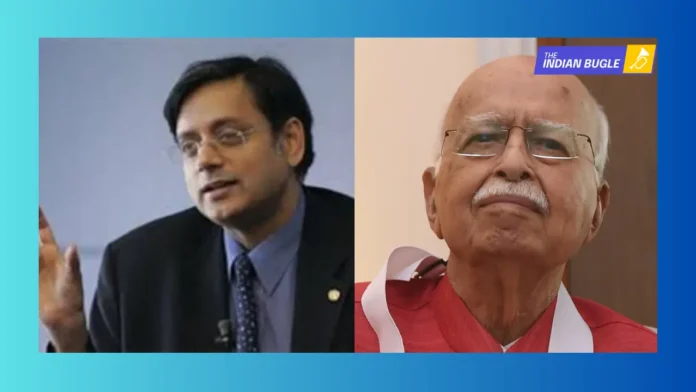
In a political moment that stirred nationwide discussion, Congress leader Shashi Tharoor extended warm birthday greetings to veteran BJP leader L. K. Advani, describing him as a statesman and visionary. The post quickly went viral, drawing both admiration and criticism. Soon after, the Indian National Congress (INC) formally distanced itself from Tharoor’s remarks, sparking a fresh debate about internal discipline, political courtesy, and legacy in Indian politics.
What Happened? The Sequence of Events
- Shashi Tharoor’s Birthday Post:
On November 8, 2025, Tharoor took to X (formerly Twitter) to wish L. K. Advani on his 98th birthday. He praised Advani for his “unwavering commitment to public service, modesty, and decency,” calling his life “exemplary.” The tone of his post reflected admiration for Advani’s contributions to public life, regardless of party lines. - Online Backlash and Political Reactions:
The post immediately drew sharp criticism from several Congress supporters and political commentators. Many argued that Advani’s legacy could not be separated from the 1990 Rath Yatra and the Babri Masjid demolition, events that marked one of the most divisive chapters in Indian political history. - Tharoor’s Defense:
Responding to the backlash, Tharoor defended his comments, saying that a leader’s entire career should not be reduced to a single episode, however controversial it may be. He added that, just as leaders like Nehru and Indira Gandhi had both achievements and failings, Advani’s long years of service deserved acknowledgment beyond one incident. - Congress Rebuttal:
The Congress party quickly issued a statement clarifying that Tharoor’s views were personal. Congress spokespersons said the party “outrightly dissociates itself from the remarks,” emphasizing that while the party encourages open debate, Tharoor’s comments do not represent the official position of the Indian National Congress.
Why This Matters – Key Angles
1. Party Discipline and Internal Messaging
The incident reflects the ongoing challenge within Congress to maintain unified messaging. When a senior leader publicly praises a prominent rival figure, it can be seen as conflicting with party ideology. Such statements force the leadership to clarify its stance to prevent misinterpretation among supporters and opponents alike.
2. Legacy and Historical Perspective
Tharoor’s remarks reignited discussions on how historical legacies are framed in Indian politics. His point — that no single event should define an entire career — raises broader questions about how political figures should be remembered. By comparing Advani’s legacy to that of Nehru and Indira Gandhi, Tharoor suggested that objectivity and fairness must guide historical assessment, not partisanship.
3. Cross-Party Courtesy and Optics
In an era of heightened polarization, Tharoor’s post can also be viewed as an attempt to revive a sense of civility across party lines. However, in doing so, it created uncomfortable optics for Congress. The BJP, meanwhile, welcomed the gesture, interpreting it as an acknowledgment of Advani’s contribution to Indian politics.
Key Talking Points
- Tharoor’s Choice of Words: His praise for Advani’s “decency and modesty” positioned the BJP veteran as a statesman, not just a partisan leader. This tone of respect across party boundaries, though uncommon, reflects Tharoor’s individual approach to political dialogue.
- Criticism Over Historical Context: Critics reminded that Advani’s role in the Rath Yatra and communal tensions of the 1990s cannot be overlooked. They argued that Tharoor’s comments glossed over the controversial aspects of Advani’s political journey.
- Congress’s Firm Stand: By publicly distancing itself from Tharoor’s statement, the Congress aimed to protect its ideological integrity and prevent mixed messaging, particularly in an election season when political narratives are under tight scrutiny.
- Tharoor’s Pattern of Independent Views: This is not the first time Tharoor has expressed opinions diverging from the party line. His earlier remarks on leadership, internal reform, and bipartisanship have often portrayed him as a maverick thinker within the Congress ecosystem.
Possible Implications
Legacy Discourse: The debate opens a larger conversation about how India remembers political figures — whether through a lens of balance or bias.
Internal Friction: The episode could intensify ongoing internal debates within Congress about leadership styles and freedom of expression.
Public Perception: Tharoor’s remarks may appeal to moderate and centrist voters who value bipartisanship but may also alienate the party’s traditional base.
Media and Opposition Spin: The BJP is likely to use the episode to highlight disunity within Congress, while political analysts will see it as a sign of ideological flux.
Conclusion
What began as a simple birthday wish evolved into a full-blown political debate about legacy, loyalty, and ideology. Shashi Tharoor’s tribute to L. K. Advani highlights the friction between individual expression and party discipline in Indian politics. While Congress moved quickly to reaffirm its ideological boundaries, Tharoor’s remarks have reignited discussion on the need for civility and balance in public discourse.
In an age of sharp political divisions, this episode stands as a reminder that even a message of courtesy can carry profound political weight — shaping not only how leaders are remembered but also how parties define themselves in the public eye.

