


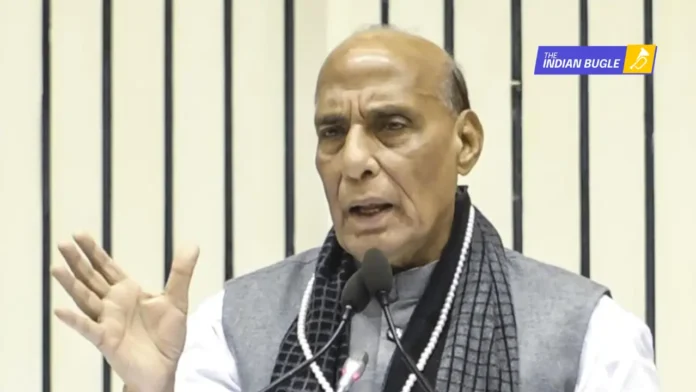
A single sentence can change the political temperature of South Asia — especially when it comes from India’s Defence Minister. Rajnath Singh’s recent remark, “borders can change… who knows, tomorrow Sindh may return to India again”, created a nationwide discussion and an international ripple effect.
While the statement was made during a cultural address to the Sindhi community, it touches upon deep historical memories, geopolitical realities, and India’s evolving national narrative.
This article unpacks the context, the history, the implications, and the potential consequences of this remark in a detailed yet easy-to-understand way.
1. The Civilisational Link Between Sindh and India
Sindhu River: The Origin of the Name “India”
- The term “India” itself is derived from the ancient word Sindhu (Indus River).
- Historically, Sindh was one of the earliest seats of the Indus Valley Civilization — Harappa, Mohenjo-Daro, and other ancient settlements flourished along this belt.
- The cultural identity of Sindh has been woven into Indian civilisational memory for thousands of years.
Pre-Partition Reality
- Before 1947, Sindh was fully part of undivided British India.
- Sindhi Hindus had a strong presence in trade, commerce, literature, and spirituality.
- Partition displaced lakhs of Sindhi families, many of whom resettled across India while retaining their cultural roots intact.
Symbolic Presence in Indian Consciousness
- India’s National Anthem includes “Punjab, Sindh, Gujarat, Maratha…”, symbolizing the historical emotional inclusion of Sindh in the Indian identity.
- Sindhis in India continue to uphold cultural traditions, food habits, language, and festivals that trace back to their ancestral homeland.
Rajnath Singh’s remark leans heavily on these civilisational connections.
2. What Rajnath Singh Actually Meant
During his address, Rajnath Singh expressed that:
- Civilisational belonging is beyond geographical borders.
- Borders are not eternal — they have changed in world history, and may change again.
- Sindh may one day return, not as a political demand, but as a symbolic reminder of shared heritage.
Key layers of the remark:
- It appeals to the emotional sentiments of the Sindhi community.
- It reinforces India’s view that culture is older and stronger than political cartography.
- The phrase “borders can change” gives the remark strategic overtones.
While not a policy declaration, it was certainly a statement with political weight.
3. The Legal and Geopolitical Reality
Current Status
- Sindh is a province of Pakistan under established international boundaries.
- Any border alteration requires international negotiation, formal agreements, or exceptional geopolitical circumstances.
Border Changes in Global History
Borders change for reasons such as:
- wars
- secession movements
- reunification efforts
- referendums
- diplomatic treaties
Rajnath Singh’s remark highlights the historical truth that borders have never been permanently frozen anywhere in the world.
India-Pakistan Dynamics
- The relationship has been strained for decades over issues like terrorism, Kashmir, and cross-border infiltration.
- India’s official stance today primarily focuses on Pakistan-occupied Kashmir (PoK), not Sindh.
- Mentioning Sindh introduces a new symbolic angle — and Pakistan is likely to view it as provocative.
4. Why Sindh Has Strong Emotional Significance in India
The Sindhi Community’s Loss
- Partition uprooted an entire community, forcing them to leave homeland, homes, temples, businesses, and culture.
- Many Sindhis still describe the loss of Sindh as an unhealed emotional wound.
Shared Cultural DNA
Both Indian and Pakistani Sindh share:
- cuisine (Sai Bhaji, Sindhi Kadhi)
- Sufi traditions
- traditions around the Indus
- folk music and poetry
- ancient temples and dargahs
- the Sindhi language
This deep cultural resonance is why Sindh often surfaces in India’s cultural and political dialogue.
5. Political Significance of the Remark
Timing and Context
The statement was made in a community gathering, suggesting:
- an attempt to honour Sindhi heritage
- acknowledgement of historical pain
- positioning the government as empathetic to displaced communities
Nationalist Dimension
- The statement appeals to civilisational nationalism.
- By linking culture and territory, it strengthens a narrative that India’s identity is far larger than its current borders.
No Policy Shift (As of Now)
There is no:
- official government document
- diplomatic move
- territorial claim
indicating an actual pursuit to reclaim Sindh.
It remains a symbolic statement.
6. How Pakistan Might Perceive the Remark
Pakistan is likely to:
- See it as a territorial provocation
- issue diplomatic protests or statements
- use it politically to rally public sentiment
- accuse India of reviving expansionist rhetoric
Given the sensitivity around PoK and the LoC, any mention of new territorial possibilities intensifies the geopolitical atmosphere.
7. Does This Mean Borders Will Change?
Not immediately, and not necessarily.
Rajnath Singh’s phrase suggests:
- borders change through history,
- and may change in the future,
- but he did not hint at military or diplomatic moves.
Instead, the remark serves more as:
- a cultural reassertion
- an emotional outreach
- a historical reminder
- a political message
- a subtle strategic signalling
Rajnath Singh’s statement — “borders can change… Sindh may return to India” — taps into a layered mix of history, culture, identity, and politics. While not a concrete policy shift, it is a powerful reminder of how civilisational memories extend beyond modern maps.
For India, Sindh is not just a geographical region; it is a symbol of shared heritage, ancient civilisation, and emotional continuity. For Pakistan, the remark may spark political and diplomatic concerns.
At the heart of the statement is a larger truth: borders may define nations, but history defines people.

