


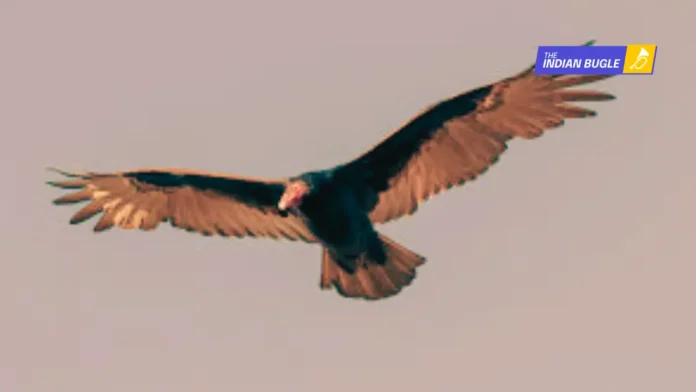
In the quiet forests near Vidisha, Madhya Pradesh, a remarkable story has taken shape — a story of survival, strength, and the breathtaking instinct of migration. It belongs to Marich, a Eurasian Griffon Vulture who, despite being rescued as a weak and injured bird, went on to complete an unbelievable 15,000-kilometre transcontinental journey.
This is not just the tale of one bird.
It is the story of nature’s resilience, the power of instinct, and the magic that unfolds when humans and wildlife work together.
The Beginning: A Rescue That Saved a Life
In early 2025, villagers near the Satna–Vidisha belt found a large vulture struggling to fly. Exhausted, dehydrated, and injured, it was close to collapse. Forest officials immediately intervened and transported it to a rehabilitation centre.
There, over several weeks:
- Its wounds were treated
- Its strength slowly returned
- And it was nourished back to health
The bird began regaining its confidence. Within two months, its massive wings — nearly three metres across — were ready to rise again.
Before releasing it, experts fitted a satellite radio collar to track its movements, hoping to understand its natural migration behaviour.
They named it Marich.
On 29 March 2025, Marich soared back into the skies from Halali Dam, Vidisha.
No one imagined what would happen next.
The Flight: Across Mountains, Deserts, and Countries
Once released, Marich wasted no time. As if remembering ancient migratory pathways etched in its DNA, it flew northwards. Its journey unfolded like a nature documentary:
Through India → Pakistan → Afghanistan
Marich’s path took it over arid plains, rugged mountains, and old caravan routes. It crossed borders without hesitation, following thermal currents and wind patterns that vultures have mastered for millions of years.
Across Uzbekistan
Here, it paused in vast open landscapes — feeding, resting, and gathering strength.
Into the grasslands of Kazakhstan
Finally, it reached the cold, expansive steppes of Kazakhstan — classic summer territory for migratory Griffon Vultures.
It spent the warmer months here, feeding on wild ungulate carcasses and soaring over valleys rich with rising thermals.
For wildlife researchers, this was a treasure:
Proof that Indian-released vultures could successfully navigate ancient Eurasian flyways.
The Return: Homeward Across Continents
As temperatures dropped in Central Asia, Marich began its homeward journey.
By early October 2025, it crossed back into India — this time entering through Rajasthan.
Soon after, it was sighted near Dholpur’s forests, slowly gliding southward, towards Madhya Pradesh.
Marich had officially completed an epic loop of over 15,000 km — a triumphant circle from India → Central Asia → back to India.
Why This Journey Matters
Marich’s flight is more than an impressive statistic. It holds deep ecological meaning:
1. A Symbol of Nature’s Resilience
Despite being injured and near death, the vulture returned to full wild behaviour — a message of hope for endangered species.
2. A Window Into Ancient Migration Routes
Its path shows how vultures move across continents, helping scientists map crucial migratory corridors.
3. Proof That Conservation Works
From rescue to rehabilitation to tracking, Marich demonstrates how human care can give wildlife a second chance.
4. A Reminder of the Vulture’s Role
Vultures are nature’s sanitation workers — cleaning carcasses, preventing disease outbreaks, and keeping ecosystems healthy.
5. A Call for International Collaboration
Migratory birds cross borders freely, but threats don’t. Protecting them requires cooperation across countries.
Who Is the Eurasian Griffon Vulture?
Majestic and powerful, these vultures are built for travel:
- Wingspan: Up to 2.8 metres
- Flight style: Soaring on thermals for hours
- Diet: Carcasses of large animals
- Habitat: Mountainous and open landscapes
- Migration: Thousands of kilometres each year
They are not predators — they are recyclers, healers of the wild.
A Story That Inspires
Marich’s journey has captured the hearts of nature lovers everywhere.
It reminds us that:
- Wildlife isn’t fragile — it is resilient
- Every rescue matters
- And sometimes, even the smallest act of care can lead to a miracle thousands of kilometres away
In a world full of climate anxiety and species decline, Marich is a ray of hope — soaring high, stitching continents with its wings, and proving that the wild still has wonders left to show us.

