


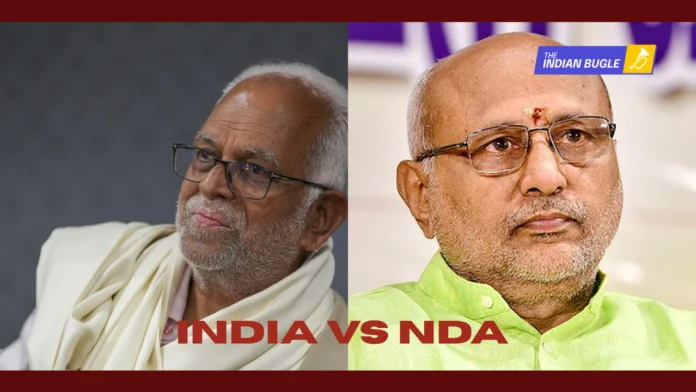
The stage is set for the Vice Presidential Election 2025, scheduled for Tuesday. The BJP-led National Democratic Alliance (NDA) appears to have the upper hand with its candidate, Maharashtra Governor CP Radhakrishnan, but the margin of victory may not be as sweeping as it was in 2022 when Jagdeep Dhankhar secured nearly 75% of the votes.
BJP’s Strength in Numbers
Currently, 239 Rajya Sabha members and 542 Lok Sabha members are eligible to vote, totaling 781. With the Biju Janata Dal (BJD) and the Bharat Rashtra Samithi (BRS) deciding to abstain, the effective voting number is expected to drop to 770. The majority mark, therefore, stands at 386 votes.
On paper, the NDA already has 425 MPs, ensuring a safe majority. Adding support from Jagan Reddy’s YSR Congress (11 MPs), the ruling coalition could touch 436 votes or more.
Even without the support of BJD and BRS, the BJP camp remains confident. Independent MPs, Akali Dal, and Zoram People’s Movement (ZPM) MPs may further boost their tally. At maximum strength, Radhakrishnan could secure around 458 votes, still well above the majority mark but fewer than Dhankhar’s 528 in 2022.
Why BJD and BRS Are Staying Away
The BJD, led by former Odisha CM Naveen Patnaik, was initially expected to back the NDA but reportedly pulled out after political rivalry intensified following last year’s Assembly polls.
Meanwhile, the BRS faces internal turmoil, including the resignation of K Kavitha, daughter of party chief K. Chandrashekar Rao, and is balancing its position ahead of the Jubilee Hills Assembly bypoll, where minority votes are crucial.
Opposition’s INDIA Bloc Strategy
The Congress-led INDIA bloc has fielded retired Supreme Court judge B. Sudershan Reddy as its candidate. With 324 votes on paper, the bloc has significantly more MPs than in 2022 but still falls short of the winning mark.
Even in the best-case scenario—gaining support from BJD, BRS, independents, and Swati Maliwal—the bloc would still trail by at least 70 votes. Sources indicate the INDIA bloc entered the fray mainly to demonstrate its growing strength compared to 2022 and to build momentum ahead of crucial Assembly elections in Bihar, Bengal, and Tamil Nadu.
Cross-Voting and Twists Ahead
Cross-voting has been a common feature of past elections. In 2022, Dhankhar’s historic win was aided by votes from the YSR Congress and the BJD. This year too, NDA sources claim they expect at least 150 cross-votes from the Rajya Sabha alone, further strengthening their candidate’s chances.
Adding intrigue is the presence of Swati Maliwal, an AAP MP whose ties with her party soured after she accused an aide of Arvind Kejriwal of misconduct. Her stance in the election remains a point of speculation.
Election Process Explained
The Vice President is elected by Members of Parliament (MPs) through a secret ballot under the supervision of the Election Commission. Each candidate must have at least 20 proposers and 20 seconders to file a valid nomination, along with a deposit of ₹15,000.
The voting system follows a preferential ballot method. If no candidate crosses the majority mark on first preference votes, the candidate with the fewest votes is eliminated, and their votes are transferred to the next preference. This continues until one candidate secures the required majority.
While the INDIA bloc’s participation highlights a stronger opposition than in 2022, the NDA’s majority ensures CP Radhakrishnan’s victory is almost certain. The only open question is by how much he wins—whether it will be a sweeping mandate like Dhankhar’s or a narrower but still decisive victory.

