


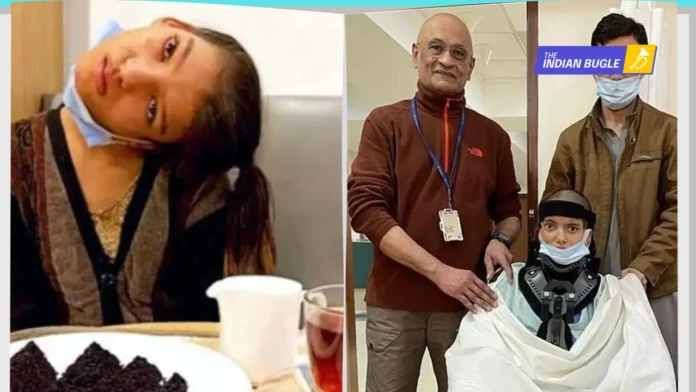
Afsheen Gul, a young girl from Mithi in Pakistan’s Sindh province, became the face of resilience after her story spread across South Asia. For more than a decade, she lived with an extremely rare and debilitating medical condition that bent her neck at a 90-degree angle. Her struggle touched millions, and her eventual recovery in India became a powerful example of how humanity rises above borders, politics, and differences.
Her story is not just medical—it is emotional, inspiring, and deeply symbolic.
Early Life and a Rare Condition
Afsheen was the youngest of seven siblings. When she was a baby, she suffered a fall that severely affected her neck. Over time, her condition deteriorated into atlanto-axial rotatory dislocation (AARD)—a rare spinal disorder where the head becomes locked in a twisted position.
Combined with cerebral palsy, the condition limited her speech, mobility, and growth. She was unable to attend school, engage in daily activities, or even lift her head to look forward. For more than 12 years, she lived in constant discomfort.
Her family, with limited financial resources, tried to seek medical help in Pakistan, but the complexity of the condition made treatment difficult.
The Turning Point: Help Arrives
Afsheen’s story gained attention from journalists and social media, creating international concern. Kind-hearted individuals stepped forward to raise awareness and funds for her treatment. Her case eventually reached the attention of one of India’s leading spine specialists, Dr. Rajagopalan Krishnan, a senior surgeon known for handling extremely complex spinal deformities.
Dr. Krishnan reviewed her medical condition and agreed to treat her—not for money, but out of compassion. His decision demonstrated the true spirit of medical ethics: a patient’s life matters more than nationality, politics, or borders.
Treatment in India: A Life-Changing Surgery
Afsheen travelled to New Delhi for treatment, accompanied by her family. After initial evaluations and stabilisation procedures, Dr. Krishnan performed a major reconstructive surgery to realign and support her cervical spine.
The surgery lasted several hours and required immense precision. Afsheen’s neck was gradually realigned, stabilised, and corrected to a near-normal position.
Her progress after surgery was remarkable. She could finally:
- Hold her head upright
- Eat and speak more comfortably
- Interact visually with people around her
- Move with less strain
For the first time in years, she experienced what it felt like to live without her head bent to one side.
About Dr. Rajagopalan Krishnan
Dr. Krishnan is a globally respected spinal surgeon known for:
- Treating complex deformities
- Performing high-risk corrective surgeries
- His humanitarian approach
- Experience across India and the UK
He leads one of India’s top spinal care departments and is known for accepting challenging cases that others often deem impossible.
In Afsheen’s case, he did not just perform a surgery—he restored dignity, mobility, and hope.
Humanity Beyond Borders: India–Pakistan Relations
Afsheen’s journey came at a time when India and Pakistan often face political tension. Yet, her story showed that humanity has no borders.
A Pakistani family found hope in India.
An Indian doctor treated a Pakistani child as his own.
People from both countries prayed for her recovery.
Her case demonstrated that compassion can bridge the deepest divides. The relationship between the two nations may be complicated, but acts like this remind the world that kindness speaks a universal language.
A New Beginning for Afsheen
After surgery and continuous rehabilitation, Afsheen’s quality of life improved significantly. She began to experience everyday joys—sitting upright, eating independently, observing her surroundings, and interacting socially.
Her family expressed heartfelt gratitude, calling the Indian medical team “a blessing that gave Afsheen a second life.”
Why Afsheen’s Story Matters
Afsheen’s journey highlights:
- The importance of early medical intervention
- The need for awareness about rare conditions
- The challenges faced by families with limited healthcare access
- The power of compassion and cross-border medical collaboration
Above all, it is a reminder that even in a divided world, humanity remains the greatest healer.
Conclusion
Afsheen Gul is more than a patient; she is a symbol of resilience and hope. Her story shows how courage, medical excellence, and human compassion can transform lives. She crossed a national border not as a citizen of a rival country but as a young girl in need, and India responded with open arms.
Her life today stands as proof that kindness is stronger than politics and that when humanity leads the way, miracles happen.

