


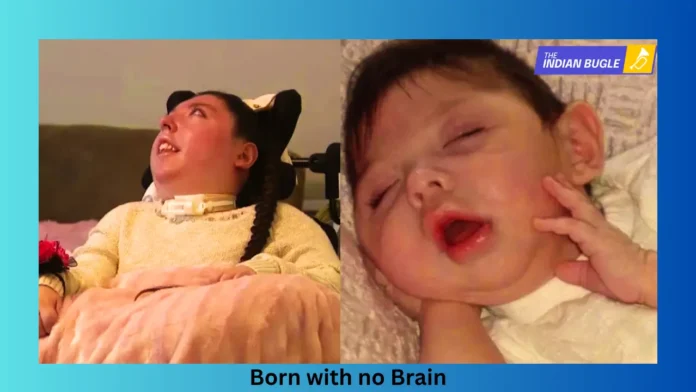
- A miraculous milestone: Alex Simpson, a young woman from Omaha, Nebraska, has defied all medical expectations by celebrating her 20th birthday.
- A rare condition: She was born with hydranencephaly, a disorder where most of the brain’s hemispheres are missing and replaced by fluid.
- Doctors’ prediction: Medical experts had told her family that she was unlikely to live past four years, but Alex continues to thrive.
- A story of love and resilience: Her family credits faith, emotional strength, and consistent care for her remarkable survival.
An Extraordinary Survival Story
When Alex was born, her parents were told that their baby girl would not live long. Doctors diagnosed her with hydranencephaly, a condition so severe that most infants do not survive beyond infancy.
Yet, two decades later, Alex continues to defy the odds. She recently celebrated her 20th birthday, surrounded by her family and caregivers who describe her as a “fighter with a heart full of joy.”
Despite being unable to see or hear, Alex recognizes voices, responds to emotions, and brings an unexplainable sense of happiness to everyone around her. Her story has captured hearts across the United States, symbolizing the power of hope, love, and medical dedication.
What Is Hydranencephaly?
Hydranencephaly is a rare congenital brain disorder where large portions of the brain’s cerebral hemispheres are absent and replaced with cerebrospinal fluid.
While such individuals lack much of the brain tissue responsible for thinking, perception, and voluntary movement, the brainstem — which controls vital functions like breathing and heartbeat — remains intact. This allows for survival in some cases, though with significant challenges.
Key facts about hydranencephaly:
- It occurs during fetal development, often due to disrupted blood flow to the brain.
- It is extremely rare, with very few documented cases worldwide.
- Children with the condition typically have severe developmental and physical disabilities.
- Most do not survive beyond early childhood — making Alex’s case incredibly rare and inspiring.
Why Doctors Call Alex’s Survival a Medical Miracle
Medical experts often refer to Alex’s case as a “miracle of medical endurance and family care.”
Most children diagnosed with hydranencephaly are not expected to live beyond infancy, but a few exceptional cases — like Alex — show that with the right medical attention, consistent care, and emotional support, long-term survival is possible.
Reaching the age of 20 is an unprecedented milestone for a person born with such a condition. Her journey challenges traditional medical assumptions and gives hope to other families facing rare neurological diagnoses.
Life With Hydranencephaly: A Family’s Commitment
Alex’s family describes her as “deeply perceptive,” even though she cannot see or hear. She communicates through expressions, movements, and reactions to familiar voices.
Her parents and younger brother have built their lives around her care — ensuring she receives proper nutrition, physical therapy, and emotional engagement every day.
They say that what keeps her strong is love and human connection. “She knows when you’re happy, and she knows when you’re sad. Her presence makes everyone around her better,” says her mother.
The Science Behind “Born With No Brain”
The viral phrase “born with no brain” is often used in the media to describe such cases, but it’s not literally true.
In hydranencephaly, while the outer portions of the brain are missing, the brainstem and parts of the midbrain usually remain. These areas are crucial for survival functions — breathing, sleeping, swallowing, and maintaining heart rate.
This distinction explains how individuals like Alex can survive, sometimes for years or even decades, despite the absence of the higher brain structures responsible for conscious thought and voluntary actions.
The Emotional and Medical Challenges
Caring for someone with hydranencephaly is physically and emotionally demanding.
Families like the Simpsons face daily challenges such as:
- Managing seizures and muscle stiffness.
- Ensuring proper nutrition, often through feeding tubes.
- Preventing respiratory complications through constant monitoring.
- Providing round-the-clock emotional and physical care.
Despite these difficulties, Alex’s family remains steadfast in their mission to give her the best life possible — proving that love and dedication can sometimes achieve what medicine alone cannot.
Why This Story Matters
Alex’s story has gone viral not only because of its medical rarity but also because it represents the extraordinary resilience of the human spirit.
Her life challenges our understanding of the brain, life expectancy, and human capability. It also opens discussions about how society perceives disability and quality of life.
Alex has become a symbol of hope for parents around the world who are caring for children with rare genetic or neurological conditions. Her story shows that every life, no matter how medically complex, holds immense meaning.
Important Clarification: Hydranencephaly vs. Anencephaly
While both conditions affect brain development, they are not the same:
- Hydranencephaly: Parts of the brain are missing and replaced with fluid, but vital brainstem functions remain.
- Anencephaly: The brain and skull fail to develop properly, and survival beyond a few hours or days is nearly impossible.
Alex’s condition falls under hydranencephaly, which explains her ability to survive long-term.
Alex’s Legacy and the Lesson Her Life Teaches
Alex Simpson’s life is a testament to perseverance, faith, and the miracles of modern medicine. Her journey reminds the world that even when science predicts impossibility, the human will to live can rewrite fate.
As she celebrates her 20th birthday, her story continues to inspire families, medical professionals, and people who believe in miracles.
Her parents say they are not focused on the years that have passed — but on the love, laughter, and memories they continue to share each day.
Conclusion
Alex Simpson’s journey from a fragile infant to a 20-year-old woman living with hydranencephaly is nothing short of extraordinary.
She continues to prove that life is not defined by limitations but by love, care, and faith. Her story serves as an inspiration not only for families battling medical uncertainty but also for everyone who believes in the miracles hidden in the human heart.
For more inspiring human stories and global health news, visit theindianbugle.com

