


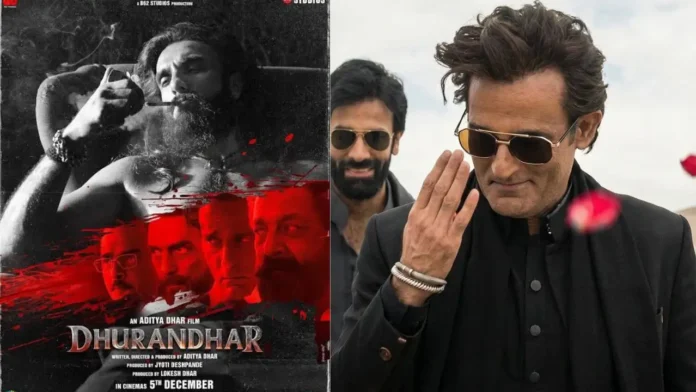
The blockbuster “Dhundhar” has become the most talked-about Bollywood film of the season. Not just for its thrilling storyline, not just for its explosive box-office run, but also because it has been banned across Pakistan and six major Gulf countries.
And yet—here’s the twist—Pakistanis themselves are praising the film, stunned by how realistically their own streets, stories, and shades of Karachi have been recreated on screen.
This mix of controversy, applause, and political tension has turned Dhundhar into one of the most dramatic off-screen sagas of 2025.
Let’s dive into why the film got banned, what Pakistanis are saying, and how the movie’s creators unintentionally started a cross-border debate.
What Is Dhundhar About?
Directed by Aditya Dhar, known for Uri: The Surgical Strike, the film is a spy thriller set in Pakistan, following the mysterious Hamza Ali Mazari (played by Ranveer Singh), who infiltrates the dangerous Lyari underworld led by the ruthless Rehman Dakaait (Akshaye Khanna).
With a star-studded cast featuring Sanjay Dutt, Arjun Rampal, R. Madhavan, and Sara Arjun, the film blends:
- high-voltage action,
- deep political undertones,
- and a gritty recreation of Karachi’s most complex neighborhoods.
Why Dhundhar Was Banned in Pakistan
Pakistan’s censor board refused certification for the movie because:
1. “Anti-Pakistan” Narrative
Authorities believed that the film’s portrayal of extremism, crime networks, and cross-border operations indirectly painted Pakistan in a negative light.
2. Political Sensitivity
Some scenes were interpreted as subtle digs at Pakistan’s internal security issues—something the censor board is extremely cautious about.
3. Strict Content Rules
Anything that may disrupt:
- national sentiment,
- public morale,
- religious harmony, or
- political stability
is immediately blocked from release.
Given the film’s bold themes, Dhundhar didn’t stand a chance.
Why Gulf Countries Also Banned It
The film has been blocked in Bahrain, Kuwait, Oman, Qatar, Saudi Arabia, and the UAE.
Authorities in these countries reportedly objected to:
- the perceived anti-Pakistan content,
- geopolitical references, and
- scenes that might provoke political discussion in the region.
For Hindi cinema, the Gulf is a major market—but Dhundhar joins the list of films denied release due to “regional sensitivities.”
But Here’s the Plot Twist… Pakistanis Are Praising the Film!
Despite the ban, Pakistanis who managed to watch clips or get access to the film are shocked—in a good way.
Why? Because Bollywood has never recreated Karachi with such stunning accuracy.
Karachi-based tax lawyer and writer Sadiq Suleman, speaking to Bollywood Hungama, said:
“I expected the usual Bollywood exaggeration, but I was stunned. The way Karachi is shown… it felt real. I showed some scenes to my parents—they lived in Meethadar and Kharadar in the 60s—and even they were amazed. The Lyari recreated in the film looks exactly like the real thing.”
He added high praise for the creative team:
“Director Aditya Dhar and his research team deserve huge credit. The attention to detail—tiny Karachi nuances, the vibe of old town, the lanes of Lyari—it’s pure perfection.
Akshaye Khanna as Rehman Dakait is fierce, and Sanjay Dutt as Chaudhry Aslam feels spot-on. I met the real Aslam Saab once back in 2010, and this performance matches that aura.”
Surprisingly, the region that banned the movie is the SAME region praising its realism!
Where Was Dhundhar Actually Shot?
Here’s the shocking reveal:
Although the movie looks like it’s been filmed in the heart of Karachi, the Lyari shown in the movie was actually shot in Kheda village, Ludhiana (Punjab).
Yes—the film fooled even Karachi locals!
That’s the level of detailing Aditya Dhar’s team achieved.
Dhundhar Row: Critics Under Fire
The film didn’t escape controversy in India either.
The Film Critics Guild issued a strong statement saying their members were being targeted for giving mixed reviews. They reported:
“What began as disagreement has turned into organized abuse, threats, and attempts to sabotage professional reviews. Some critics are being intimidated for simply sharing their assessment.”
The Dhundhar review war is raging almost as fiercely as the film’s action sequences.
Dhundhar Box Office: A Monster Hit
Despite bans and controversies, the film is unstoppable.
- ₹200 crore+ in India
- ₹274.25 crore worldwide
- ₹58 crore overseas
With a runtime of 214 minutes (3 hours 34 minutes), it’s one of the longest big-ticket Bollywood films in recent years—and still drawing full houses.
So Why Is Dhundhar Really Banned?
The short answer:
Geopolitics, creative boldness, and a story that hits too close to home.
The film’s fictional narrative mirrors real-world tensions, and while audiences love the thrill, governments prefer caution.
India–Pakistan: Politics Aside, Humanity Wins
Interestingly, while authorities banned the movie, many Pakistanis are openly appreciating India’s filmmaking brilliance.
This shows that even when political lines divide nations, art finds a way to connect people.
Cinema continues to remind us that what governments debate, people often embrace—with curiosity, emotion, and open hearts.
Final Verdict
Dhundhar may be banned in Pakistan and the Gulf, but the controversy has only fueled its popularity.
Its impeccable storytelling, realistic world-building, and electric performances are turning it into a cultural moment far bigger than the ban itself.
One thing is clear:

