


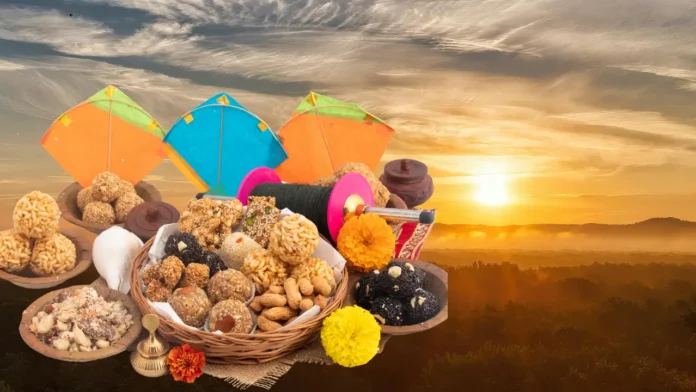
Makar Sankranti is a solar festival. Therefore, its timing ties to the Sun’s position, not the Moon’s. This single fact explains why the date hardly changes from year to year. This article breaks the mechanics down. It stays simple, accurate, and human.
Solar vs lunar calendars — the key difference
A lunar calendar follows the Moon. Lunar months are about 29.5 days. A lunar year is ~354 days. A solar calendar follows the Sun. A solar year is ~365.24 days. Most Hindu festivals follow lunar dates, so they shift each year. Makar Sankranti follows the solar cycle, so it stays nearly fixed.
What astronomically defines Makar Sankranti
Makar Sankranti marks the Sun’s entry into the zodiac sign Capricorn (Makara). In observable terms, it is the Sun crossing the ecliptic longitude of 270°. This is a geometric, repeatable event. The Sun completes the cycle once every ~365.24 days. Hence, the festival falls on almost the same Gregorian date annually.
Why is it usually January 14
Because the tropical/solar year and the calendar keep the Sun’s entry into Capricorn close to mid-January in the Gregorian calendar, the observance lands on January 14 in most years. Calendar conventions in India historically aligned the festival with this solar transition, so the date became culturally fixed around January 14.
Why do some years show Jan 15 instead
Two small factors cause occasional one-day shifts. First, the extra ~0.24 days per year accumulate and are corrected by leap years in the Gregorian system. Second, slow astronomical changes such as axial precession slightly shift zodiacal longitudes over centuries. Combined, these effects sometimes nudge the observed date to January 15.
Precession and long-term drift
Earth’s axial precession alters where constellations lie along the ecliptic over thousands of years. Traditional sidereal (star-based) zodiacs used in some Indian calendars differ from tropical zodiacs used in Western astronomy. As a result, over long periods, the exact recorded moment of the Sun’s entry into “Makara” can drift relative to Gregorian dates unless calendars are adjusted periodically.
Calendar systems and regional practices
India uses multiple calendar reckonings: solar, lunisolar, and region-specific variants. Many regional calendars already treat Makar Sankranti as a solar marker, so local observance remains consistent. However, the astronomical reference (sidereal vs. tropical) used in a calendar affects long-term alignment and can produce small regional differences.
Cultural consequences of being solar-based
Because it is nearly fixed, Makar Sankranti acts as a predictable seasonal marker. Farmers, markets, and social rituals plan around it. The fixed timing makes it a public festival calendar anchor, unlike shifting lunar festivals that move across seasons.
Practical summary — three simple points
- It’s solar: linked to the Sun entering Capricorn.
- The Sun’s motion is steady, so the date stays nearly constant.
- Small corrections (leap years, precession, calendar differences) sometimes shift it by a day.
Makar Sankranti is almost fixed because it tracks the Sun’s predictable crossing into Capricorn, not the Moon’s changing phases.
The festival’s steadiness is both astronomical and cultural. The Sun’s regular path gives a reliable seasonal marker. Meanwhile, human calendars and tiny astronomical wobbles explain the rare one-day changes. So when you celebrate on January 14, you are following a solar rhythm that has guided communities for centuries.

: the solar basis, calendar mechanics, small astronomical shifts, and cultural impact — explained simply and precisely.)