


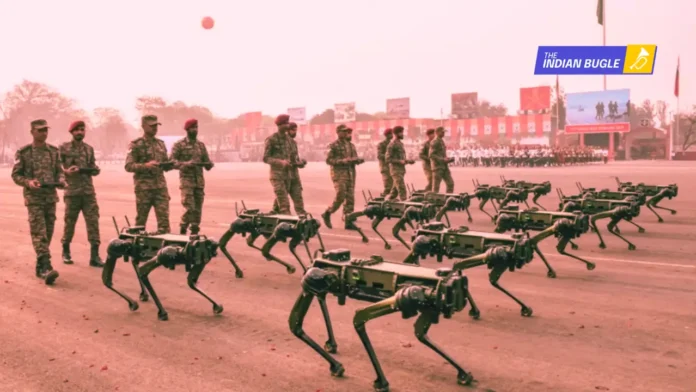
The Indian Army has inducted robotic MULEs to support troops in harsh and remote areas. These four-legged robots carry loads, scout ahead and relay sensor data. They operate where vehicles struggle. Their induction marks a practical move toward robotics in defence.
What is a Robotic MULE?
A Robotic MULE is a quadruped support robot. It acts like an automated pack animal. It combines mobility, sensors and modular payload options. It navigates rough slopes, narrow tracks and debris. It carries supplies and performs reconnaissance tasks.
Key specifications and features
The robots are all-terrain and weather-hardened. They work in extreme temperatures and high altitudes. They carry tactical loads suitable for patrols and posts. They include cameras, infrared sensors and communication links. They can be configured for logistics, surveillance or specialized tasks. They operate semi-autonomously with remote control options.
Why the Army needs them
First, they reduce soldier fatigue by carrying supplies in difficult terrain. Second, they lower risk by scouting ahead of foot patrols. Third, they provide persistent surveillance where human presence is costly. Fourth, they speed up resupply in forward posts and during relief operations.
Deployment and roles
The Army deployed units in forward sectors and high-altitude areas. Commanders use them to supply remote outposts and to patrol difficult approaches. They assist night operations through thermal sensing. They also support disaster relief by moving equipment through rubble or unstable ground. Units operate them as team assets controlled by small detachments.
Operational advantages
Robotic MULEs extend the reach of patrols without increasing human exposure. They maintain a steady pace on hard trails and steep gradients. They collect live imagery and send it to command posts. They can free up soldiers for mission-critical tasks. They also serve as force multipliers during sustained border deployments.
Limitations and challenges
Power remains a core constraint. Batteries limit endurance in cold zones. Communication links can degrade in remote valleys. Autonomy can struggle with novel obstacles. Maintenance needs trained staff and spare parts. Weather and snow can increase wear and tear. Integration with existing doctrine requires training and SOPs.
Technical improvements needed
Firstly, extend battery life and enable hot-swap power systems. Secondly, improve autonomy for complex, unstructured terrain. Thirdly, harden comms with mesh networking and satellite fallback. Fourthly, design modular payloads for specific mission kits. Fifthly, simplify field maintenance and diagnostics.
Training and doctrine
Units must learn to operate, maintain and employ these robots tactically. Training should cover remote control, waypoint navigation and emergency recovery. Doctrine must define rules of engagement for autonomous sensors. SOPs should cover lost-link procedures and casualty evacuation support roles.
Ethical, legal and safety considerations
Robotic MULEs must follow clear use policies. They are support platforms, not weapons. Commanders must ensure data privacy for civilians. Robust logging will help audits and incident tracing. Safety checks must precede every mission.
Case uses and real incidents
In border sectors, the robots carried ammo, rations and medical kits to remote posts. They scouted approaches and reported movement to observation posts. In relief scenarios, they traversed debris fields to deliver vital equipment. These field uses demonstrated utility and highlighted areas for refinement.
Cost and sustainment
The upfront cost is significant, but savings appear in reduced manpower strain and faster logistics cycles. Sustainment costs include batteries, spares and training. Long-term planning must budget for upgrades and lifecycle replacement.
Strategic impact
Robotic MULEs signal a shift toward force modernisation. They combine robotics, sensors and battlefield logistics. They let the Army operate more effectively in terrain that favors mobility and endurance. They also open pathways for integrating AI and unmanned systems across services.
Recommendations
First, scale deployments gradually while collecting operational feedback. Second, prioritise battery research and resilient comms. Third, set up regional maintenance hubs and train dedicated technicians. Fourth, draft doctrine covering employment, safety and data use. Fifth, encourage industry-military collaboration for modular payloads.
Conclusion
The induction of robotic MULEs marks a practical leap for the Indian Army. These robots solve real problems in logistics and surveillance. However, they need better power, tougher comms and focused doctrine to reach full potential. With steady improvements, they will become a routine force multiplier in India’s difficult terrain.

