


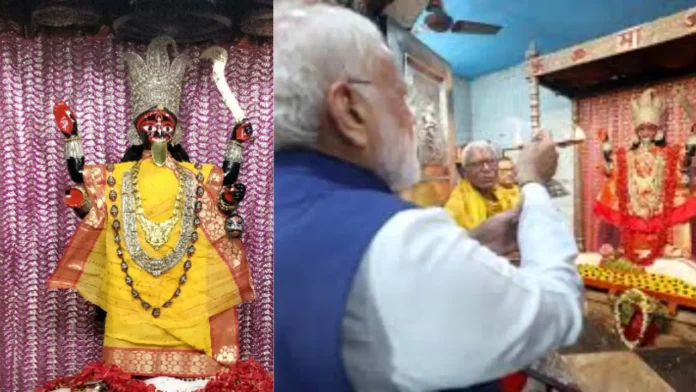
Tucked along the bustling Bidhan Sarani, this ancient tantric temple — where Ramakrishna Paramahansa once sang hymns and PM Modi recently sought blessings — is one of Kolkata’s most spiritually charged addresses. Here is why you must visit.
There are temples you visit as a tourist. And then some temples visit you — that get under your skin, linger in your memory long after you have left, and call you back without warning. Thanthania Kalibari, tucked along the busy stretch of Bidhan Sarani in North Kolkata, belongs unmistakably to the second category.
From the street, it does not announce itself with grandeur. The structure sits modestly above the main road, its tiled outer walls catching the morning light, the name of the temple embossed in metal since 2018. But step past the threshold, cross the courtyard with its ancient harikath — the sacrificial altar — and something changes. The city noise dims. The air thickens with incense. And the weight of three centuries settles gently on your shoulders.
A temple older than the city itself
Kolkata was formally established by the British East India Company in 1690. Thanthania Kalibari predates it. Founded in 1703 by a tantric practitioner named Uday Narayan Brahmachari, the temple began as an act of pure devotion — built on a shmashana (cremation ground), with mud walls and a palm-leaf roof, its presiding deity Maa Siddheshwari moulded from clay by Brahmachari’s own hands. That the temple stands today, more than 320 years later, is itself a kind of miracle.
The temple was rebuilt and re-established in 1806 by a businessman named Shankar Ghosh, who also constructed the Pushpeswar Shiv Mandir — an elegant “ath-chala” style Shiva temple — within the same complex. Ghosh’s descendants have served as sevayets (hereditary priests) of the temple ever since, maintaining a living link to that early 19th century restoration that most of Kolkata has long forgotten.
“Shankarer hridoy majhe, Kali biraje” — Maa Kali resides within the heart of Shankar.— Engraved on the walls of Thanthania Kalibari, spoken by Ramakrishna Paramahansa
The Ramakrishna connection
If Thanthania Kalibari has one story that elevates it above all others, it is this: Ramakrishna Paramahansa — the 19th-century mystic whose teachings shaped Swami Vivekananda and whose influence on Bengali spirituality is incalculable — was a regular visitor here. When he stayed at Jhamapukur Lane nearby in 1853, he would come to this temple often, singing devotional hymns to Maa Siddheshwari. The young Gadadhar, as he was then known, would sit before the deity and lose himself in song.
His words from those visits are literally written on the walls — the famous bani engraved in stone that devotees read as they enter the inner sanctum. Shankar Ghosh’s grandson, Swami Subodhananda, went on to become a direct disciple of Ramakrishna himself, making the family’s connection to the saint not merely historical but deeply personal.
Even later in his life, when Ramakrishna fell ill and was convalescing at Shyamapukur, his followers came to Thanthania Kalibari to pray for his recovery — and it was during this visit that the unusual ritual of offering non-vegetarian prasad to the deity was first established, a tradition the temple maintains to this day.
What makes this temple unlike any other
Thanthania Kalibari is a tantric temple, and it follows tantric traditions that most modern temples have long abandoned. Animal sacrifice continues on all amavasya (no-moon) nights and during Kali Puja. Non-vegetarian prasad — most famously dab-chingri (tender coconut and prawn) — is offered to the deity throughout the year, with vegetarian prasad served only on the two most sacred Kali Puja nights.
Inside the complex are two temples: the main shrine of Maa Siddheshwari Kali, and the Shiva temple built by Shankar Ghosh. Two marble tablets on the wall of the main temple carry inscriptions — one bearing the temple’s name, and one bearing Ramakrishna’s famous bani. The idol itself is reconstructed every year, painted in red and black, and is considered Jagrat — living and awake.
Established 1703 AD
Presiding Deity Maa Siddheshwari (Kali)
Temple Type Tantric
Morning Hours 6:00 AM – 11:00 AM
Evening Hours 3:00 PM – 8:00 PM
Open All 7 days
The curious legend of the name
Ask a local about the name “Thanthania,” and you will likely hear the story of the bell. According to legend, the area was once a dense forest, prowled by dacoits. To warn the neighbourhood when a raid was imminent, a bell was hung — and its “than, than, than” clanging became the community’s alarm system. The area around it came to be known as Thanthania, and the temple took its name from the sound that once meant danger but now signals devotion.
Best time to visit
The temple is open seven days a week and receives devotees year-round. However, certain days carry a special energy. Tuesdays and Saturdays are considered the most auspicious days and draw the largest crowds of local worshippers. Amavasya nights — especially the grand Kali Puja that falls on Diwali’s eve — transform the temple into one of the most electrifying spiritual experiences Kolkata has to offer.
Kali Puja (Diwali eve), Phalaharini Puja (Jyaistha), Ratanti Kali Puja (Magha)., Aadikali Puja (Kartik). Every Tuesday & Saturday, all Amavasya nights
How to get there
Getting to Thanthania Kalibari
Metro Nearest station: M.G. Road. Walk 750m via Muktaram Baby Street to Bidhan Sarani, then turn right. Or take a hand-pulled rickshaw from the station.
Bus Routes 47, S3A, S3B, 21, 28, and 44 all run via Bidhan Sarani. From Sealdah, journey takes 33–46 minutes. Fare approximately ₹10.
Tram Heritage Kolkata Tram from Esplanade Terminus to Shyambazar Depot. Nearest stop: Thanthania Kalibari.
Auto/Cab service available from Sealdah at fares similar to buses. Cab available from any part of Kolkata.
Traveller’s tips
Visit early morning (6–8 AM) for a quieter, more contemplative experience before the crowds build.
Remove footwear before entering. Modest dress is recommended as a mark of respect.
Photography inside the sanctum may be restricted — always ask before shooting.
Combine with a walk to College Street and the nearby Rabindra Sarani for a full North Kolkata heritage trail.
If visiting on Kali Puja, arrive at least an hour early — the queues can stretch back to the main road.
Why Thanthania Kalibari stays with you
In a city as layered as Kolkata, it is easy to reduce Thanthania Kalibari to a line in a heritage itinerary — “320-year-old temple, Ramakrishna connection, must visit.” But that does the place a disservice. What this temple offers is something rarer: continuity. The same family has been worshipping here for over 200 years. The same rituals Ramakrishna witnessed are performed today. The same idol — reconstructed annually but unchanged in spirit — looks out from the same sanctum where a young Gadadhar once stood and sang.
In a world that is constantly renovating its past into something more presentable, Thanthania Kalibari remains gloriously, stubbornly itself. That, more than any plaque or legend, is the reason to come.

