


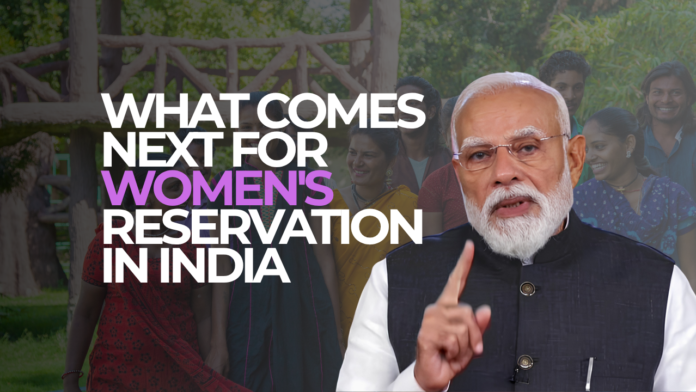
India · Parliament · April 18, 2026: The Constitution (131st Amendment) Bill failed in Lok Sabha by a margin of 54 votes. PM Modi addressed the nation. The 2023 law remains on paper, unrealised. Here is the full picture.
| 298 Voted in favour | 230 Voted against | 352 Votes needed |
Two-thirds supermajority (352 of 528 members present) required — Bill fell 54 votes short
How we got here
India’s debate over legislative seats for women is now three decades old. The idea first surfaced in 1996, lapsed repeatedly, and finally crossed a major hurdle in September 2023 when Parliament passed the Nari Shakti Vandan Adhiniyam — the 106th Constitutional Amendment — with near-unanimous support: 454 votes in favour in the Lok Sabha and all 214 in the Rajya Sabha. The law promised a 33% reservation for women in the Lok Sabha and state assemblies for 15 years, with a sub-quota for SC and ST women within those seats.
The catch: implementation was tied to a delimitation exercise that could only happen after a fresh census. With the 2021 Census delayed and still underway, and the next Lok Sabha elections in 2029, the window was closing fast. Women’s reservation, in practice, would have missed 2029 entirely under the original framework.
What the 2026 bills proposed
On April 16, the government introduced three bills in a special session of Parliament: the Constitution (131st Amendment) Bill, the Delimitation Bill, and the Union Territories Laws (Amendment) Bill. Together, they were designed to break the deadlock by using the already-available 2011 Census for delimitation — rather than waiting for the delayed 2027 Census — thereby enabling women’s reservation in time for the 2029 elections.
The package also proposed expanding the Lok Sabha from 545 to 850 seats, giving every state more seats even as proportional reallocation based on population took effect. This was the government’s answer to southern states’ fears that a population-based redistribution would slash their representation: a larger pie so no state had to lose seats in absolute terms.
PM Modi addresses the nation
“Today I’m here to discuss an important issue, especially for the women of this country. Despite our best efforts, we haven’t succeeded… I apologise to all the mothers and sisters of the nation for this.”
— PM Narendra Modi, address to the nation, April 18, 2026
Speaking to the country at 8:30 pm on Saturday, PM Modi framed the bill’s defeat squarely as the opposition’s betrayal of India’s women. He said that while crores of women were watching Parliament, Congress, DMK, TMC, and SP were clapping in celebration when the bill was defeated — calling them “dynastic parties” who fear that genuine women’s empowerment would challenge their family-based political power.
The Prime Minister said the opposition’s “sin” of blocking the bill will be punished by voters, particularly by the women of the 21st century who, he argued, are closely watching every development. He accused the Congress of having consistently opposed or delayed every significant reform in India’s history, and of using the delimitation issue to mislead the country and create divisions.
Why the opposition said no to Women’s Reservation
The opposition’s stated position was not against women’s reservation itself — multiple leaders, including Congress’s Shashi Tharoor, reaffirmed support for the 33% quota in principle. Their objection was to the bill’s linkage with delimitation. Southern states like Tamil Nadu and Kerala faced stark arithmetic: under population-proportional delimitation, Tamil Nadu’s Lok Sabha seats could fall from 39 to 32, and Kerala’s from 20 to 15.
Rahul Gandhi argued the bills were an attempt to sideline the caste census, depriving OBCs and Dalits of representation. The DMK’s Kanimozhi alleged the special session was timed to disrupt ongoing elections in Tamil Nadu and other states. Parties like the SAD and TMC supported women’s reservation but demanded it be implemented on the present strength of Parliament, without any delimitation exercise.
Where things stand now
The 2023 Nari Shakti Vandan Adhiniyam remains law — it has not been repealed or challenged. But it cannot come into force without a delimitation exercise, and delimitation cannot happen without the census. The 2021 Census, whose reference date has been set at March 1, 2027, is unlikely to yield a completed delimitation before the 2029 Lok Sabha elections. This means, as of today, women’s reservation is a constitutional promise with no clear implementation pathway before 2029.
The special Parliament session has ended. Both Rajya Sabha and Lok Sabha have been adjourned sine die. The Delimitation Bill was withdrawn by the Centre after the constitutional amendment failed.
What alternatives does the government have?
| Option A: Implement reservation on the current 543-seat Lok Sabha The opposition’s demand. No delimitation needed. But delinking from census requires a fresh constitutional amendment — the same two-thirds hurdle just failed. Hard — same majority needed | Option B: Wait for the 2027 census under the original 2023 law Default path. Census reference date is March 2027; delimitation takes years after. Women’s reservation almost certainly misses 2029 elections entirely. Likely — but deferred to 2034 |
| Option C: Renegotiate the delimitation formula with southern states Offer seat minimums or phased population-based transition to bring DMK, YSRCP, and others on board. Requires political consensus the current moment may not allow. Possible — but complex | Option D: Make women’s reservation the central issue in the 2029 elections Campaign on opposition’s blocking of the bill. If BJP wins a larger mandate with a two-thirds majority, reintroduce the legislation from a position of strength. Politically viable |
The bigger picture
The defeat of the 131st Amendment is a significant legislative setback — rare for a government with a comfortable majority in the Lok Sabha. But constitutional amendments require two-thirds of members present and voting, a threshold the ruling alliance could not clear without opposition support. The fight over women’s reservation has now become inseparable from the fight over delimitation, which is itself one of the most politically charged issues in Indian federalism: a zero-sum reallocation of power between a demographically growing north and a more prosperous south.
Women currently make up less than 15% of the Lok Sabha. The 2023 law was supposed to change that. Three years later, it remains unimplemented. The 2026 attempt to operationalise it has failed. Whether the next attempt happens before or after 2029 — and on whose terms — will define the next chapter of this three-decade debate.

