


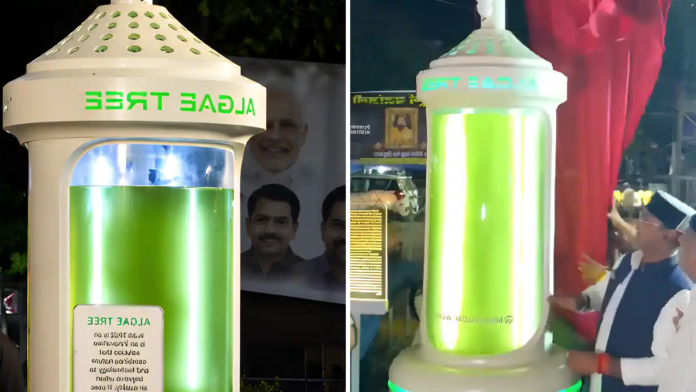
Bhopal has achieved a major milestone in environmental innovation. The capital city of Madhya Pradesh has become the first city in the country to install a modern “Algae Tree” that can absorb carbon dioxide directly from the atmosphere.
The machine has been installed at Swami Vivekananda Park in the Ashoka Garden area. The project has already begun to attract attention for its unique role in combating pollution and improving urban air quality.
According to officials, this advanced system can generate oxygen equivalent to nearly 25 trees while continuously absorbing harmful carbon dioxide from the environment.
What Is an Algae Tree?
Despite its name, an Algae Tree is not a real tree. It is a modern environmental technology system designed to clean the air using microalgae.
Microalgae are tiny plant-like organisms that naturally absorb carbon dioxide during photosynthesis and release oxygen. Scientists have now adapted this natural process into a compact urban machine.
The structure usually contains:
- Water filled with microalgae
- A carbon dioxide absorption system
- Solar-powered technology
- Automated circulation systems
- Air purification mechanisms
As polluted air passes through the system, the algae absorb carbon dioxide and help release cleaner oxygen-rich air into the atmosphere.
Why This Technology Matters
Indian cities continue to face rising pollution levels because of:
- Increasing vehicles
- Industrial emissions
- Construction dust
- Urban heat
- Shrinking green spaces
Planting traditional trees remains essential. However, dense urban areas often lack enough space for large-scale plantations. That is where technologies like Algae Trees may help.
These systems require very little space compared to regular trees. Yet they can still support air purification efforts in crowded cities.
Environmental experts believe such innovations could become especially useful in:
- Traffic-heavy junctions
- Public parks
- Metro stations
- Commercial hubs
- Industrial areas
How Powerful Is the Bhopal Algae Tree?
Officials associated with the project claim the machine can produce oxygen comparable to around 25 mature trees.
While it cannot replace natural forests, the technology can support urban sustainability projects where space remains limited.
The machine also works continuously and can help monitor environmental conditions in real time.
Some advanced algae systems globally also support:
- Temperature control
- Carbon monitoring
- Smart city data collection
- Renewable energy integration
If maintained properly, such installations may become an important part of future climate-resilient cities.
Why Bhopal Is Leading This Initiative
Bhopal has increasingly focused on environmental sustainability and smart urban development in recent years.
The city is already known for:
- Large lakes and green zones
- Smart City projects
- Public cleanliness initiatives
- Urban environmental programs
By introducing the country’s first Algae Tree, Bhopal has positioned itself as a testing ground for next-generation green technology in India.
The initiative also reflects a growing shift toward combining nature and technology to address climate challenges.
Can Algae Trees Replace Real Trees?
The simple answer is no.
Natural trees provide far more benefits than oxygen production alone. They support biodiversity, reduce soil erosion, lower temperatures, store carbon for decades, and improve mental well-being.
However, Algae Trees can act as a supplementary solution in urban environments where planting large forests is difficult.
Experts say the best approach is to combine:
- Traditional tree plantation
- Urban forests
- Green rooftops
- Sustainable infrastructure
- Smart environmental technologies like algae systems
Together, these measures can improve city air quality more effectively.
The Future of Green Cities in India
Climate change and pollution are pushing cities to rethink urban planning.
Across the world, governments are experimenting with:
- Carbon capture systems
- AI-powered pollution monitoring
- Vertical forests
- Smart air purification towers
- Renewable energy integration
India is also slowly entering this phase of environmental innovation.
If the Bhopal project succeeds, similar Algae Trees could appear in other major Indian cities in the coming years.
Cities struggling with poor air quality may especially benefit from compact technologies that support cleaner urban environments.
Final Thoughts
The installation of India’s first Algae Tree in Bhopal marks an important step toward sustainable urban innovation.
The technology may not replace natural forests, but it highlights how science and environmental thinking can work together to tackle pollution challenges.
As Indian cities continue to grow rapidly, solutions like these could become part of the future of smart and climate-conscious urban living.

