


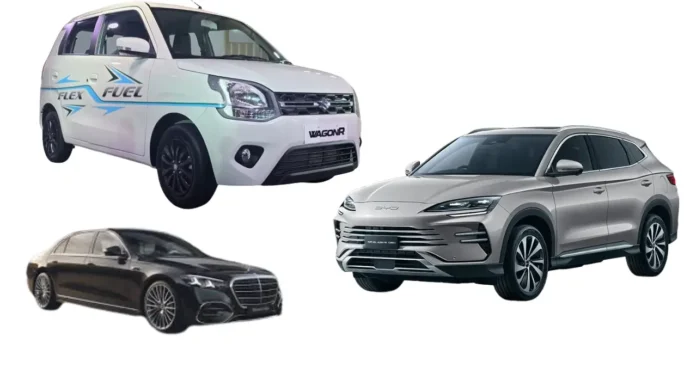
From India’s first E100 flex-fuel car and the country’s debut PHEV SUV to a V8 BMW and a performance Skoda, June 2026 is one of the most consequential months in Indian automotive history.
Eight new cars are expected to launch in India in June 2026: the Maruti Suzuki Flex Fuel (India’s first E100 car), BYD Sealion 6 DM-i (India’s first PHEV SUV), Mercedes-Benz S-Class Facelift (with a PHEV powertrain), Mini Countryman C, Honda ZR-V, BMW X6 M60i, Skoda Kodiaq RS, and the Tata Sierra EV. Powertrains span flex-fuel, plug-in hybrid, strong hybrid, full electric, and high-performance petrol — a rare breadth for a single calendar month.
June 2026 Car Launches — At A Glance
| # | Car | Expected Date | Powertrain | Est. Price |
|---|---|---|---|---|
| 1 | Maruti Suzuki Flex Fuel | June 4–5 | Flex Fuel | ~₹6–9 lakh |
| 2 | BYD Sealion 6 DM-i | June 9 | PHEV | ~₹45–50 lakh |
| 3 | Mercedes-Benz S-Class Facelift | June 15 | PHEV | ~₹1.7 cr+ |
| 4 | Mini Countryman C | June 17 | Petrol | ~₹45–50 lakh |
| 5 | Honda ZR-V | Late June | Strong Hybrid | ~₹22–28 lakh |
| 6 | BMW X6 M60i | June (TBC) | V8 Petrol | ~₹1.5 cr+ |
| 7 | Skoda Kodiaq RS | June (TBC) | Turbo Petrol | ~₹60–65 lakh |
| 8 | Tata Sierra EV | June–July window | Electric | ~₹18–25 lakh |
The Indian automobile market has had several big months in recent memory, but June 2026 is shaping up to be something genuinely special. The month does not just bring a high volume of launches — it brings a rare diversity of powertrains, a cluster of firsts for the Indian market, and price points that stretch from the mass-market affordable to the ultra-luxury stratosphere. Maruti Suzuki and BYD are both poised to introduce technologies India has never seen at the retail level. Mercedes-Benz is bringing its most important sedan forward with electrification for the first time. BMW is reviving a nameplate that has been missing from Indian showrooms for over three years. And Tata Motors is betting big on the revival of one of its most beloved badges — this time, with an electric heart.
Here is a detailed look at all eight new car launches expected in India in June 2026.
Maruti Suzuki Flex Fuel (WagonR / Fronx)
India’s first mass-market passenger car capable of running on 100% ethanol
June 4 (Reveal) / June 5 (Sale)E100 Flex Fuel
Model: WagonR or Fronx (TBC)
Ethanol: Up to E100
Est. Price:₹6–9 lakh (ex-showroom)
Segment: Mass Market
This is arguably the single most consequential car launch in India in many years, and it happens to be the most affordable one on this list. Maruti Suzuki chose the eve of World Environment Day — June 4 — to unveil what will become the first mass-market passenger car in India to run on ethanol blends up to 100%. The commercial launch followed on June 5.
For months, speculation centred on two candidates: the WagonR Flex Fuel — showcased at the Bharat Mobility Expo 2024 — and the Fronx Flex Fuel, which made its international debut at the 2025 Japan Mobility Show. Industry reports pointed more strongly towards the WagonR, which has appeared at multiple public events and better fits the target profile of an entry-level, high-volume flex-fuel car. However, Maruti kept the final model under wraps until the day of the reveal.
The significance of this launch is hard to overstate. India has long pursued an ethanol blending programme, with E20 (20% ethanol blended with petrol) becoming the country’s near-term fuel policy target. A car that can seamlessly switch between pure petrol and pure ethanol — or any combination in between — removes the engineering constraints that have limited biofuel adoption in passenger vehicles. For buyers in ethanol-producing states, it opens the door to meaningfully lower running costs.
Why it matters: The Maruti Flex Fuel is not just a new product — it is a new fuel paradigm entering the Indian passenger vehicle market for the first time. If Maruti’s distribution muscle is behind it, this technology could reach millions of Indian buyers far faster than any EV transition can.
BYD Sealion 6 DM-i
India’s first retail plug-in hybrid SUV — 1,092 km combined range
June 9, 2026, PHEV
Engine: 1.5L Petrol + Electric
Battery:18.3 kWh
EV Range:~90 km
Combined Range:1,092 km
Power:323 PS (AWD)0–100 km/h:5.9 sec
Screen:15.6-inch rotating
Est. Price:₹45–50 lakh
Just as Maruti is making history at the affordable end, BYD is doing the same in the premium SUV space. The Sealion 6 DM-i, launched on June 9, 2026, is India’s first retail plug-in hybrid SUV — a category that has been conspicuously absent from the Indian market for years despite strong global uptake.
The DM-i stands for Dual Mode – intelligent, BYD’s terminology for a PHEV system that couples a 1.5-litre petrol engine with an 18.3 kWh battery pack. The AWD version produces 323 PS and 550 Nm of torque, accelerating from 0 to 100 km/h in 5.9 seconds. The combined range of 1,092 km directly addresses the anxiety that highway trips and charging infrastructure gaps create for Indian EV buyers. With up to 90 km of pure electric city driving, most urban commuters could go days without touching petrol.
Until now, BYD India’s portfolio consisted entirely of pure EVs — the Atto 3, Seal, eMAX 7, and Sealion 7. The Sealion 6 DM-i changes that profile significantly, positioning the brand against petrol-powered premium SUVs like the Toyota Fortuner and Volkswagen Tayron, rather than competing purely in the EV space.
Why it matters: India’s PHEV segment has been a blank slate. The Sealion 6 DM-i writes the first chapter — and with BYD’s pricing and technology track record, it could unlock a large pool of buyers who want EV efficiency without range anxiety.
Mercedes-Benz S-Class Facelift (S 450e PHEV)
India’s first PHEV S-Class — 100 km of electric range in a flagship sedan
June 15, 2026, PHEV
Engine:3.0L Turbo-Petrol + Electric
Power:435 bhp
Torque:680 Nm
Battery:22 kWh
EV Range:~100 km
Screen: MBUX Superscreen
Mercedes-Benz officially confirmed the June 15 launch of the facelifted S-Class in India well in advance, making it the most firmly scheduled arrival on this list. The headline addition is the S 450e variant — India’s first PHEV-equipped S-Class — pairing a 3.0-litre turbocharged petrol engine with an electric motor to produce 435 bhp and 680 Nm. A 22 kWh battery pack provides up to 100 km of pure electric driving range.
Beyond the powertrain, the facelift is substantial by any measure. Mercedes claims up to 90% of the car is new compared to the pre-facelift version. On the outside, the signature tri-arrow LED elements appear in both the headlamps and taillights, joined by a refreshed bumper set, a larger illuminated grille, and updated multi-spoke alloy wheels. The interior receives the full MBUX Superscreen treatment: a 14.4-inch central touchscreen flanked by dual 12.3-inch displays, all running the latest MB.OS operating system with over-the-air update capability and an AI-based digital assistant.
For Mercedes-Benz India, the PHEV S-Class serves a strategic purpose beyond the product itself. It allows the brand to offer meaningful electrification to luxury buyers who are not yet ready to commit to a full EV — a larger group in India than in many Western markets.
Why it matters: The S-Class is the benchmark luxury sedan globally. Bringing a PHEV variant to India signals that electrification is no longer a fringe offering even at the very top of the market.
Mini Countryman C
Locally assembled, more accessible — the Countryman range gets a new entry point
June 17, 2026, Petrol
Engine:1.5L 3-cyl Turbo Petro
lPower:136 hp
Gearbox:7-speed DCT
Length:~4.44 m
Screen: 240mm circular OLED
ADAS: Level 2
Assembly: Chennai (BMW plant)
Mini confirmed the launch of the Countryman C in India for June 17, 2026 — a date that also marks the start of local assembly for the Countryman nameplate in the country. Built at the BMW Group plant in Chennai, the Countryman C sits below the performance-focused Countryman JCW All4 and the electric Countryman Electric in the range, making it the most attainably priced version for Indian buyers.
This generation of the Countryman is significantly larger than its predecessor, stretching to approximately 4.44 metres — approaching the proportions of a proper compact SUV rather than the boutique hatchback-crossover it once was. Power comes from a 1.5-litre three-cylinder turbocharged petrol engine producing 136 hp, paired with a seven-speed dual-clutch automatic transmission, the same drivetrain shared with the BMW X1.
Inside, Mini’s signature circular OLED touchscreen now measures 240 mm in diameter and serves as the digital hub for connectivity, infotainment, and vehicle controls. Level 2 driver assistance features are included, and the new-generation platform delivers a noticeably more spacious rear cabin — a historic weak point for the Countryman that the India-spec buyers have long flagged.
Why it matters: Local assembly typically translates to sharper pricing, and a keener Countryman C price could unlock a new tier of Mini buyers who have admired the brand but found it just out of reach.
Honda ZR-V
Honda’s flagship hybrid SUV for India — 22.8 kmpl claimed mileage
Late June 2026 Strong Hybrid
Engine:2.0L Petrol + Electric (e:HEV)
Power:181 bhp
Torque:315 Nm
Gearbox:e-CVT
Claimed ARAI:22.8 kmpl
Route: CBU
Honda unveiled the ZR-V for the Indian market alongside the City facelift in May 2026, positioning it as the brand’s new flagship SUV in the country. Price announcement is expected before the end of June, with CBU deliveries slated to commence in July. The ZR-V completes Honda India’s hybrid SUV push, which began with the City Hybrid and continues up through this premium segment offering.
The ZR-V uses Honda’s e: HEV strong-hybrid system — a 2.0-litre petrol engine working with two motor-generators through an e-CVT unit, producing a combined 181 bhp and 315 Nm of torque. The claimed ARAI fuel efficiency of 22.8 kmpl is the headline number Honda will lean on in its marketing, particularly as diesel alternatives shrink and petrol prices remain a concern for premium buyers.
Honda’s strategic rationale is clear: Toyota and Maruti Suzuki have already built significant momentum in strong hybrid passenger vehicles, and the ZR-V is Honda’s attempt to bring that reputation for refined, efficient motoring into the premium SUV space. With the City Hybrid proving that Indian buyers are receptive to Honda’s hybrid approach, the ZR-V extends the brand’s credibility into a segment where it currently has no product.
Why it matters: The ZR-V is Honda India’s most significant SUV launch in years and its first strong-hybrid offering in that format. It directly challenges the Toyota Urban Cruiser Hyryder and Maruti Suzuki Grand Vitara hybrids in terms of refinement and efficiency.
BMW X6 M60i
The V8-powered coupe-SUV returns to India after a three-year absence
June 2026 (Date TBC)V8 Performance
Engine:4.4L V8 Twin-Turbo
Pre-bookings:Open
Segment: Ultra-Luxury Performance SUV
Est. Price:₹1.5 crore+
BMW showcased the refreshed X6 in India in early May 2026 and opened pre-bookings via its official website shortly after — a strong signal that the commercial launch is imminent within June. The X6 nameplate marks a return to the Indian market after a gap of more than three years, and the M60i designation confirms that the V8 variant is leading the revival rather than a more modest entry-level option.
The X6 has always occupied a distinctive niche: the four-door coupe-SUV format that sacrifices a little headroom and boot utility in exchange for a dramatically raked roofline and the visual drama that comes with it. The M60i sits below the full M Competition but above the standard petrol variants — a sweet spot that delivers near-performance driving character with a slightly broader ownership appeal.
BMW’s decision to lead with the X6 M60i in India is a bet on the growth of India’s ultra-luxury buyer base, which has consistently surprised market watchers over the past few years. With Mercedes-Benz also launching a flagship product the same month, June 2026 is setting up to be an unusually competitive period at the very top of the Indian auto market.
Why it matters: The X6’s return signals BMW’s growing confidence in India’s appetite for non-traditional, style-led luxury vehicles — a category that barely existed in the country a decade ago.
Skoda Kodiaq RS
India’s first RS-badged SUV from Skoda — the performance flagship arrives
June 2026 (Expected)Turbo Petrol AWD
Engine:2.0L Turbo-Petrol
Power:~265 bhp
Drivetrain:AWD
Route: CBU
Est. Price:₹60–65 lakh
The RS badge is Skoda’s performance designation — think of it as the brand’s equivalent to BMW’s M Sport or Mercedes-AMG — and until June 2026, it has never appeared on a Skoda SUV in the Indian market. The Kodiaq RS changes that, arriving as the range-topping variant above the standard Kodiaq that has already established itself as a well-regarded choice in the mid-size premium SUV segment.
Internationally, the Kodiaq RS uses a 2.0-litre turbocharged petrol engine with all-wheel drive producing approximately 265 bhp. The visual differentiation is carried through a sportier exterior package: blacked-out elements, more aggressive front and rear bumpers, larger wheels, and the red brake callipers that RS enthusiasts expect. The cabin follows the performance theme with darker upholstery, sportier front seats, and RS-specific stitching and trim details throughout.
The India launch is expected via the CBU (completely built unit) route, which will keep volumes limited but preserve the exclusivity positioning that an RS product demands. Pricing in the region of ₹60–65 lakh would make it a compelling alternative to the BMW X3 and Mercedes GLC for buyers who want driving engagement alongside family-SUV practicality.
Why it matters: The Kodiaq RS is proof that India’s premium SUV buyers are increasingly seeking performance variants rather than simply spec-laden comfort editions. Skoda is testing Indian appetite for the full RS story for the first time.
Tata Sierra EV
The legendary name returns — this time, fully electric
June–July WindowElectric
Battery Options:65 kWh / 75 kWh
Est. Real-World Range: 500+ km (75 kWh)
Drivetrain: RWD / AWD
ADAS: Level 2
Platform: Gen 2 EV (Harrier EV)
Est. Price: ₹18–25 lakh
No nameplate in the Indian automotive consciousness carries quite the same weight as the Tata Sierra. The original Sierra — boxy, rugged, and unmistakable — defined a generation of Indian roads in the 1990s. The Sierra’s return as an electric SUV is therefore not just a product launch; it is a cultural moment for Indian car enthusiasts.
Tata Motors’ official confirmation places the Sierra EV in a July–September 2026 window, though some reporting has pointed to a June announcement or reveal event. The production-spec model is expected to share its 65 kWh and 75 kWh battery packs with the Harrier EV, with the larger pack expected to deliver over 500 km of real-world range. Both single-motor rear-wheel-drive and dual-motor all-wheel-drive configurations are anticipated.
The cabin is expected to feature a triple-screen dashboard layout, a panoramic sunroof, V2L and V2V charging functionality, Level 2 ADAS, and Tata’s connected car technology suite. Pricing is estimated to start from around ₹18 lakh (ex-showroom), which would place it in direct competition with the Hyundai Creta Electric and the Mahindra BE 6 — two of the most discussed EVs in India right now.
Why it matters: The Sierra EV will be among Tata’s most-watched launches in recent years — not merely as a product, but as a statement about the company’s ambition to combine heritage storytelling with its Gen 2 EV platform leadership.
The Bigger Picture: What June 2026 Tells Us About India’s Auto Market
The eight cars launching in June 2026 are not just a list of new products — they are a snapshot of where Indian automotive demand is heading simultaneously in multiple directions. At the affordable end, Maruti is addressing fuel security and running costs through flex-fuel technology. At the premium end, Mercedes and BMW are testing the depth of India’s luxury wallet. In the middle, BYD, Honda, and Tata are betting on different versions of electrification — PHEV, strong hybrid, and full electric — as the new normal for Indian buyers.
What makes June 2026 exceptional is not just the quantity of launches, but the fact that so many of them represent firsts for the Indian market. The country’s first E100 flex-fuel car. It’s the first retail PHEV SUV. It’s the first PHEV S-Class. India’s first RS-badged Skoda SUV. These are not incremental launches in a crowded category — they are category openers, technology debuts, and brand-defining moments compressed into a single month.
For Indian car buyers, June 2026 presents a rare opportunity: the chance to be among the first owners of technologies and vehicles that will define the next decade of motoring in this country.

