


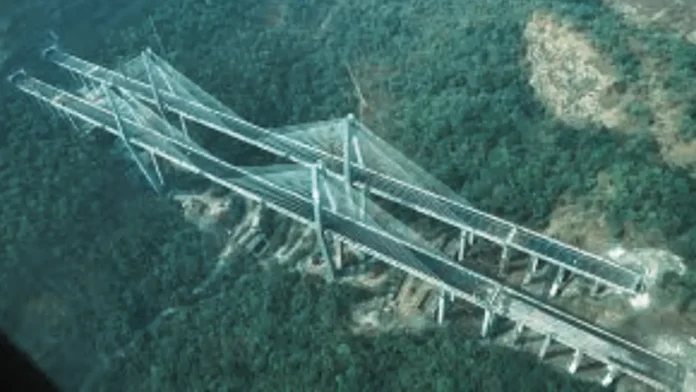
After seven years of tunnelling through the Western Ghats, India’s most ambitious expressway bypass project opens today — cutting 6 km off the route and eliminating the most dangerous stretch on one of the country’s busiest corridors.
13.3 km Total length of new link
₹6,700 Crore Total project cost
25–30 minutes Travel time saved
8 lanes Access-controlled highway
The Problem
A 19 km bottleneck in the Ghats
The Mumbai–Pune Expressway (officially the Yashwantrao Chavan Expressway) has been India’s first 6-lane concrete expressway since 2002, spanning 94.5 km and handling roughly 43,000 passenger car units daily. Yet for all its engineering merit, one stretch has remained its Achilles heel — the Khandala Ghat.
Between the Adoshi Tunnel and the Khandala exit, the expressway’s 6 lanes merge with the 4-lane NH-4, creating a combined 10-lane load on a 6-lane road through hairpin curves, steep gradients, and terrain brutally prone to monsoon landslides. A single incident — such as the oil tanker that overturned in February 2026 and paralysed both routes for over 30 hours — can bring the entire corridor to a standstill. The result is chronic congestion that spreads beyond the ghat in both directions, raising accident rates as frustrated drivers speed on the open sections to compensate for lost time.
“This stretch faces significant challenges as the cable-stayed bridge is coming up at a height of almost 100 m above Khandala Valley.”— MSRDC Official, January 2025
Project Specifications
Engineering inside the link
The Missing Link replaces 19 km of winding ghat road with a 13.3 km straight, access-controlled 8-lane corridor connecting Khopoli to Kusgaon. The project is divided into two packages, each awarded to a specialist contractor in August 2018.
Twin Tunnel — Package I 10.67 km
Two bored tunnels: a 1.75 km approach tunnel and the main 8.92 km bore, described as one of the widest road tunnels in the world at 23.75 m. Built by Navayuga Engineering Co. Ltd., the road passes 182 m below Lonavala Lake.
Cable-Stayed Bridges — Package II 1,440 m total
Two viaducts (790 m + 650 m) over Tiger Valley near Lonavala. The 645 m bridge carries the deck ~100 m above ground on 170–182 m pylons — the trickiest element, requiring work in winds of up to 70 km/h. Built by Afcons Infrastructure Ltd.
Route
Khopoli Exit → twin tunnels → Tiger Valley viaduct → Kusgaon interchange. Bypasses the entire Khandala Ghat section and all its associated NH-4 merges.
Capacity augmentation
Package II also widens 6.5 km of the existing expressway between Khalapur Toll Plaza and Khopoli Exit from 6 to 8 lanes, ensuring no new bottleneck forms at the entry point.
8-lane access-controlled
Speed: up to 120 km/h
Two twin tunnels
Two cable-stayed bridges
11 pipe culverts
2 box culverts
General Consultant: Geodata-LB Consortium
Cost & Financial Structure
What the project costs — and who pays
| Item | Detail |
|---|---|
| Original approved cost (2015-16 SOR) | ₹4,797.57 crore |
| Revised project cost (as executed) | ≈ ₹6,695–6,700 crore |
| Execution mode | EPC (Engineering, Procurement, Construction) |
| Funding mechanism | MSRDC borrowings; IRR = borrowing rate + 2% |
| Toll impact | No toll hike on opening. Collection period extended by 15 years (to 2045 approx.) to recoup cost |
| Current toll — private car | ₹540 (unchanged) |
| Current toll — multi-axle truck | ₹2,200 (unchanged) |
MSRDC confirmed no toll increase will accompany the opening. The cost of the new infrastructure will be recouped through the extension of the existing toll collection period — originally set to end in 2030, now extended by approximately 15 years — rather than by raising per-trip charges on motorists.
Cost Advantage
What users save on every trip
The economic and practical value for daily commuters, logistics operators, and occasional travellers is substantial. With 85% of current expressway traffic expected to route through the new link, the aggregate annual savings across fuel, time, and vehicle wear are significant.
Fuel saving (per trip) ₹40–80
6 km shorter route at ghat gradients means meaningfully less fuel consumption — especially for heavy vehicles and buses that burn significantly more on climbs.
Time saving 25–30 min
Straight tunnel route at up to 120 km/h vs. the current 60–80 km/h maximum through hairpin curves. For a daily commuter making 250 trips a year, this is over 100 hours saved annually.
Logistics advantage
Faster, more predictable transit times benefit freight operators on one of India’s highest-volume industrial corridors. Reduced idle time in ghat queues directly lowers per-km trucking costs.
Safety dividend
Elimination of the NH-4 merge removes the most accident-prone stretch. MSRDC’s stated goal is to make the corridor a zero-fatality expressway — the Missing Link is the single biggest enabler of that target.
Project Timeline
Seven years from approval to opening
In 1995, RITES conducted feasibility studies and recommended an alternative route for the ghat section.
June 2017 Maharashtra Cabinet Sub-Committee approves the project on EPC mode at ₹4,797.57 crore.
In December 2017, the Geodata-LB Consortium was appointed as the General Consultant.
August 2018 Letters of Acceptance issued to Navayuga Engineering (Phase I – tunnels) and Afcons Infrastructure (Phase II – viaducts).
March 2024 Original target deadline missed. Cable-stayed bridge pylons over Tiger Valley remain the critical-path challenge.
January 2025 92% of civil work is complete. New deadline set for August 2025, then revised to early 2026.
April 2026
99% of civil work is complete. Load testing on the cable-stayed bridge is underway. Safety certifications in progress.
May 1, 2026 — Today
Partial inauguration on Maharashtra Day by Chief Minister Devendra Fadnavis. Light motor vehicles and buses permitted initially. Full access to follow upon completion of all certifications.
Construction Challenges
Why did this project take longer than planned
Key engineering and environmental hurdles
- The main tunnel passes 182 m below Lonavala Lake, requiring exceptional waterproofing and ground monitoring throughout.
- Cable-stayed bridge pylons rise to 182 m in a valley subject to sustained winds of up to 70 km/h, slowing all aerial construction work.
- Western Ghats terrain — classified as a biodiversity hotspot — demanded strict environmental controls and route alignment reviews.
- Heavy monsoon rainfall (the ghat receives among the highest precipitation in India) caused seasonal construction shutdowns every year.
- Supply chain disruptions in 2025–26 delayed asphalt surfacing and final finishing works, pushing the inauguration into May 2026.
What Opens Today
Partial inauguration — what to expect
The May 1 opening is a partial inauguration. Priority access will be given to four-wheelers and buses. Two-wheelers, heavy freight vehicles, and other categories will be phased in as safety certifications are completed. There will be no toll hike. MSRDC has confirmed that funding will not impede the project’s final completion phase.
For weekend travellers to Lonavala, Khandala, and Pune, the practical change is immediate: 25–30 minutes cut from the journey, and the elimination of the dread of a Sunday-evening standstill at the Adoshi tunnel that has defined the route for two decades.
No toll hike confirmed. Light motor vehicles from Day 185% of traffic to use the new route. Full access: pending final certs. Heavy freight: phased entry

