


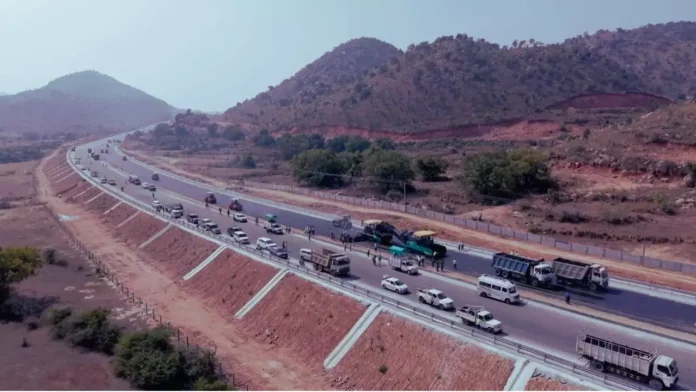
India is no longer just building roads. It is redefining how roads are built.
The Bengaluru–Kadapa–Vijayawada Economic Corridor has become a symbol of this shift. During its construction, India achieved something that no country had done at this scale before. It set multiple global records in highway construction.
This is why headlines are calling it “the first in the world.” However, the real story lies in execution, not just the title.
What Exactly Happened
In January 2026, the National Highways Authority of India achieved four global records while building this corridor.
The team did not just work fast. They worked at a scale that pushed engineering limits.
Here is what they achieved:
- Continuous laying of 28.89 lane km of bituminous concrete in 24 hours
- Over 10,600 metric tonnes of material were laid in a single day
- Massive 57,500 metric tonnes laid in a continuous stretch
- Record 156 lane km of paving, far beyond previous global benchmarks
These are not routine numbers. They reflect precision planning, coordination, and endurance.
Why This Achievement Is Different
Many countries build highways. That is not new.
However, what sets this project apart is continuous execution at scale.
Usually, road construction happens in segments. Teams stop, adjust, and restart. Here, work continued without interruption.
As a result, India broke records in:
- Speed
- Volume
- Continuity
This combination is rare. That is why the achievement stands out globally.
Understanding the Corridor
The corridor itself is equally important. It is not just a record site. It is a critical economic route.
- Length: Around 343 km
- Type: Six-lane access-controlled highway
- Route: Connects Bengaluru with Vijayawada via Kadapa
- Project under: Bharatmala initiative
Once completed, it will significantly improve travel and logistics across southern India.
Faster Travel, Stronger Connectivity
At present, travel between Bengaluru and Vijayawada takes about 11–12 hours.
With this corridor, the time may drop to nearly 6 hours.
This change will not only save time. It will reshape movement across the region.
- Trucks will move faster
- Fuel consumption will reduce
- Supply chains will become more efficient
Consequently, industries in Karnataka and Andhra Pradesh will benefit.
How India Pulled This Off
This achievement did not happen overnight. It required strong planning and execution.
Several factors played a key role:
- Advanced road-laying machines are working continuously
- Real-time monitoring of construction quality
- Highly coordinated teams working in shifts
- Strict timelines with minimal downtime
In simple terms, it was a combination of technology and teamwork.
What It Means for India
This milestone sends a clear message. India is now capable of delivering infrastructure at global standards.
More importantly, it shows that India can:
- Execute mega projects quickly
- Maintain quality while scaling up
- Compete with global infrastructure leaders
This is not just about one highway. It reflects a broader transformation.
The Truth Behind “First in the World”
The phrase can be misleading if taken literally.
This is not the first highway of its kind. Many countries have expressways.
However, it is among the first projects globally to achieve such large-scale continuous paving records.
That is the real achievement.
Final Take
The Bengaluru–Vijayawada corridor is more than a road. It represents a shift in India’s ambition.
Earlier, the focus was on catching up. Now, the focus is on leading.
This project shows that India is not just building faster highways. It is building them smarter and at a scale the world is starting to notice.
And that is where the real story lies.

