


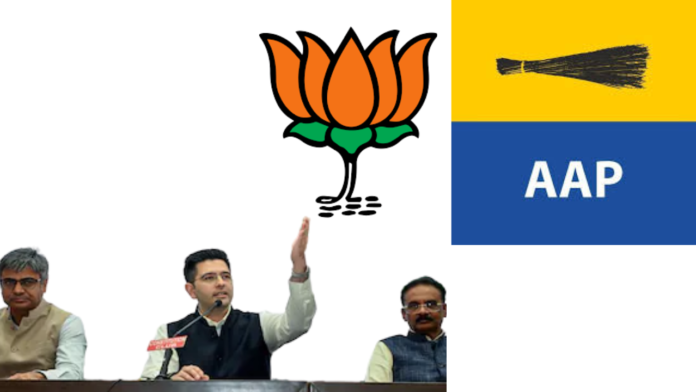
In the most dramatic defection in AAP’s 14-year history, seven of ten Rajya Sabha MPs — including party stalwarts Raghav Chadha and Sandeep Pathak — invoke the Constitution to formally merge with the ruling BJP, leaving Kejriwal’s party on life support in the Upper House.
At a Glance
- 7 of AAP’s 10 Rajya Sabha MPs resign and announce merger with BJP
- Raghav Chadha, Sandeep Pathak, and Ashok Mittal lead the breakaway faction
- Chadha invokes the two-thirds constitutional provision to legitimise the merger
- Only Sanjay Singh, Narain Dass Gupta, and Balbir Singh Seechewal remain with AAP
- Chadha had been stripped of his deputy leader post weeks before the walkout
In a bombshell development that sent shockwaves through Indian politics on Friday, Raghav Chadha — once the telegenic face of the Aam Aadmi Party’s Rajya Sabha presence — led a mass exodus of seven MPs out of Arvind Kejriwal’s party. The defectors announced their formal merger with the Bharatiya Janata Party at a charged press conference in the national capital, delivering what analysts are calling a near-fatal blow to AAP’s presence in the Upper House of Parliament.
Flanked by fellow MPs Sandeep Pathak and Ashok Mittal, Chadha invoked the constitutional two-thirds merger provision to legitimise the move. This clause shields defectors from disqualification under the anti-defection law if two-thirds of a legislature party’s members consent to a merger. With seven of AAP’s ten Rajya Sabha MPs having signed their consent, Chadha’s faction technically clears that bar.
10 AAP’s total Rajya Sabha MPs before the split
7 MPs who quit to merge with the BJP
3 MPs still loyal to Kejriwal’s AAP
“The AAP that I nurtured with my blood and sweat, and gave 15 years of my youth to, has completely strayed from its principles, values, and core morals.”— Raghav Chadha, Press Conference, April 24, 2026
“We have decided that we, the two-thirds members belonging to the AAP in Rajya Sabha, exercise the provisions of the Constitution of India and merge ourselves with the BJP,” Chadha declared to a packed room of reporters, his voice steady despite the gravity of what he was announcing. “This morning, we submitted the signed letter and documents to the Rajya Sabha Chairman.”
Chadha was joined by Sandeep Pathak, who had spent a decade within the party as one of its most trusted organisational voices. “For 10 years, I remained associated with this party. And today, I am parting ways with the Aam Aadmi Party,” an emotional Pathak said.
Who Left — and Who Stayed
The seven departing Rajya Sabha MPs form a cross-section of AAP’s nominated talent pool, spanning politics, education, industry, and sport.
Raghav Chadha, Former Deputy Leader of AAP in Rajya Sabha, chartered accountant turned prominent politician
Sandeep Pathak, Key organisational figure in AAP; decade-long party association
Ashok Mittal, Educationist, founder of Lovely Professional University; replaced Chadha as RS Deputy Leader
Harbhajan Singh, legendary off-spin cricketer; Rajya Sabha MP from AAP after retirement from cricket
Rajinder Gupta Founder, Trident Group; Padma Shri awardee; RS MP from Punjab since 2025
Swati Maliwal
Former Delhi Women’s Commission chief, previously at loggerheads with Kejriwal’s office, resigned. Three MPs chose to remain with the party. Sanjay Singh of Delhi — arguably AAP’s most combative voice in the Upper House — stayed put, as did Delhi MP Narain Dass Gupta and Punjab’s Balbir Singh Seechewal, a revered environmental activist known for his river-cleaning campaigns.
The Months That Led Here
While Friday’s press conference came as a shock to the public, insiders say the fault lines had been widening for months. The flashpoint, many believe, was the removal of Raghav Chadha from his position as AAP’s deputy leader in the Rajya Sabha — a move he described as “wounding.” Ashok Mittal, one of the defectors, had been installed in his place, making it all the more ironic that Mittal stood beside Chadha at the breakaway press conference.
Sources also point to Chadha being denied speaking time in the Rajya Sabha sessions in the weeks leading up to the split — a humiliation that party insiders say he found impossible to overlook. Adding fuel to fire, Swati Maliwal — already embroiled in a bitter public dispute with Kejriwal’s inner circle over an alleged assault incident at the Chief Minister’s residence — had made no secret of her alienation from the party.
“Over the past few years, I have increasingly felt that I am the right person in the wrong party.”— Raghav Chadha
Kejriwal Hits Back
Arvind Kejriwal was quick to go on the offensive, accusing the BJP of engineering the defection through pressure and inducements. The AAP chief framed the exodus as a coordinated act of political poaching rather than a voluntary departure based on ideology. His party pointed out that many of the departing MPs had been appointed to the Rajya Sabha directly by AAP leadership and owed their political careers to the party.
Nonetheless, the optics are undeniably damaging. Losing seven of ten Rajya Sabha members in a single afternoon — including some of the party’s most recognisable faces — strips AAP of both its upper house strength and its public narrative of internal unity at a time when it is already grappling with a bruising defeat in the Delhi assembly elections.
What the Constitution Says
The Tenth Schedule of the Indian Constitution — commonly known as the anti-defection law — disqualifies legislators who voluntarily give up party membership. However, it provides a crucial exemption: a merger is recognised as valid if at least two-thirds of the legislature party agrees to it. Chadha’s faction, comprising seven of ten AAP Rajya Sabha MPs, clears this threshold, which means they technically cannot be disqualified for defecting. The Rajya Sabha Chairman will now examine the documents submitted and make a formal ruling on the merger’s validity.
What This Means for Indian Politics
For the BJP, the gain is both numerical and symbolic. Absorbing seven Rajya Sabha members — including a nationally beloved cricketer and prominent industrialists — strengthens the ruling party’s hand in the Upper House while simultaneously weakening the principal voice of the Aam Aadmi Party at the national level. Critics of the government will argue this is yet another instance of the “washing machine” effect — a term opposition parties use to describe how politicians with controversial records clean up their image upon joining the BJP.
For AAP, the damage cuts deep. The party that rose on a wave of anti-corruption activism and idealistic politics now finds itself with a Rajya Sabha contingent of just three members. With Sanjay Singh, Narain Dass Gupta, and Balbir Singh Seechewal as its sole parliamentary presence in the Upper House, the party’s legislative leverage has been dramatically reduced.
Whether Friday’s defection marks the beginning of AAP’s unravelling at the national level — or simply a painful inflection point before a reinvention — will depend on how Kejriwal responds in the days ahead. What is clear is that Indian politics has just witnessed one of its most seismic single-day reshufflings in recent memory.

