


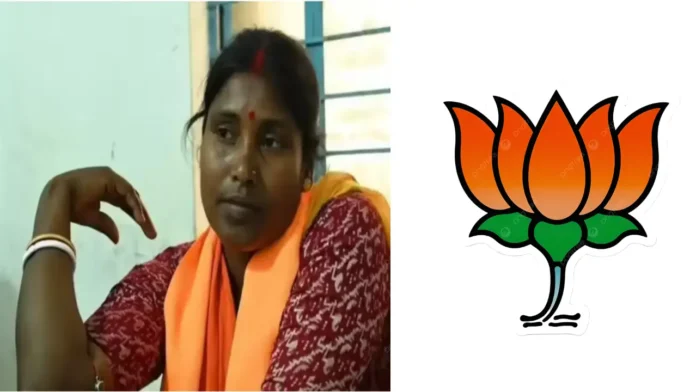
Earning ₹4,000 a month working in two households, Kalita Majhi took unpaid leave to fight the West Bengal Assembly election on a BJP ticket — raising her voice for tribals, water, schools, and jobs that she says the ruling TMC has long ignored.
Name Kalita Majhi
BJP · Ausgram, Purba Bardhaman
Party BJP
Seat Ausgram
District Purba Bardhaman
Occupation Domestic worker
Monthly income ₹4,000
Election WB Assembly 2026
Previous contest 2021 (same seat)
BJP candidate
Kalita Majhi
Bharatiya Janata Party
41%
2021 vote share
vs
2021 margin: <12,000 votes
TMC candidate
Abhedananda Thander
Trinamool Congress
Won
Incumbent MLA, 2021
The candidate
Kalita Majhi is not a career politician. She is a tribal woman from Ausgram in Purba Bardhaman who works as a domestic helper in two households, earning ₹4,000 a month. When the BJP selected her as their candidate for the 2026 West Bengal Assembly election, she did something striking: she took a month’s unpaid leave from her employers to campaign full-time.
This is not her first time on the ballot. In the 2021 West Bengal Assembly elections, the BJP fielded her from the same Ausgram seat. Despite being a first-time candidate with no political machinery behind her, she secured 41% of the vote, losing to TMC’s Abhedananda Thander by fewer than 12,000 votes. That performance convinced the party to field her again in 2026.
“I am handling all household work while campaigning, and I have been able to do this because my family has supported me.”
— Kalita Majhi
Majhi describes her candidacy as a responsibility handed to her by the party and Prime Minister Modi — one she intends to honour. She has been campaigning across villages in Ausgram’s forest belt, meeting tribal families, women, and daily-wage workers whose concerns she shares from lived experience.
Tribal community. First contested: 2021Two-time BJP candidate
Key issues she is raising
Majhi’s campaign is built entirely around local, grassroots grievances — many of them chronic complaints from tribal and forest-area villages that have gone unaddressed across administrations.
Healthcare
No functional local health centres — the poor must travel to Purba Bardhaman district hospital for any treatment.
Education
Schools exist on paper but lack teachers. Students suffer, particularly in tribal belt villages.
Drinking water
Acute scarcity in forest areas. Women bear the burden of fetching water, a problem no scheme has solved.
Women’s safety
She says incidents in the area go unreported — women are afraid to speak openly about what they face.
“The state government has not done anything for the tribals. If there are schools, there are no teachers. Poor people need jobs — not just allowances.”
— Kalita Majhi
She also challenged the sustainability of welfare schemes like Lakshmi Bhandar, arguing that tax-funded allowances cannot replace employment, and that prices of goods and electricity bills are rising while jobs remain absent in the region.
Jobs & development, Tribal welfare, School teachers, Water access
Her political journey
2021
BJP fields Kalita Majhi for the first time from Ausgram, then a domestic worker earning ₹2,500 a month from four households. She contests against TMC’s Abhedananda Thander and wins 41% of the votes, losing by under 12,000 votes.
2021–2025
Continues working as a domestic helper. Remains engaged with local BJP organisation in Ausgram and surrounding villages, maintaining ground-level contact with tribal communities.
March 2026
BJP re-nominates her for the 2026 West Bengal Assembly election. She takes unpaid leave from two households where she works to campaign. Her candidacy is reported nationally as the election’s most striking “common man” narrative.
April 29, 2026
Ausgram goes to the polls in Phase 2 of the West Bengal Assembly elections. She faces incumbent TMC MLA Abhedananda Thander once again.
May 4, 2026
Votes counted. Result to be declared. Will a margin of fewer than 12,000 votes finally tip the other way?
Why the BJP chose her — again
The BJP’s decision to field Majhi twice reflects a deliberate strategy. In a constituency with a significant tribal population and deep forest-belt villages, a candidate who shares the community’s daily reality carries a credibility no party parachute candidate can manufacture. Her 2021 performance — 41% of the vote on her first-ever attempt — validated that instinct. The narrow margin also suggests the seat is genuinely winnable for the party if it can consolidate anti-TMC votes.
Her candidacy also fits a broader BJP pattern of fielding grassroots profiles in Bengal — similar to the party’s 2021 decision to nominate Chandana Bauri, a daily-wage labourer, from Saltora in Bankura. These candidates are projected as living proof that the party is not purely an elite urban formation, but one rooted in ordinary working lives.
Critics will note that symbolic candidacies do not always translate into MLA wins, and that the structural advantages of an incumbent TMC are real. But Majhi herself seems unfazed. As she put it simply: “I will shoulder the responsibility given to me by the PM and other officials.”

