


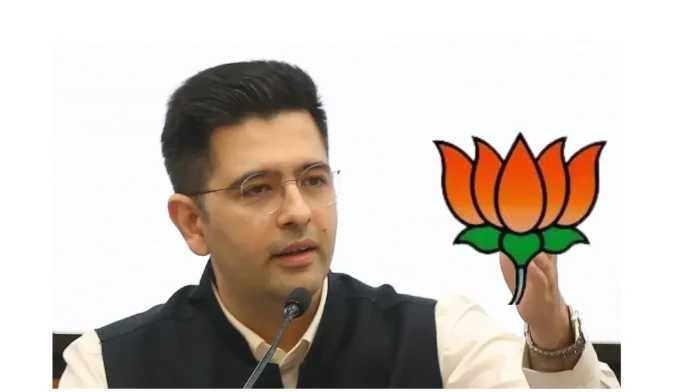
In 2022, a young Rajya Sabha MP named Raghav Chadha proposed a law to make defection harder. Four years later, he used the very loophole his bill would have closed — to walk out of the party he helped build.
Indian politics has produced many ironies. Rarely, though, does one arrive so precisely documented, with the evidence sitting on parliamentary record for all to see.
On 5 August 2022, Raghav Chadha — then the youngest member of the Rajya Sabha and a close aide of AAP chief Arvind Kejriwal — introduced a Constitution Amendment Bill as a Private Member’s Bill, calling for a tougher anti-defection law. He gave a passionate speech about lawmakers who betrayed the mandate of voters. He called floor-crossing a betrayal of democracy itself.
This week, Raghav Chadha crossed the floor.
“Nefarious floor crossing by legislators in total disregard of the democratic wishes of the electorate who returned them.”
— Raghav Chadha, describing defection in his 2022 Private Member’s Bill
What happened this week
Seven Aam Aadmi Party Rajya Sabha MPs — Raghav Chadha, Ashok Kumar Mittal, Harbhajan Singh, Sandeep Kumar Pathak, Vikramjit Singh Sahney, Swati Maliwal, and Rajinder Gupta — resigned from the party on April 24 and joined the Bharatiya Janata Party at its Delhi headquarters.
Chadha stated that the decision was taken collectively by more than two-thirds of AAP’s Rajya Sabha MPs, invoking constitutional provisions that permit such a merger. A few days prior, he had been removed as AAP’s deputy leader in the Rajya Sabha, with the party alleging that he had failed to raise key issues against the government.
The Rajya Sabha Chairman approved the merger. The Rajya Sabha Secretariat issued an official notice confirming the move, and all seven MPs are now listed in official records as part of the BJP. With this, the BJP’s strength in the Rajya Sabha rose to 113.
The numbers game: why 7 was the magic number
Under the anti-defection law, included in the Tenth Schedule of the Constitution, a member can lose their seat if they leave their party voluntarily or defy the party whip while voting. However, if at least two-thirds of a party’s members in the House decide to join another party, it is considered a valid merger rather than defection.
AAP currently has 10 MPs in the Rajya Sabha. With seven MPs backing the move, the group claims to have crossed the two-thirds threshold required to avoid disqualification.
Existing Law (2/3 threshold) 7 of 10
Chadha’s group meets this bar exactly. Merger approved.
Chadha’s 2022 Bill (3/4 threshold) 8 of 10
His group of 7 would have fallen short. Merger blocked.
The bill that haunts him
The proposed legislation was aimed at what Chadha himself described as “nefarious floor crossing by legislators in total disregard of the democratic wishes of the electorate.” It sought to strengthen the Tenth Schedule of the Constitution. Beyond raising the merger threshold, the Bill carried two additional provisions that make its resurfacing this week all the more pointed: it proposed that any MP or MLA who changed party after winning an election be banned from contesting elections for six years. It also sought to prevent “Resort Politics” by requiring elected representatives to appear before the Chair within seven days of withdrawing support from a government.
The Irony, Precisely Stated
Under the Bill that Chadha himself tabled in 2022, three-fourths of AAP’s ten Rajya Sabha members — meaning eight — would have been required. His current group of seven would not have qualified. And even if it had, every one of them would have faced a six-year bar from contesting any election. The Bill never passed. It remains listed against Chadha’s name in the Rajya Sabha records.
Is the merger even legally valid?
While Chadha’s move has widespread political ramifications — both for the AAP and for Punjab, which is heading for polls — it also gives rise to intricate legal questions.
For a merger to take place between AAP and the BJP, legal experts argue that the original political party — the AAP national party — through its party national head, should announce such a merger. If two-thirds of the AAP legislators across all legislative houses accept the merger, it would take effect. Otherwise, it is a situation of the tail wagging the dog, with a handful of legislators in a single house hijacking the party by announcing a merger with another party.
This understanding is supported by the Supreme Court’s Constitution Bench judgment in Subhash Desai v. Principal Secretary, Governor of Maharashtra (2023), which stated that a legislative party cannot act independently from the political party. To allow the legislative party to disconnect from its original political party would defeat the objectives of the Tenth Schedule.
Ultimately, the matter will have to be settled by the Supreme Court, and its decision in the Goa MLAs’ case will have a crucial bearing on the AAP-BJP merger in the Rajya Sabha.
Key facts at a glance
1Chadha introduced a Private Member’s Bill on Aug 5, 2022 to raise the merger threshold from 2/3 to 3/4 of a party’s legislative strength.
2His 2022 Bill also proposed a 6-year election ban for any MP or MLA who switched parties after winning.
3On April 24, 2026, Chadha led 6 AAP MPs to join BJP — using the exact loophole his bill would have closed.
4Rajya Sabha Chairman approved the merger. BJP strength in the Upper House now stands at 113.
5AAP’s Sanjay Singh has sought disqualification of Chadha, Mittal, and Pathak. Legal battle ongoing.
What this means for AAP — and Indian democracy
The AAP, once a symbol of political disruption and moral politics, has now lost seven of its ten Rajya Sabha members in a single day. With Punjab elections on the horizon, the damage is not merely numerical — it is reputational and structural.
More broadly, this episode puts a spotlight on India’s anti-defection law — a law that was designed to protect democracy but has, in practice, been used as a roadmap for engineering splits with just enough numbers to claim legality.
Raghav Chadha, in 2022, understood this problem better than most. He wrote a bill to fix it. That bill sits, unenacted, in the Rajya Sabha archives — a monument to the gap between what our lawmakers preach and what they practise.

