


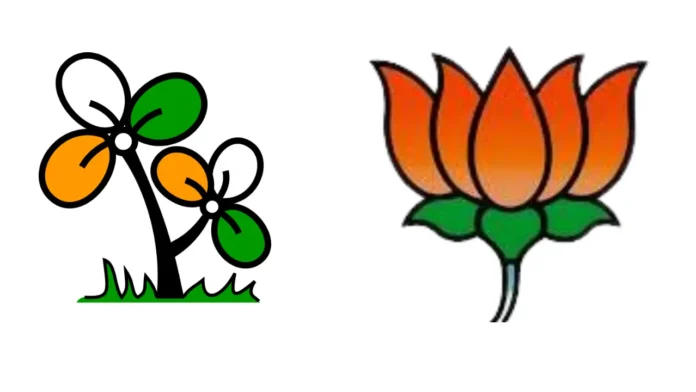
As West Bengal gears up for Phase 2 of the 2026 Assembly Elections, a Kolkata sweet shop has turned party symbols into edible art — proving that in Bengal, even politics tastes better with mishti.
Bengal has a long and affectionate relationship with sweets. Births, weddings, festivals, funerals — none of them pass without a plate of mishti. So perhaps it was only a matter of time before elections joined the list.
With Phase 2 of the 2026 West Bengal Assembly Elections just 48 hours away, a prominent confectioner in Kolkata has launched a special line of election-themed Sandesh. This beloved milk-based sweet is as central to Bengali identity as the Rabindra Sangeet or the monsoon. Except this time, each delicate piece is shaped and embossed with the symbols of the major contesting parties: the Trinamool Congress, the Bharatiya Janata Party, and the Communist Party of India (Marxist).
“In Bengal, nothing happens without sweets, not even a revolution or an election. We want people to celebrate the festival of democracy with something sweet.”
— Sweet shop owner, Kolkata
The sweetest ballot in the country
The sandesh — traditionally crafted from chhena (fresh cottage cheese) and sugar, pressed into moulds — has been reimagined here as a canvas for political expression. The shop’s artisans have intricately moulded each sweet to feature the logos of the three main parties vying for Bengal’s mandate, making them as much a conversation piece as a treat.
The initiative has drawn a steady stream of curious customers and media attention, with visitors picking up boxes of political sandesh as both a snack and a souvenir of an election season unlike any other.
TMC — Trinamool CongressBJP — Bharatiya Janata PartyCPI(M) — Communist Party of India (Marxist)
The bigger picture: Phase 2 stakes
The sweet gesture arrives at a charged political moment. Phase 2 of the 2026 West Bengal Assembly Elections, scheduled for April 29, will cover 142 seats — making it the largest and most consequential phase of the election. The phase encompasses the core strongholds of the Trinamool Congress, including Kolkata and its surrounding urban industrial belts.
The most-watched contest of this phase is the face-off between Chief Minister Mamata Banerjee and BJP’s Suvendu Adhikari in the Bhabanipur constituency — a clash that political observers are describing as a defining moment for both parties.
Security and sandesh, side by side
While sweet shops add flavour to the electoral atmosphere, the security machinery is running at full throttle. Central Armed Police Forces have intensified their presence at the state’s most critical transit points — including a massive checking operation at the iconic Howrah Bridge and Howrah Railway Station. Commuters and vehicles were subjected to rigorous inspections to prevent the movement of illicit cash, liquor, or weapons ahead of the vote.
The contrast is distinctly Bengali — armed forces at the bridge, artisanal sweets in the parlour, and an electorate that has historically taken both democracy and dessert very seriously.
More than a marketing stunt
It would be easy to dismiss the political sandesh as a novelty. But in a state where food is culture and culture is politics, the gesture carries weight. Bengal’s sweet shops have long been community anchors — places where neighbourhoods gather, news is exchanged, and opinions are formed over a cup of tea and a piece of mishti doi.
Turning party symbols into edible form is, in its own way, a leveller. Whether you vote for TMC, BJP, or Left, you can eat them all. And in a political climate as polarised as Bengal’s in 2026, that might just be the most radical statement a sweet shop can make.

 logos in traditional sandesh as West Bengal votes on April 29 across 142 assembly constituencies.)