


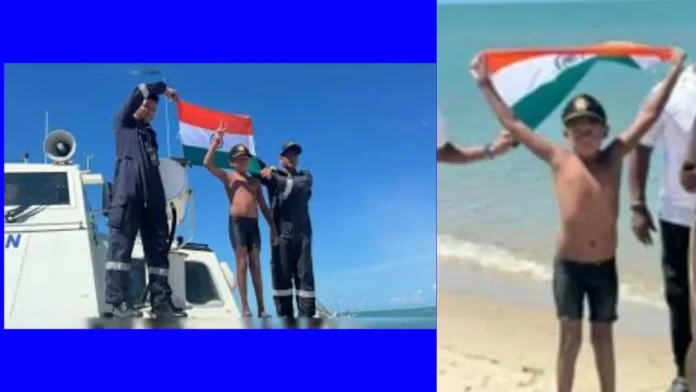
Most seven-year-olds spend their April mornings in classrooms or playing in their backyards. Ishank Singh spent his time in the middle of the ocean.
On April 30, 2026, this third-grade student from Dhurwa, Ranchi, jumped into the waters off Talaimannar, Sri Lanka. Nine hours and fifty minutes later, he touched the shore at Dhanushkodi, India. He had just swum 29 kilometres across the Palk Strait — one of the most unforgiving stretches of open water in Asia.
He was, officially, the youngest and fastest person in the world to complete this crossing. The Universal Records Forum (URF World Records) certified him with the title: “The Youngest and Fastest Palk Strait Swimmer.”
He is seven years old.
What Is the Palk Strait — and Why Does It Matter?
Before understanding what Ishank did, you need to understand what the Palk Strait actually is.
It is a body of water that separates the southern tip of India from the northern coast of Sri Lanka. Swimmers call it India’s equivalent of the English Channel. That comparison is not an exaggeration — if anything, it understates the challenge.
The strait carries strong, unpredictable tidal currents that shift direction without warning. The weather changes rapidly. Monsoons and cyclones expose these waters to choppy seas and rough winds. Beneath the surface, sharks and jellyfish are regular companions.
Even the most seasoned swimmers have described the experience as brutal. One veteran noted that the sea starts pleasant and then turns very rough, forcing you to fight against strong winds and a choppy, hostile surface. Swimmers don’t just need physical strength to cross this strait. They need mental toughness, sharp navigation, and hours of sustained discipline.
The crossing from Talaimannar to Dhanushkodi — the route Ishank chose — stretches roughly 29 kilometres. Adult athletes typically complete it in nine to fourteen hours. The previous youngest person to attempt and complete this route was 10-year-old Jai Jaswanth, who crossed it in 2019 in 10 hours and 30 minutes.
Ishank finished it in 9 hours and 50 minutes. He was seven.
The Boy Behind the Record
Ishank Singh lives in Dhurwa — a locality in Ranchi, the capital of Jharkhand. He studies in Class 3 at DAV Shyamali School.
His journey to the Palk Strait did not begin on April 30. It began much, much earlier — in the waters of Dhurwa Dam.
Every single day, Ishank trained at Dhurwa Dam in Ranchi for four to five hours. He covered 15 to 20 kilometres per session. Once a week, he pushed through an extended eight-hour training block with his full swimming team beside him. This was not a hobby. This was a discipline.
Two coaches shaped him. Coach Aman Kumar Jaiswal provided personal, hands-on training. Coach Bajrang Kumar guided his preparation from the technical side. Together, they built a seven-year-old into an open-water machine.
Before the Palk Strait, Ishank was not untested. On February 22, 2026, he competed in the Gateway of India open-water event, completing a one-kilometre swim in the Arabian Sea. He finished third. He was also preparing for a competition in the Periyar River in Kochi — a race with no age restriction, open to all swimmers.
In other words, Ishank did not stumble into a world record. He earned it, stroke by stroke, month after month.
The Day of the Crossing
April 30, 2026. Talaimannar, Sri Lanka.
Ishank entered the water at the start of the day. The Palk Strait stretched ahead of him — 29 kilometres of open sea, tidal currents, and deep uncertainty.
He swam.
For almost ten hours, he moved through water that challenges grown adults and elite athletes. The currents pushed. The sea changed. The hours added up. None of it stopped him.
At the end of 9 hours and 50 minutes, his hand touched the Indian shore at Dhanushkodi, Tamil Nadu.
He had done it.
What the Record Actually Means
To put Ishank’s achievement in context, it helps to look at the history of Palk Strait crossings.
The first-ever crossing happened in 1954, when Murugapillai Navratnaswami took 26 hours and 50 minutes to swim the full 59-kilometre route from Valvettithurai, Sri Lanka to Point Calimere, India. Over the decades, swimmers gradually reduced times and shortened routes. By 2022, the fastest crossing of the 29-kilometre route stood at around 9 hours and 28 seconds.
But all of these swimmers were adults or teenagers. The youngest previous record-holder for this crossing was 10-year-old Jai Jaswanth in 2019 — and he took 40 minutes longer than Ishank.
No child of Ishank’s age had ever attempted this, let alone completed it.
As a result, Ishank now holds a record that sits in its own category. He is not just the youngest. He is the youngest by three full years — an age gap that, in the world of open-water swimming, is extraordinary.
How Jharkhand Reacted
The news spread fast. Ranchi MP and Union Minister of State for Defence, Sanjay Seth, took to social media to celebrate, calling Ishank “Ranchi ka nanha lal” — Ranchi’s tiny gem. He described the achievement as a golden moment not just for Jharkhand, but for all of India.
Chief Minister Hemant Soren was also tagged in widespread social media celebrations of the feat. The entire state felt the pride of this moment.
Back at DAV Shyamali School, the reaction was the same. Teachers who had watched Ishank grow from a curious child to a record-breaking athlete stood proud. The principal confirmed that the whole school shared in his glory.
For Jharkhand — a state not typically associated with open-water swimming — this record carries special meaning. It shows that world-class talent does not need a coastal upbringing or elite infrastructure. It needs a will, a dam, two coaches, and a child who refuses to set limits for himself.
What Makes Ishank’s Training So Remarkable
Swimming 29 kilometres in the open ocean requires more than just fitness. It requires training your body to sustain effort for nearly ten hours, which, for most adults, is a full working day.
For a seven-year-old, the physical demands are even more complex. Children’s bodies recover differently. Their cardiovascular systems are still developing. The sheer volume of daily training — four to five hours every single day — is a load that most professional adult swimmers would find demanding.
And yet, Ishank not only sustained this training but thrived on it.
His preparation at Dhurwa Dam was the foundation. Open water behaves very differently from a pool. Currents shift. Temperatures vary. There are no lane ropes. Every metre demands judgment, not just speed. By training daily in open water, Ishank built exactly the skills the Palk Strait would demand from him.
His one-kilometre Arabian Sea swim in February was, in hindsight, a preview. He competed without hesitation against swimmers far older than him and finished on the podium. He was ready long before he reached Sri Lanka.
A Record That Belongs to More Than One Person
World records have individual names on them. But behind every record is a community.
Behind Ishank stands his family, who trusted a seven-year-old’s ambition and built their routines around it. Behind him stand coaches Aman Kumar Jaiswal and Bajrang Kumar, who turned raw talent into tested ability. Behind him stands a school that cheered instead of questioned, and a city that believed before the world had reason to.
Dhurwa Dam — a quiet reservoir on the outskirts of Ranchi — became the training ground for a world record. That says something powerful about what ordinary places can produce when extraordinary commitment fills them.
Why This Story Matters Beyond Swimming
Ishank’s record will live in the books. But the real story is what it tells us.
It tells us that geography is not destiny. Jharkhand is landlocked. The nearest ocean is hundreds of kilometres away. And yet, a child from Ranchi just became the world’s greatest young open-water swimmer.
It tells us that age is not a ceiling. Every benchmark Ishank crossed — the Gateway of India swim, the Palk Strait crossing, the world record — people could have said “he’s too young.” Nobody in his corner said that.
It tells us that everyday training builds extraordinary results. There was no magic. There was a dam, two coaches, and four to five hours of work every single day.
Above all, it tells us something simple and human: sometimes, a child just decides to swim — and the ocean gets out of the way.

