


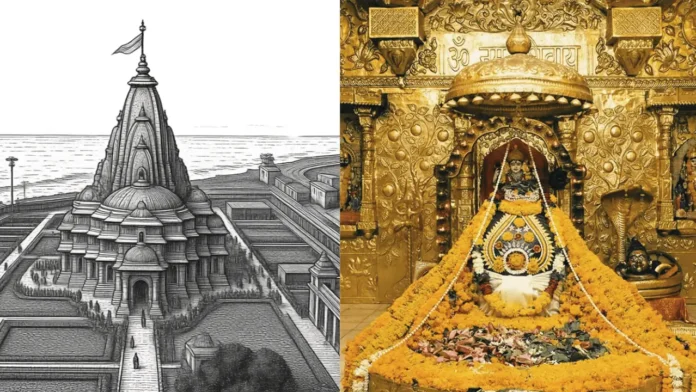
75 Years of Punarnirman
1,000 Yrs since Ghazni’s attack
17 Times attacked & rebuilt
12 Jyotirlingas
On May 11, 1951 — exactly 75 years ago today — President Dr. Rajendra Prasad consecrated the newly reconstructed Somnath Temple, fulfilling a resolve made by Sardar Vallabhbhai Patel on the soil of free India. Today, as the nation marks the Somnath Amrut Mahotsav, we revisit twelve extraordinary facts about this shrine that has refused to die — a temple that mirrors the very soul of India.
Fact 01 The Moon God built it first — in gold
According to legend, Soma (the Moon God) was cursed by his father-in-law, Daksha, to lose all his radiance after neglecting 26 of his 27 wives. He came to Prabhas Patan, performed penance before Lord Shiva, and was partially freed from the curse. In gratitude, Soma built the very first Somnath temple — in gold. Later, Ravana is said to have rebuilt it in silver, and Lord Krishna in sandalwood during the Dwapara Yuga. The name “Somnath” itself means Lord of Soma — the Moon’s own deity.
Fact 02: The first and most radiant of the 12 Jyotirlingas
Ancient texts, including the Shiva Purana and the Jnanasamhita, unanimously place Somnath at the very top of the 12 Jyotirlinga shrines — sacred sites where Shiva manifested as an infinite pillar of light. This makes Somnath the Adi Jyotirlinga, the primordial luminous form of the Lord. Devotees believe that a single pilgrimage here carries the merit of visiting all twelve.
Fact 03 Mentioned in the Mahabharata & Bhagavata Purana
The site of Prabhas Patan appears in some of India’s oldest texts. It is also the place where Lord Krishna is said to have left his mortal body after being accidentally struck by the hunter Jara’s arrow near Bhalka Tirth — just a short distance from the temple. Somnath thus holds the sacred memory of both Shiva and Krishna within one landscape.
History of Destruction & Resurrection
725 CE First recorded attack by Al-Junayd, Arab governor of Sindh. The temple was rebuilt by the Gurjara-Pratihara king Nagabhata II in the 9th century.
1026 CE Mahmud of Ghazni’s infamous raid — he looted 20 million dinars’ worth of gold and desecrated the Jyotirlinga. Reportedly, 50,000 devotees died defending the shrine. The temple was yet to be rebuilt within twelve years.
1299 CE Alauddin Khilji’s generals sacked the temple. Veer Hamirji Gohil sacrificed his life defending it. Rebuilt by the Chudasama king Mahipala I in 1308.
1706 CE, Mughal emperor Aurangzeb ordered the final destruction. Ahilyabai Holkar of Indore built an adjacent temple in 1783 to keep the worship uninterrupted.
1947 CE On November 12 (Diwali day), Sardar Vallabhbhai Patel visited the ruins and declared his resolve to rebuild the temple through a public trust model — the Somnath Trust.
1951 CE President Dr. Rajendra Prasad consecrated the rebuilt temple on May 11. The structure, built by traditional Somapuri craftsmen, was complete after 5 years of reconstruction work.
Fact 04 Attacked 17 times — and rebuilt each time
Across centuries of foreign invasions — Arab governors, Ghaznavids, the Delhi Sultanate, the Mughals, and even the Portuguese — Somnath was attacked and looted 17 times. Yet each time, devoted rulers and common people pooled their faith and resources to raise the temple again. No other shrine in the world carries such a relentless record of destruction and rebirth, making Somnath arguably the most resilient temple on earth.
Fact 05 Built in the majestic Chalukya (Māru-Gurjara) style
The current temple was constructed in the Chaulukya style of architecture — also called Māru-Gurjara — known for its soaring shikhara (spire), intricate lattice carvings of elephants, lions, celestial beings, and legendary scenes from Hindu texts. The shikhara rises nearly 155 feet above the ground, visible from far out at sea. The flag mast atop the spire stands 37 feet tall and is changed three times every single day.
Fact 06: No land between here and Antarctica
One of the most astonishing geographic facts about Somnath is inscribed on a pillar (Baan-Stambh) on the temple premises in Sanskrit: on the longitude of Somnath’s seashore, there is absolutely no land between this point and the South Pole — only open ocean all the way to Antarctica. It places Somnath at the westernmost sacred gateway of the Indian subcontinent, and the inscription is a testament to how advanced ancient Indian geographic knowledge truly was.
Fact 07: A Triveni Sangam at the seashore
The temple sits at the confluence of three sacred rivers — the Kapila, the Hiran, and the mythical Saraswati — where they meet the Arabian Sea. This Triveni Sangam elevates Somnath’s spiritual potency immensely. Pilgrims take a holy dip at this junction before entering the temple, combining the blessings of the sea and the three rivers in a single act of devotion.
Fact 08 Sardar Patel’s resolve on Diwali, 1947
Just months after Independence, on Diwali day — November 12, 1947 — Sardar Vallabhbhai Patel stood among the ruins of Somnath and declared that restoring this temple was essential to restoring India’s cultural confidence. He backed the formation of the Somnath Trust to oversee public fundraising and reconstruction. K.M. Munshi, author of Somnath, The Shrine Eternal, became the driving intellectual force behind the effort. Patel never lived to see its completion — he passed away in December 1950 — but his vision was fulfilled on May 11, 1951.
Fact 09 Built through public donations, not the state treasury
The reconstruction was deliberately kept outside government funding. Sardar Patel chose a public trust model so that the temple would truly belong to the people of India. Donations poured in from across the country. The traditional Somapuri master builders of Gujarat were engaged, ensuring that the craft lineages that had built such temples for centuries were preserved and honoured in the new structure.
Fact 10: Consecrated by the President himself
On May 11, 1951, India’s first President, Dr. Rajendra Prasad, performed the installation ceremony — pratishtha — for the new temple. This was a landmark moment: a head of the secular Republic of India personally consecrating a Hindu shrine, underscoring that the restoration was as much a civilisational act as a religious one. The current Chairman of the Somnath Trust is the Prime Minister of India.
Fact 11: Three aartis daily — and a legendary sound & light show
The temple performs the Mangala Aarti at dawn, Madhyan Aarti at midday, and Sandhya Aarti at dusk — all open to devotees. Each evening after sunset, a spectacular sound-and-light show narrates Somnath’s turbulent and triumphant history in multiple languages, recreating the epoch of Mahmud of Ghazni, the age of reconstruction, and the devotion of millions. With waves crashing on the Arabian Sea behind the illuminated spire, the experience is unlike any in India.
Fact 12 2026: 1,000 years since the most infamous attack
The year 2026 marks an extraordinary double milestone: 75 years since the temple’s consecration in independent India, and 1,000 years since Mahmud of Ghazni’s devastating raid of January 1026 CE — the most recorded attack in the temple’s history. Prime Minister Narendra Modi described this convergence as a moment for India to reflect on “the unconquerable spirit of Somnath” and announced special pujas for the next 1,000 days to mark both milestones together.
“Somnath is not merely a temple. It is the living proof that no force on earth can extinguish the flame of faith.”
— Reflecting the spirit of the Somnath Amrut Mahotsav, May 11, 2026
🕉 Jai Somnath
On this 75th anniversary of Punarnirman, Somnath stands not as a relic of the past but as an eternal declaration — that devotion endures, civilisations endure, and India endures. From the Moon God’s golden shrine to the honey-stone spire rising against the Arabian Sea today, the story of Somnath is the story of an inextinguishable light.

