


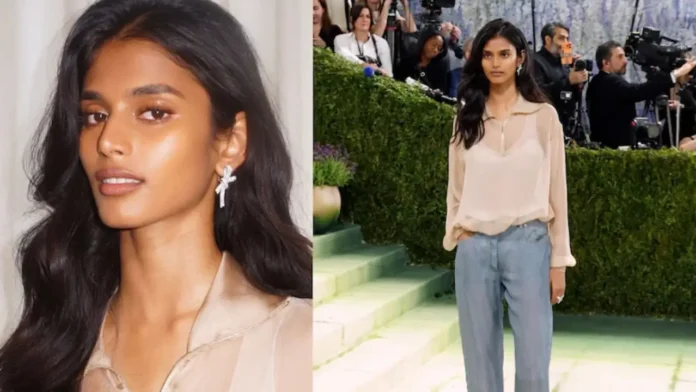
In an industry that often celebrates legacy, privilege, and familiar faces, Bhavitha Mandava arrived from an entirely different world. She did not grow up inside fashion circles. She did not spend her teenage years chasing runways or luxury campaigns. Instead, she spent them studying architecture, design systems, and technology.
Yet within less than two years, Bhavitha transformed from an international student in New York into one of the most talked-about names in global fashion.
Her rise was not accidental. It came from timing, courage, adaptability, and an identity she refused to dilute.
Today, Bhavitha Mandava stands at the intersection of fashion, technology, architecture, and representation. More importantly, she represents a generation of Indian women entering elite global spaces without abandoning where they come from.
Early Life in Hyderabad
Hyderabad shaped Bhavitha Mandava long before the world knew her name.
Born on February 3, 2000, into a Telugu family, Bhavitha grew up in a city where old-world culture meets modern innovation. Hyderabad’s fast-changing skyline influenced her fascination with structure and design from an early age.
Unlike many fashion icons, Bhavitha never dreamed about magazine covers or luxury campaigns. Her first love was architecture.
She pursued a Bachelor’s degree in Architecture from Jawaharlal Nehru Technological University, where she developed a strong understanding of spatial thinking, geometry, proportion, and visual storytelling.
That educational background later became one of her biggest strengths in fashion. Designers often look for models who understand movement, silhouette, and composition. Bhavitha naturally understood those ideas because architecture had already trained her eye.
Moving to New York and Starting Again
After completing her undergraduate studies, Bhavitha moved to New York City to pursue a Master of Science degree in Integrated Design and Media/Human-Computer Interaction at New York University Tandon School of Engineering.
The transition was not easy.
Like thousands of international students, she had to balance academics, finances, and emotional distance from home. New York offered opportunity, but it also demanded resilience.
To support herself, Bhavitha worked as a Design Lab Coordinator at NYU’s MakerSpace. The role helped her pay expenses, but it also immersed her in a collaborative creative environment.
Friends and colleagues later described her as focused, observant, and deeply curious. Even before fashion entered her life, she had already built a reputation for discipline and creativity.
That period became crucial because it grounded her identity before global attention arrived.
The Subway Encounter That Changed Everything
In the summer of 2024, Bhavitha’s life shifted unexpectedly.
While commuting through the New York subway system, a modelling scout noticed her. Encounters like these often sound cinematic. Most, however, lead nowhere.
Bhavitha initially hesitated. Modelling had never been part of her long-term plan. Still, the possibility of earning additional income while studying made her reconsider.
That decision changed everything.
Within weeks, she travelled to Milan, where she met Matthieu Blazy.
Blazy reportedly recognised something unusual in her presence immediately. She did not resemble the polished, predictable image often associated with luxury fashion. Instead, she carried intellectual sharpness, calm confidence, and a face that felt modern yet timeless.
Soon after, Bhavitha walked exclusively for Bottega Veneta’s Spring/Summer 2025 presentation.
Fashion insiders took notice almost instantly.
Why Bottega Veneta Became Her Perfect Beginning
For many new models, the industry can feel transactional. Yet Bhavitha’s entry through Bottega Veneta gave her something rare — narrative credibility.
The brand has long valued understated elegance over excessive glamour. Bhavitha fit that philosophy naturally.
Her runway presence felt different. She did not perform for attention. Instead, she projected quiet control. That quality resonated strongly during a period when luxury fashion increasingly leaned toward subtle sophistication rather than overt extravagance.
Campaign appearances followed quickly. Editorial shoots expanded her visibility across Europe and the United States.
Soon, major fashion houses began approaching her.
Becoming the First Indian Woman to Open a Chanel Show
The defining moment of Bhavitha Mandava’s career arrived on December 2, 2025.
At Chanel’s Métiers d’Art 2026 presentation in New York, Bhavitha became the first Indian woman in history to open a Chanel runway show.
The location carried symbolic meaning. Chanel staged the show inside a disused subway-inspired setting in the Bowery, echoing the environment where Bhavitha herself had first been discovered.
Fashion rarely creates narratives this perfectly.
Opening a Chanel show is not simply another runway appearance. It signals trust, prestige, and visibility at the highest level of luxury fashion. The opening model sets the emotional tone for the entire presentation.
For Bhavitha, the moment carried even greater cultural importance.
Indian models have appeared on global runways for decades. Yet very few have occupied central positions within the hierarchy of European luxury fashion houses. Bhavitha’s achievement, therefore, represented more than personal success. It marked a visible shift in who gets to define global beauty and luxury.
The British Vogue Cover That Cemented Her Global Status
In early 2026, Bhavitha reached another milestone when she appeared on the cover of British Vogue.
Magazine covers still matter in fashion because they validate longevity. Runways create buzz, but editorial recognition builds legacy.
The cover positioned Bhavitha not merely as a trending model but as an influential cultural figure.
Fashion commentators also noted how naturally she bridged multiple worlds. She spoke comfortably about architecture, technology, migration, creativity, and fashion without sounding manufactured.
That authenticity strengthened her appeal.
The Met Gala 2026 Controversy Explained
Bhavitha’s debut at the Met Gala 2026 sparked intense online debate.
She arrived wearing what appeared to be a minimalist outfit: a white tank top, faded denim, and a sheer jacket.
Social media reacted immediately.
Some viewers praised the styling as intelligent and subversive. Others argued that a rising Indian star deserved a more dramatic fashion moment for such a prestigious debut.
However, the public initially misunderstood the concept entirely.
The outfit was actually a highly detailed Haute Couture creation by Chanel. According to reports, artisans spent nearly 250 hours constructing the look.
The ensemble intentionally referenced the New York subway platform where Bhavitha’s modelling journey began.
That context transformed the outfit from “simple” into deeply narrative-driven fashion.
Bhavitha later defended the look by explaining that it reflected her personal story rather than internet expectations.
In many ways, the controversy revealed a larger truth about contemporary fashion culture. Audiences often celebrate “authenticity” until someone genuinely embraces understatement instead of spectacle.
Bhavitha refused to perform excess simply because the moment demanded it.
Why Bhavitha Mandava Represents a New Era
Bhavitha’s influence extends far beyond modelling.
She represents a growing shift inside global fashion where intelligence, cultural identity, and interdisciplinary backgrounds matter as much as conventional glamour.
Her story resonates strongly because it feels modern and believable.
She is not someone manufactured entirely by fashion institutions. She entered the industry carrying experiences from architecture, technology, migration, and academic life.
That complexity makes her relatable to younger audiences worldwide.
For Indian representation, especially, her rise carries enormous significance.
For years, South Asian visibility in luxury fashion remained limited or stereotyped. Bhavitha challenges those limitations simply by existing as herself — educated, ambitious, understated, and globally competitive.
She does not fit into older expectations of how Indian women should appear or behave in Western luxury spaces.
That is precisely why her presence feels important.
Balancing Fashion, Technology, and Identity
Even as her modelling career accelerated, Bhavitha reportedly continued balancing academic commitments and creative interests connected to design and technology.
That balance distinguishes her from many traditional fashion success stories.
Her educational background in human-computer interaction and integrated media reflects broader industry changes where fashion increasingly intersects with digital culture, AI, immersive design, and technological storytelling.
Bhavitha therefore represents more than runway beauty. She embodies the future-facing creative professional — someone capable of moving between disciplines fluidly.
Fashion brands increasingly value that multidimensional perspective.
Social Media Influence Without Manufactured Celebrity
Bhavitha’s growing social media following reflects genuine curiosity rather than aggressive celebrity branding.
Audiences appear drawn to her because she feels grounded.
Her online image avoids excessive performance. Instead, she shares moments connected to work, creativity, travel, and identity with unusual restraint for the digital age.
That understated presence aligns perfectly with the aesthetic direction many luxury brands now favour.
In an era dominated by hyper-visibility, Bhavitha’s quiet confidence stands out.
The Larger Meaning of Her Story
Bhavitha Mandava’s rise matters because it expands the imagination of what success can look like.
She did not abandon education for fame. She did not reinvent herself completely to fit fashion’s expectations. And she did not erase her cultural identity to become globally accepted.
Instead, she carried every part of herself into the industry.
That approach has made her more than a successful model. It has made her symbolic of a broader generational change.
Young people today no longer want one-dimensional success stories. They admire individuals who can exist across multiple worlds at once.
Bhavitha represents exactly that possibility.
From Hyderabad classrooms to New York subway stations and Chanel runways, her journey reflects ambition shaped by intellect, risk, adaptability, and authenticity.
And judging by the speed of her ascent, the fashion industry has only begun to understand her impact.

