


Ancient yogis knew how to survive scorching Indian summers without a single air conditioner. Science now explains why its methods worked. These 10 cooling asanas and pranayamas lower body temperature, calm the nervous system, and prepare you for the day’s heat — in just 20 minutes.
Poses covered
10 asanas + pranayamas
Routine length 20 minutes
Best time 5 AM – 7 AM
Suitable for all levels, all ages
When temperatures climb past 40°C across India’s plains, most people reach for the AC remote. But for millions without that option — and for those who want a natural, science-backed way to manage heat — yoga offers a remarkably effective answer. Specific pranayamas (breathing techniques) directly lower core body temperature through evaporative cooling in the respiratory tract. Inversions calm the nervous system and reduce heat-triggered anxiety. Gentle forward folds activate the parasympathetic nervous system — the body’s “rest and cool” response — counteracting the fight-or-flight heat stress response.
This 20-minute morning routine is designed specifically for Indian summer conditions. Do it before 7 AM, on an empty stomach, ideally near a window or outdoors in the shade.
Before you begin: Practice on an empty stomach. Use a cotton yoga mat or a simple drape. Wear light cotton clothing. Keep a glass of room-temperature water nearby. Never practice in direct sunlight in summer — always in shade or indoors with ventilation.
The 10 cooling poses — complete guide
01 Sheetali Pranayama
Cooling breath — शीतली प्राणायाम
Breathing
Sheetali is the single most powerful cooling technique in all of yoga — and the science is direct. When you inhale through a curled tongue, the air passes over a large, moist surface area, losing heat through evaporative cooling before entering the lungs. This is the same mechanism that makes sweating work — but applied directly to your respiratory system. Research published in the International Journal of Yoga confirmed that regular Sheetali practice measurably reduces body temperature and oral temperature within minutes of practice. It also calms the vagus nerve, reducing heat-triggered irritability and anxiety that Indian summer routinely causes.
Duration 5 minutes
Repetitions 10–15 rounds
Effect: Direct body cooling
Level
All levels
How to do it
Sit comfortably. Roll your tongue into a tube shape and extend it slightly outside the lips. Inhale slowly and deeply through the rolled tongue. Close the mouth, hold for 2 seconds, then exhale through the nose. Repeat 10–15 times. If you cannot curl your tongue, try Sheetkari (next pose).
02 Sheetkari Pranayama
Hissing breath — शीत्कारी प्राणायाम
Breathing
Sheetkari is Sheetali’s companion — an equally effective cooling pranayama for people who cannot roll their tongue (a genetic trait roughly 30% of Indians cannot perform). Instead of a rolled tongue, you press the upper and lower teeth together and inhale through the gaps — creating a soft hissing sound. The cooling mechanism is identical: cool, moist air contacts the teeth, tongue, and gum surfaces, lowering the temperature of inhaled air before it reaches the lungs. Ancient texts describe Sheetkari as “the destroyer of thirst,” — which aligns precisely with its effect on the hypothalamus, the brain’s thermostat.
Duration 3–5 minutes
Repetitions 10–12 rounds
Effect Cools the hypothalamus
Level All levels
How to do it
Sit in Sukhasana. Press teeth together lightly, part the lips, and inhale through the gaps between teeth with a soft “ssss” sound. Feel the cool air on your teeth and tongue. Exhale through the nose. Practise 10–12 rounds as an alternative or addition to Sheetali.
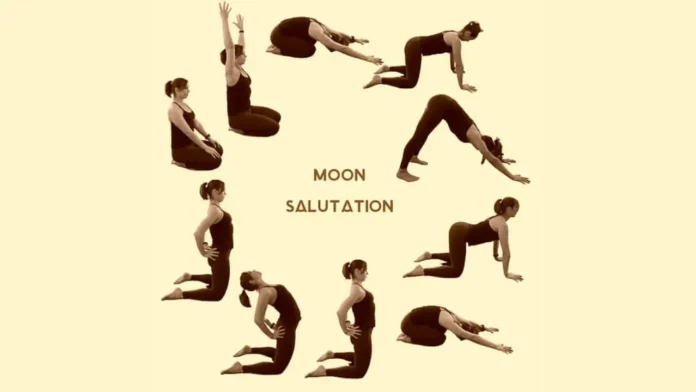
03 Sitali Moon Salutation
Chandra Namaskar — चन्द्र नमस्कार
All levels
While everyone knows Surya Namaskar (Sun Salutation), few know that its cooling counterpart — Chandra Namaskar (Moon Salutation) — was specifically designed for summer practice. Where Surya Namaskar is energising and heat-generating, Chandra Namaskar is slow, lateral, and introspective. It stimulates the Ida nadi — the lunar energy channel in yogic anatomy — which corresponds in modern physiology to the parasympathetic nervous system. Activating this system directly counteracts the sympathetic “heat stress” response, reducing cortisol, lowering heart rate, and allowing the body to dissipate heat more efficiently through peripheral blood flow.
Duration 5–6 minutes
Rounds 3–4 rounds
Pace Very slow
Focus Left side dominant
Key tip
Move at half the speed you would in Surya Namaskar. Breathe deeply and slowly through the nose throughout. Include wide lateral lunges (Ashwa Sanchalanasana) and side-bending poses (Ardha Chandrasana). End each round in Balasana (child’s pose).
04 Balasana — Child’s pose
बालासन — the great restorer
Beginner
Balasana is deceptively simple — and profoundly cooling. When the forehead rests on the mat, it activates the prefrontal cortex’s calming circuits and simultaneously stimulates marma points (pressure points in Ayurveda) at the Ajna chakra between the brows, which ancient texts describe as directly connected to thermal regulation. In modern terms, the forward-folded, compressed position lengthens the spine, reduces blood pressure, and triggers a deep parasympathetic response. The body temperature perception drops noticeably within 60 seconds of holding this pose. For children and the elderly, this is the safest and most accessible cooling pose on this list.
Hold time 1–3 minutes
Effect Deep nervous system calm
Safe for the elderly, children, and pregnant women
Avoid if Knee injury
How to do it
Kneel on the mat, sit back on your heels, and extend your arms forward (or rest them alongside the body). Lower your forehead to the mat. Breathe deeply and slowly. Hold for 1–3 minutes. Use a folded blanket under the forehead for comfort if needed.
05 Paschimottanasana
Seated forward bend — पश्चिमोत्तानासन
All levels
This seated forward fold is classified in Hatha Yoga Pradipika as one of the most powerful poses for cooling Pitta — the Ayurvedic dosha associated with fire, heat, and inflammation. The deep compression of the abdomen stimulates the vagus nerve and activates digestive organs, reducing the heat-related sluggishness and acidity that summer typically causes. The forward fold also stretches the entire posterior chain — the back of the body — which becomes chronically tight and hot in summer due to dehydration and tension. Holding this pose with slow, deep breaths is the seated equivalent of cooling down an overheated engine.
Hold time 1–2 minutes
Ayurvedic effect: Reduces Pitta
Also helps Digestion, back pain
Avoid if Slipped disc
How to do it
Sit with legs extended. Inhale, lengthen the spine. Exhale, hinge forward from the hips (not the waist), and reach toward the feet. Hold the ankles, shins, or feet — wherever you comfortably reach. Do not force. Breathe slowly. Hold 1–2 minutes.
06 Viparita Karani
Legs up the wall — विपरीत करणी
Beginner
Viparita Karani — lying on your back with legs resting vertically against a wall — is one of yoga’s most underrated summer poses. By inverting the legs, venous blood that has pooled in the lower body (common in summer when blood vessels dilate from heat) drains back to the heart and core organs, reducing swelling, fatigue, and the heavy-legged feeling that hot Indian days cause. The supine position also activates the parasympathetic nervous system, slowing heart rate and reducing the body’s heat-generating metabolic activity. Many yoga teachers in India recommend this pose specifically for people who have spent time outdoors in the Loo.
Hold time 5–10 minutes
Best time after outdoor activity
Effect: Reduces leg swelling
Props needed Wall or bolster
How to do it
Lie on your back near a wall. Swing legs up to rest vertically against the wall. Arms can rest at the sides or on the belly. Place a folded blanket under the hips for support. Close eyes, breathe naturally, and hold for 5–10 minutes. Excellent as an afternoon restorative practice.
07 Supta Baddha Konasana
Reclining bound angle — सुप्त बद्ध कोणासन
Beginner
This reclined butterfly pose opens the inner groin and hip region — areas that carry significant heat in the body due to their proximity to major blood vessels. By gently stretching the inner thighs and groin, this pose stimulates the femoral arteries and encourages peripheral circulation, helping the body release stored heat through the skin. It also opens the chest and diaphragm, enabling deeper, slower breathing — which directly correlates with lower heart rate and reduced body temperature. In restorative yoga, this is considered the “thermal reset” pose — the one you return to when the body is overheated from an active sequence.
Hold time 3–5 minutes
Effect Peripheral heat release
Safe for Pregnancy (with bolster)
Props Blanket, bolster helpful
How to do it
Lie on your back. Bring the soles of the feet together and let the knees fall outward like a butterfly’s wings. Rest your hands on the belly or sides. Place folded blankets under the outer thighs for support if the hips are tight. Hold for 3–5 minutes with slow breathing.
08 Ardha Matsyendrasana
Half spinal twist — अर्ध मत्स्येन्द्रासन
All levels
Spinal twists are the body’s internal massage — and in summer, they serve a particularly valuable cooling function. Ardha Matsyendrasana compresses and then releases the liver, kidneys, and digestive organs in sequence, stimulating the removal of metabolic waste products that accumulate faster in summer heat. It also stretches the intercostal muscles between the ribs, improving respiratory efficiency so each breath delivers more oxygen with less muscular effort — reducing heat generated by breathing. In Ayurveda, this twist is prescribed for reducing Pitta accumulation in the digestive system, the root cause of the acidity and irritability that so many Indians experience in May and June.
Hold time 30–60 sec each side
Effect Detox + spinal health
Helps with Summer acidity, fatigue
Avoid if Spinal injury
How to do it
Sit with legs extended. Bend the right knee and place the right foot outside the left thigh. Place the left elbow outside the right knee and twist the torso to the right. Hold 30–60 seconds while breathing deeply into the twist. Repeat on the other side.
09 Sarvangasana
Shoulder stand — सर्वांगासन
Intermediate
Sarvangasana — the “queen of asanas” — exerts gentle pressure on the thyroid gland in the throat, stimulating it to regulate metabolism and, in turn, body temperature. A hyperactive thyroid or metabolism generates excess body heat — a common aggravator in summer. The inversion also dramatically increases venous return to the heart, reducing the burden on the cardiovascular system that summer heat typically increases. While this pose requires more practice than the others, even a supported variation (with a blanket under the shoulders) provides significant cooling and nervous system benefits. Do not attempt without basic training.
Hold time 1–3 minutes
Effect Thyroid + metabolism regulation
Avoid if Neck/spine issues, BP
Level Intermediate
Safety note
Always place a folded blanket (4–5 cm thick) under the shoulders to protect the cervical spine. Never turn the head in this pose. If you have high blood pressure, thyroid disorders, or neck injuries, practice Viparita Karani instead as a safe alternative.
10 Yoga Nidra / Shavasana
Conscious rest — योग निद्रा / शवासन
Beginner
Every cooling yoga session must end with Shavasana — and ideally a brief Yoga Nidra (yogic sleep) practice. This is not merely rest: Shavasana is a deliberate, complete withdrawal of the body’s thermal and muscular activity, allowing the nervous system to fully integrate the cooling effects of the preceding practice. During Shavasana, the body’s metabolic rate drops to its lowest waking level — generating minimum heat. Core temperature measurably drops in subjects who hold Shavasana for more than 7 minutes. Yoga Nidra, a guided relaxation practiced in Shavasana, additionally activates the hypothalamus to reset the body’s thermostat to a lower baseline. It is the final — and most important — tool in your summer cooling toolkit.
Duration 5–10 minutes
Effect Thermostat reset
Never skip. Always end here
Enhancement
Use the Yoga Nidra audio
How to do it
Lie flat on your back, feet slightly apart, arms at your sides with palms facing up. Close your eyes. Consciously relax every part of the body from the feet upward. Breathe naturally. Lie completely still for 5–10 minutes. Cover yourself with a thin cotton sheet if needed.
Your complete 20-minute morning cooling routine
0–5 min Sheetali + Sheetkari Pranayama — 10 rounds each, seated comfortably
5–10 min Chandra Namaskar — 3 slow rounds, left side first
10–13 min Paschimottanasana + Ardha Matsyendrasana — 90 seconds each
13–15 min Balasana — 2 minutes, forehead on mat, deep breathing
15–17 min Viparita Karani or Sarvangasana — 2 minutes against wall
17–20 min Shavasana / Yoga Nidra — complete stillness, never skip
Important summer yoga safety tips
Never practise hot yoga or vigorous vinyasa in Indian summer — it generates internal heat and increases heatstroke risk. Always practise in a ventilated, shaded space. If you feel dizzy, nauseous, or excessively sweaty during practice, stop immediately, lie in Shavasana, and drink water. People with hypertension should avoid inversions (Sarvangasana) and practise Viparita Karani instead.
The bottom line
India’s classical yoga tradition was built in a country that regularly experiences temperatures above 45°C — and it developed precise tools for surviving that heat without modern technology. Sheetali and Sheetkari pranayamas directly lower body temperature through respiratory evaporative cooling. Moon salutations and forward folds calm the heat-generating sympathetic nervous system. Inversions reset circulation and reduce cardiovascular heat load. Shavasana resets the hypothalamus. Together, these 10 practices form a complete, science-backed cooling system that any Indian family can practise — for free, every morning, in 20 minutes.

