


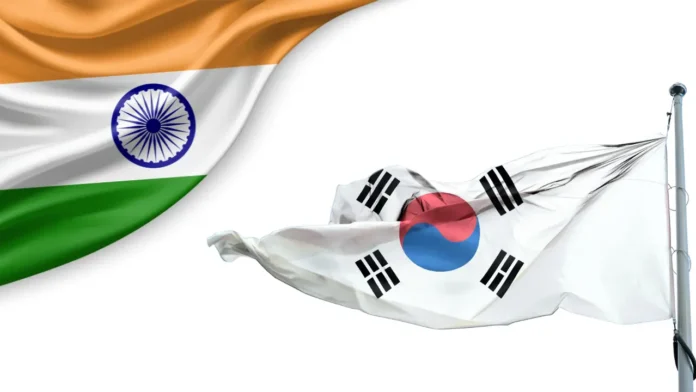
South Korean President Lee Jae-myung’s landmark state visit to New Delhi — the first in eight years — sets a $50 billion trade target, a CEPA upgrade, and a new blueprint for Indo-Pacific cooperation between two of Asia’s largest democracies.
A visit eight years in the making
When South Korean President Lee Jae-myung touched down at AFS Palam in New Delhi on April 19, 2026, accompanied by First Lady Kim Hea-kyung, it marked the end of an unusually long diplomatic silence between the two nations that call themselves Special Strategic Partners. The last time a South Korean head of state had visited India was in 2018 — a gap that neither capital seemed fully satisfied with, but neither had moved urgently to close.
Lee, who assumed the South Korean presidency in June 2025 after one of the country’s most dramatic political journeys — from poverty to imprisonment to the Blue House — arrived in India as part of a broader regional outreach that will next take him to Vietnam. His visit to India, however, is being treated as the centrepiece: a signal that Seoul is serious about anchoring itself in the Global South, and that New Delhi is ready to be a foundational partner in that effort.
“We are going to transform this trusted partnership into a futuristic partnership — from chips to ships, talent to technology, environment to energy.”
— PM Narendra Modi, joint press statement, Hyderabad House, April 20, 2026
The summit: what happened at Hyderabad House
Following a ceremonial welcome at Rashtrapati Bhavan — with President Droupadi Murmu and PM Modi both on the forecourt — and a visit to Rajghat to pay tribute to Mahatma Gandhi, Lee sat down with Modi for delegation-level talks at Hyderabad House. The outcome was a package of announcements that both sides described as a structural reset of the relationship.
Five major mechanisms were launched or committed to at the summit:
India-Korea Financial Forum — a new platform to facilitate financial flows and investment between the two countries. Finance
Industrial Cooperation Committee — a structured body to strengthen business-to-business cooperation and manufacturing partnerships. Industry
Economic Security Dialogue — a dedicated channel for critical technology cooperation and supply chain resilience. Tech & Security
Korean Industrial Townships — designated zones within India to facilitate Korean SME entry and manufacturing scale-up. Make in India
CEPA upgrade within 12 months — both sides committed to renegotiating and upgrading the India-Korea Comprehensive Economic Partnership Agreement within one year. Trade
The six sectors driving the partnership
Semiconductors
Cooperation in chip design, fabrication, and supply chain security. South Korea’s Samsung and SK Hynix have deep expertise India wants access to.
Shipbuilding
A focal point of the summit. India’s employment priorities align with South Korea’s industrial shipbuilding strengths — a natural match.
Artificial Intelligence
AI cooperation in research, deployment, and digital governance — part of the broader “critical and emerging technologies” agenda.
Green energy
South Korea joined the International Solar Alliance — unlocking joint renewable energy projects and clean tech investment flows.
Defence production
Korean engineering integrated into India’s Make in India defence initiative — building domestic manufacturing capacity for defence hardware.
Cultural & people ties
An India-South Korea Friendship Festival has been announced for 2028. The Korean Wave (K-culture) has built organic people-to-people goodwill.
Who is Lee Jae-myung — and why does his visit matter?
Lee Jae-myung is not a typical Asian head of state. Born into poverty in a rural South Korean village, he worked in a factory as a child, losing a finger to industrial machinery. He taught himself law, became a human rights lawyer, rose through local government, and eventually became governor of Gyeonggi Province and then a two-time presidential contender. His election in 2025 followed the impeachment of his predecessor and a period of acute political instability in Seoul.
Modi acknowledged Lee’s personal story in his opening remarks — describing it as “an inspiring example of struggle, service, and dedication.” The personal chemistry between the two leaders, who had met previously, was cited by both sides as a foundation for the expanded partnership.
For Lee, the India visit is also an ideological statement. His government has positioned South Korea as a key player in Global South diplomacy — a pivot away from over-reliance on the United States and China as the sole anchors of Seoul’s foreign policy. India, as the world’s most populous country and the fifth-largest economy, is central to that strategy.
Lee Jae-myung, President of South Korea
“Amidst ongoing supply chain instability and a global economic crisis stemming from the aftermath of the Middle East conflict, the Republic of Korea and India are emerging as increasingly vital strategic partners for one another.”
Lee Jae-myung, on India’s global role
“India is no longer just a consumer market, but has emerged as a key country driving global production and supply chains.”
The CEPA question: why is upgrading the trade pact complex
The Comprehensive Economic Partnership Agreement between India and South Korea was signed in 2009 and came into force in 2010. It was one of India’s early landmark free trade agreements — and has had a mixed record. While bilateral trade has grown, Indian industry has long complained that the agreement disproportionately benefited South Korean exporters, particularly in electronics and machinery, while Indian goods faced non-tariff barriers entering Korean markets.
The commitment to upgrade CEPA within 12 months is, therefore, both a diplomatic signal and a complex negotiating challenge. India will likely push for greater market access for its pharmaceutical, IT services, and textile exports, while South Korea will seek easier entry for its industrial goods and SMEs through the newly announced Korean Industrial Townships. Striking a balance that satisfies both manufacturing lobbies within a year is ambitious — but the political will at the top appears genuine.
The geopolitical backdrop: why now?
The strategic context
The West Asia conflict has disrupted global supply chains. US-China tensions have pushed both India and South Korea to diversify economic partnerships. The Indo-Pacific framework has given democracies like India, South Korea, Japan, and Australia a shared vocabulary — and a shared urgency — to build alternative supply chains not dependent on any single dominant power.
South Korea’s strategic calculus is clear: it cannot afford to have all its eggs in either the US or China’s basket. India offers scale — a 1.4 billion-person market, a growing manufacturing base, a young workforce, and an increasingly assertive role in Indo-Pacific affairs. For India, South Korea brings exactly what the “Make in India” and “Atmanirbhar Bharat” missions need: world-class precision engineering, semiconductor expertise, shipbuilding technology, and proven industrial township models.
The Economic Security Dialogue — one of the five mechanisms announced — is the clearest sign of how seriously both sides are treating supply chain vulnerability. This is not a trade forum. It is a security-oriented channel specifically designed to ensure that critical technology — chips, rare earth processing, advanced materials — does not become a geopolitical weapon wielded by a third party against either nation.
South Korea also joined the International Solar Alliance and the Indo-Pacific Oceans Initiative at this summit — two India-led multilateral frameworks that signal Seoul’s desire to be seen as an active, not passive, player in the Indo-Pacific architecture that India has been quietly constructing.
The relationship: a timeline
1973 Diplomatic relations established — India and South Korea formalise ties after years of limited engagement.
2009 CEPA signed — The Comprehensive Economic Partnership Agreement unlocks significant trade growth, but later draws criticism for trade imbalance.
2015 Special Strategic Partnership — ties elevated to the highest diplomatic tier during PM Modi’s visit to Seoul. Cooperation expands in defence, infrastructure, and technology.
2018 Last state visit — South Korean President Moon Jae-in visits India. After this, the relationship enters a quieter phase.
2025 Lee Jae-myung becomes president — takes office in June 2025 following political upheaval in Seoul. Prioritises Global South outreach.
2026 Summit reboot — Lee’s first state visit to India. $50B trade target, CEPA upgrade, five new mechanisms, and a “futuristic partnership” declared at Hyderabad House.
What the business community is watching
President Lee’s participation in the Business Forum at Bharat Mandapam — bringing together industry leaders from both nations — signalled that this visit was not merely ceremonial. The Korean Industrial Townships concept is being watched closely by Indian state governments, particularly those already hosting Korean investment (Rajasthan, Tamil Nadu, and Maharashtra have existing Korean industrial clusters).
Korean conglomerates — Samsung, LG, Hyundai, POSCO, and Lotte — already have significant India operations. The new frameworks are designed to bring the second tier of Korean industry — the SMEs that form the backbone of South Korea’s precision manufacturing ecosystem — into India’s industrial map. These companies bring process engineering, quality systems, and niche technology that large conglomerates do not transfer.
On the Indian side, IT and pharmaceutical sectors are hoping that the CEPA upgrade will finally crack open meaningful market access in South Korea — a market that has historically been difficult for Indian service exports to penetrate.
The bottom line
The India-South Korea summit of April 2026 is more than a diplomatic photo opportunity. It is a structural repositioning of Seoul away from excessive dependence on Washington and Beijing, and of New Delhi toward a deeper technological and industrial partnership with a nation that has exactly the capabilities India’s manufacturing ambitions require. The $50 billion trade target is ambitious. The 12-month CEPA deadline is tight. But the direction is clear: two democracies in an uncertain Indo-Pacific are choosing each other more deliberately than at any point in the past five decades.

