


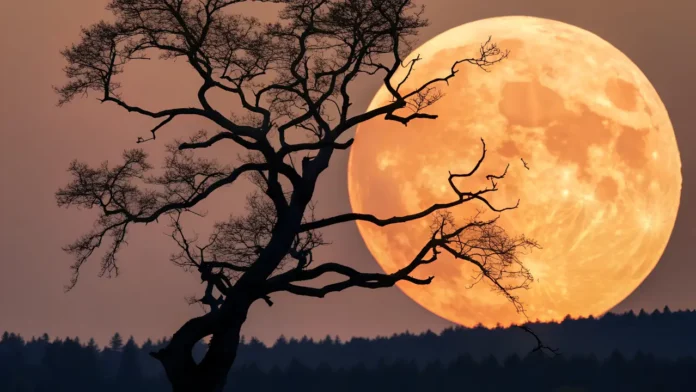
A wolf supermoon is a January full Moon that occurs near lunar perigee. In plain terms, it is the January “Wolf Moon” combined with the Moon’s closest orbital point to Earth. This article explains the phenomenon step by step. It covers the orbital cause, how much bigger and brighter the Moon looks, any measurable effects on Earth, cultural roots, frequency, and practical observing tips.
Definition — Wolf Moon and Supermoon
Wolf Moon = traditional name for the January full Moon. Supermoon = a full or new Moon that happens near lunar perigee, the Moon’s closest approach to Earth. Therefore, a wolf supermoon is simply the January full Moon occurring at or near perigee. The term is popular, not formal astronomy jargon.
Orbital cause (simple mechanics)
The Moon follows an elliptical orbit. The closest point is perigee. The farthest point is the apogee. The Moon’s distance from Earth varies by roughly 50,000 km between perigee and apogee. When the full Moon aligns in time with perigee, the lunar disk appears larger. The timing depends on orbital geometry and the synodic month (the cycle of full to full Moon). Because the orbit and phase cycles are not identical, perigee sometimes lands near a full Moon.
The Wolf Supermoon in 2026 peaks on January 3, 2026, when the Moon reaches full phase at perigee, meaning close to Earth. The full Moon will still appear full the night before and the night after, but the official moment of fullness is on January 3.
How much bigger and brighter?
At perigee, the Moon can appear noticeably larger than at apogee. Typical figures: the apparent diameter can increase by up to about 14% compared with the farthest full Moon. The visual area then grows by roughly 30%, which translates to increased brightness. However, human perception often underestimates or exaggerates this change, especially without visual references. The largest visual impact happens near moonrise because of the moon-horizon illusion. Photometry shows the full Moon at perigee can be up to ~30% brighter than the same phase at apogee, although atmospheric conditions change apparent brightness more.
Effects on Earth — tides and other impacts
Perigee raises tidal forces slightly. For a supermoon, tidal ranges can be a few centimetres to decimetres higher than average spring tides. In most coastal regions, this change is negligible. Extreme weather, storm surge, or local geography can amplify impacts, but the supermoon itself does not cause storms or earthquakes. Scientists monitor tides precisely, and they attribute large tidal events mostly to meteorological or oceanographic factors, not the modest extra pull of a supermoon.
Cultural and historical context
The name “Wolf Moon” dates to North American and Old World folk traditions. People associated the January full Moon with wolf howls and winter hardships. Other cultures have different January Moon names (e.g., “Old Moon,” “Ice Moon”). Modern skywatching events use traditional names for outreach. Astronomers, however, prefer Julian dates and phase descriptions.
Frequency and predictability
Supermoons occur several times per year because the perigee shifts relative to the lunar phase. A wolf supermoon happens only when January’s full Moon coincides closely with perigee. That alignment repeats irregularly; sometimes it happens several years in a row, sometimes not. Astronomers can predict exact dates and times years using orbital models.
Observing tips
Choose a clear night with a low eastern horizon for moonrise. Use a long focal length lens or a small telescope to capture lunar detail. Frame the Moon with foreground objects at moonrise to show apparent size. For sharper photos, shoot when the Moon is higher, and the atmosphere is steadier, but the size illusion is smaller then. Use manual exposure: start near 1/125s at ISO 100 for the full Moon and adjust. Use a tripod and remote trigger to avoid blur. Avoid over-processing; the Moon’s true surface detail looks best with modest sharpening and contrast.
Photography checklist (quick)
- Lens: 200–600 mm or a telescope.
- Camera: tripod + remote or timer.
- Settings: ~1/125s, f/8, ISO 100 (adjust to taste).
- Composition: include a horizon object at moonrise for scale.
- Focus: manual, live-view zoom for critical focus.
- Bracket exposures for safety.
Common myths, clarified
Myth: A supermoon causes earthquakes or extreme weather. Fact: No causal link; only minor tidal amplification occurs. Myth: The Moon will look dramatically larger to everyone. Fact: Size change is subtle; moonrise illusions often dominate perceived size.
Conclusion
A wolf supermoon blends a cultural name with a simple orbital fact. It presents a slightly larger, brighter Moon in January when perigee and the full phase align. The science is straightforward: elliptical orbit + synced timing = bigger Moon. The practical result makes for a fine photo and a good excuse to watch the sky.

