


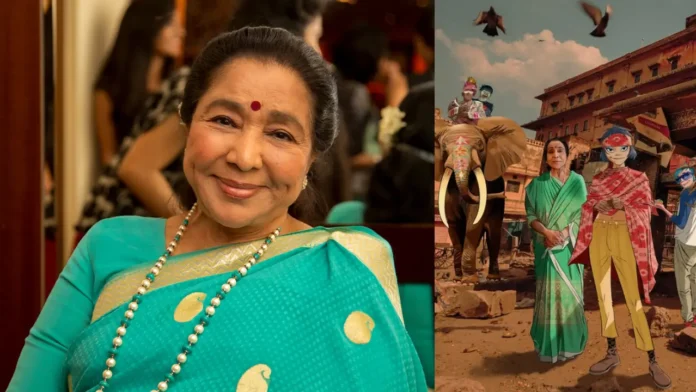
The passing of Asha Bhosle at the age of 92 marks not just the loss of a legendary singer, but the closing of a defining chapter in Indian music history. For over seven decades, her voice shaped emotions, stories, and cultural memory across generations.
Yet, in her final days, it was not just her music but her words that captured the world’s attention. Her last Instagram post—deeply philosophical and spiritual—has now become a powerful reflection on life, identity, and eternity.
The Final Days: A Quiet Farewell
According to reports, Asha Bhosle had been battling prolonged health complications. She was admitted to Breach Candy Hospital following cardiac and respiratory distress and was placed in intensive care.
Her health had been declining over months, indicating that her passing, while deeply painful, was not entirely unexpected. Yet, the emotional impact was profound—because her voice had always symbolized vitality, adaptability, and timelessness.
A Final Message That Touched Millions
On March 18, weeks before her passing, Asha Bhosle shared what would become her final public message. The post, set against the spiritual backdrop of Varanasi, was not a farewell—but a realization.
She reflected on:
- The purpose of her life
- Her identity as an artist and human being
- The journey across relationships, music, and duty
Using the metaphor of a river, she described life as a crossing—where music served as the boatman guiding her through existence.
Her words revealed something rare: not fear of death, but acceptance.
Music as a Spiritual Journey
What distinguished Asha Bhosle’s final reflection was its philosophical depth.
She did not view music merely as an art form or profession. Instead, she described it as:
- A guiding force
- A spiritual companion
- A means of self-realization
Her belief that she would become “part of the sounds of the universe” reflects ideas deeply rooted in Indian philosophy—particularly the concept of Nada Brahma (the universe as sound).
This interpretation reframes her legacy:
She did not just sing songs—she became part of an eternal soundscape.
A Career That Redefined Indian Music
Asha Bhosle’s career is one of the most versatile in global music history.
Unmatched Range
- Playback singing across multiple Indian languages
- Genres ranging from classical and ghazal to pop and cabaret
- Thousands of songs spanning over 70 years
Cultural Impact
- Voice behind iconic Bollywood songs
- Collaborations with legendary composers
- Influence on generations of singers in India and abroad
She was not confined to a style—she continuously reinvented herself, making her one of the most adaptive artists of her time.
Her Final Global Collaboration: A Bridge Across Cultures
Even in her 90s, Asha Bhosle remained artistically active.
Her final collaboration came with Gorillaz on the track “The Shadowy Light”, produced by Damon Albarn.
Why This Matters
- It showcased her global relevance even in later years
- The track blended:
- Indian classical elements
- Contemporary global music
- Featured renowned Indian artists like:
- Amaan Ali Bangash
- Ayaan Ali Bangash
- Ajay Prasanna
Themes of the Song
- Life and mortality
- Transition and afterlife
- Spiritual continuity
Interestingly, these themes closely mirrored her final Instagram message—suggesting a deeply personal connection between her art and her inner reflections.
Philosophy of Life and Death
Asha Bhosle’s final words offer a framework to understand her worldview.
Key Ideas
- Life is a journey, not a destination
- Identity is shaped through:
- Relationships
- Duties
- Creative expression
- Death is not an end but a merging with the universe
This perspective aligns with classical Indian spiritual thought, where liberation (moksha) is seen as union with the cosmic whole.
Public Reaction: Grief and Reflection
The response to her passing has been overwhelming:
- Fans are revisiting her songs across generations
- Artists acknowledging her influence
- Social media is amplifying her final message
Many found comfort in her words, interpreting them not as goodbye, but as guidance on how to live meaningfully.
An Enduring Legacy
Asha Bhosle leaves behind more than a discography—she leaves behind a philosophy of art and life.
Her legacy exists on multiple levels:
1. Musical Legacy
Thousands of songs that continue to define Indian cinema and music.
2. Cultural Legacy
A symbol of adaptability, resilience, and artistic excellence.
3. Spiritual Legacy
A perspective that transforms music into a path of self-discovery.
Conclusion
The passing of Asha Bhosle is undeniably the end of a monumental era. Yet, in her own words, she has not truly gone.
She believed she would dissolve into the very sounds that make up the universe—and in many ways, she already has.
Every melody she sang continues to echo, reminding us that while voices may fade, music—and meaning—endures forever.

